 Mochi Labs
Why Behind-the-Scenes Content Is Outperforming Polished Posts in 2026
Behind-the-scenes content is outperforming polished posts in 2026, and it is not an accident, it is a habit worth building on purpose into your content plan.
A phone propped against a coffee mug. A take that didn't make the final cut. A voice cracking mid-line.
None of that used to be the post. It used to be what got cut before the post went up.
So why does a shaky, unscripted clip now pull more comments than the reel someone spent three hours color grading? Because the feed is saturated with content that looks machine-smoothed, and a viewer's thumb has gotten good at telling the difference between a person and a polish job. Outside research backs up what a lot of creators are already feeling in their own numbers: unscripted, visibly human content is outperforming the overproduced kind, and 2026 is the year that stopped looking like a fluke and started looking like a pattern worth planning around.
What's Driving the Shift Toward Process Content
For a few years, the fastest way to grow was to look like you had a production team even when you didn't: tighter edits, cleaner audio, a thumbnail that could pass for a magazine cover. That playbook hasn't stopped working, but it's gotten crowded, and a chunk of what's filling the feed around it now isn't made by a person pushing to get better. It's generated, templated, or assembled by a tool with no stake in the outcome.
The AI-slop backlash
When every third video in a feed has the same synthetic sheen, an overly smooth voiceover, stock-photo lighting, a caption that reads like it was written to satisfy an algorithm, a viewer starts treating "polished" as a yellow flag instead of a green one. The posts that stand out are the ones that couldn't have been generated: the ones with a flubbed line left in, a hand visibly shaking the camera, a laugh that happens off-script.
What the trust research says
This isn't just a vibe. The 2025 Edelman Trust Barometer found that people trust individuals and peers more than institutions, and trust a brand's own polished voice least of all when there's no visible person behind it. Put that next to what's showing up in creators' own feeds and the shift stops looking random. A process clip reads as a person. A polished post increasingly reads as a product.
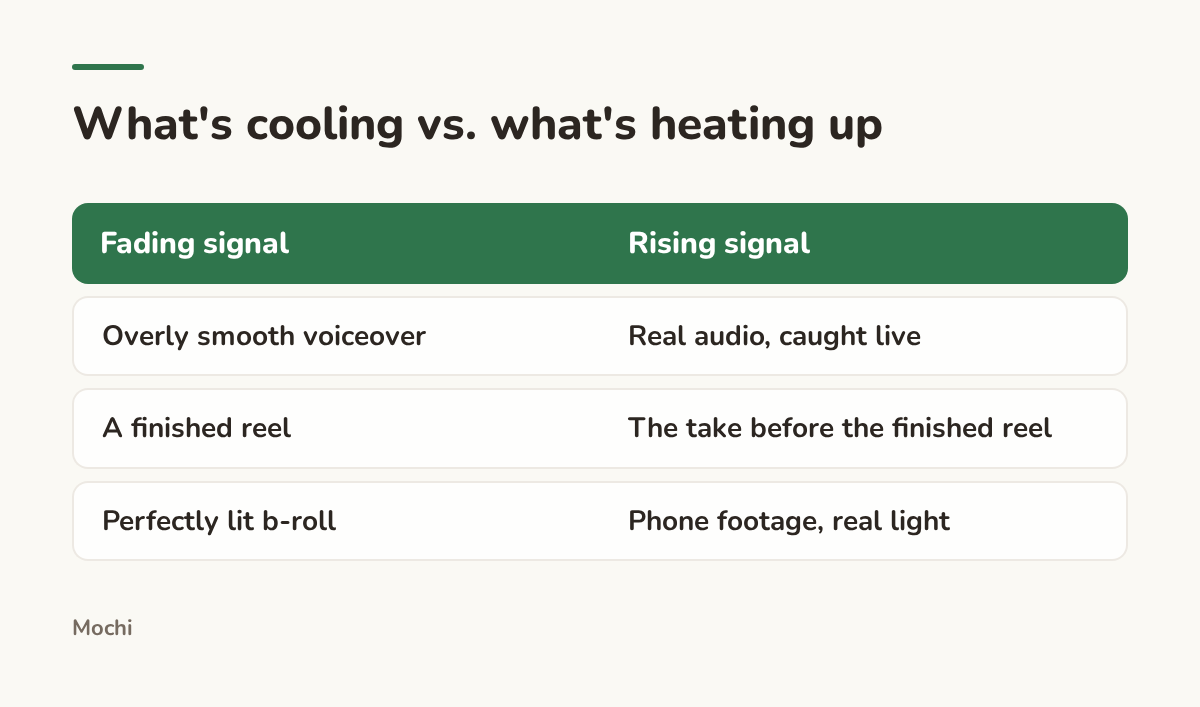
The feed is rewarding proof of a person over proof of production value.
Why Unscripted Footage Builds Trust a Polished Post Can't
A finished reel shows you the result. A process clip shows you the person getting there, and a person is much harder to fake than a result.
That's the whole mechanism. When a viewer sees the take before the final cut instead of just the final cut, they're not only watching more footage, they're watching proof: proof that an actual person was in the room, tried, and kept going after the first attempt didn't land.
A reel can be assembled by anyone with the right software. A flub can't.
Research on how perceived authenticity moves through trust to shape purchase intent backs this up directly: authenticity doesn't persuade a viewer on its own, it builds trust first, and trust is what actually moves someone from watching to buying. A caption can claim honesty. A visible mistake proves it.
So what does that proof actually look like once you stop treating it as an accident and start treating it as the post?
What Process Content Actually Looks Like
Process content isn't "lower quality on purpose." It's a specific kind of footage: the moment before or after the finished thing, shown instead of hidden. A qualitative study of what actually keeps viewers engaged in behind-the-scenes video found it usually comes down to context: personal context (why the moment mattered to the creator), environmental context (where it happened), and medium context (how rough the footage looks next to the finished product). That's a pretty clear brief for what to shoot.
Take a wedding photographer who always deletes the clip of herself resetting a bounce flash between portraits. That exact footage, messy cord and all, tends to earn more saves than the finished gallery it led to, because a couple scrolling for their own photographer wants to see someone who knows what they're doing under pressure, not just the output of it.
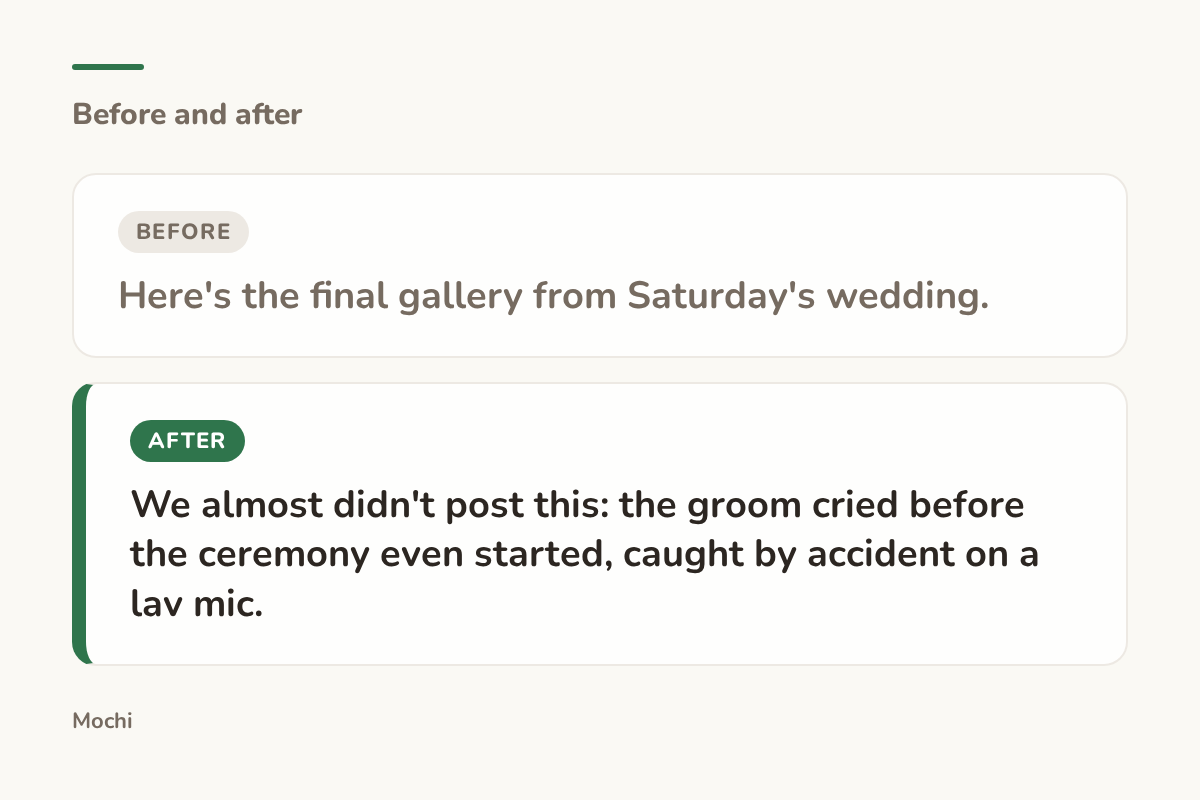
Before: Here's the final gallery from Saturday's wedding. After: We almost didn't post this: the groom cried before the ceremony even started, caught by accident on a lav mic.
The rewrite doesn't hide the work. It just stops deleting the part where the work was actually happening.
Take a musician who records a dozen takes of a bridge and keeps only the clean one for the single. The take where her voice cracks, the one she almost threw out, is often the clip that gets replayed, because a crack is specific and a clean take is generic.
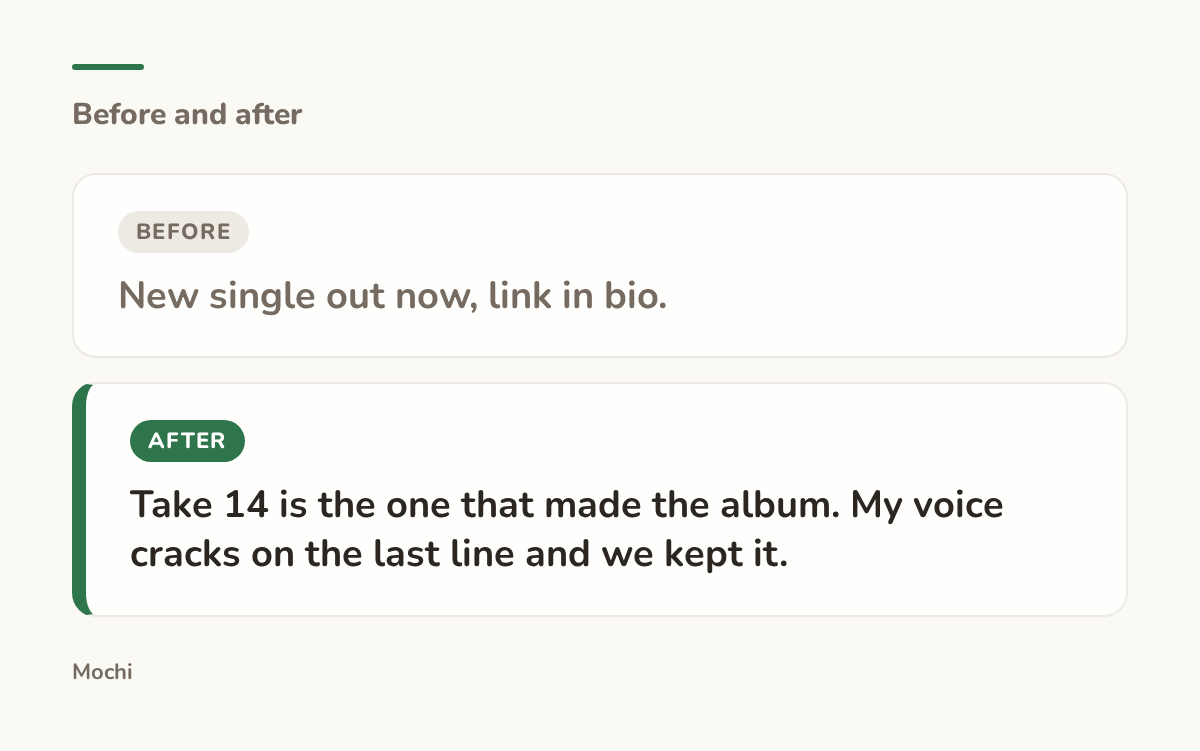
Before: New single out now, link in bio. After: Take 14 is the one that made the album. My voice cracks on the last line and we kept it.
Same lesson, different instrument: specific beats clean.
Take a videographer who sits on an unlisted clip from his camera roll for weeks because the color grade isn't finished. Posted plainly, grade left undone, it outperforms the polished version he eventually cuts, because the unfinished version reads as a window into the craft and the finished one reads as an ad for it.
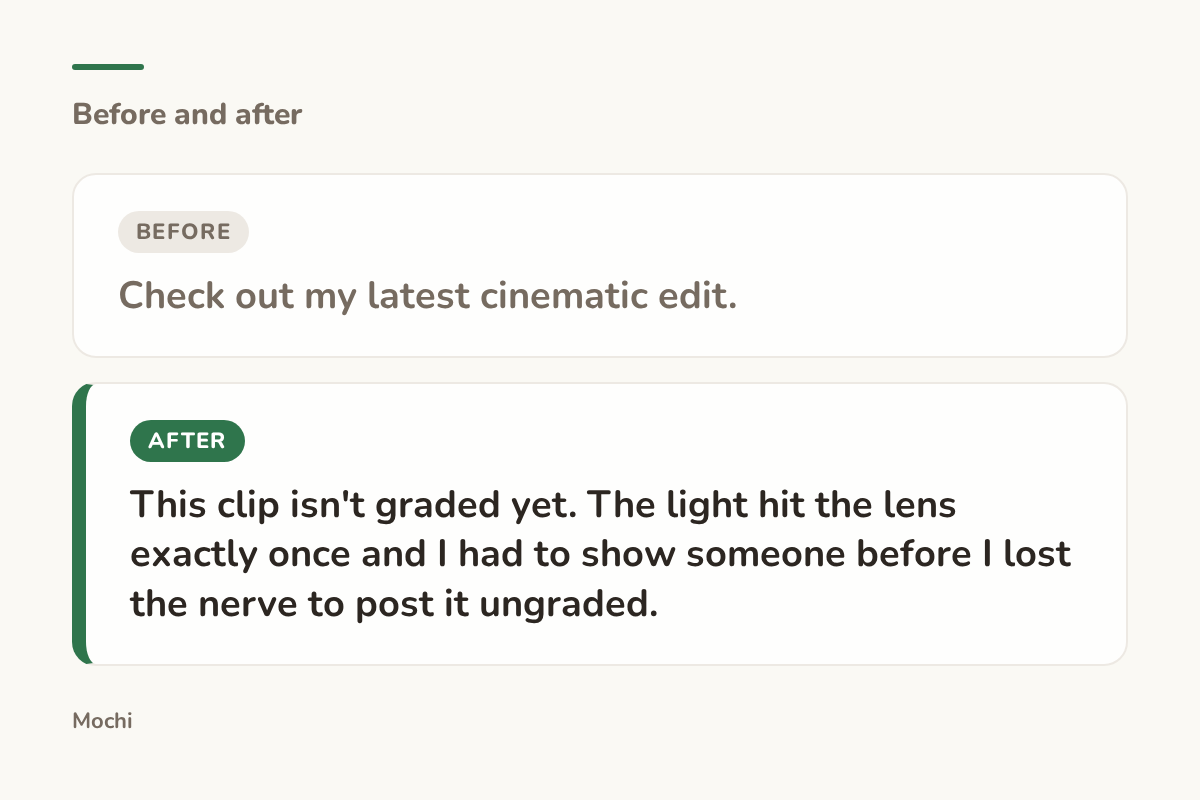
Before: Check out my latest cinematic edit. After: This clip isn't graded yet. The light hit the lens exactly once and I had to show someone before I lost the nerve to post it ungraded.
None of these are weak content dressed up as a trend. They're the discard pile, posted on purpose.
How to Build Process Content Into Your Plan, Step by Step
The risk with any of this is leaving it to chance: posting the behind-the-scenes clip only on the rare day you remember to hit record before you tidy up. Treat it as deliberate and it stops being a lucky accident and starts being a pillar you can actually plan around.
Step 1: Decide what counts as "process" before you're in the room
Name the categories ahead of time so you're not deciding on the fly: the setup, the failed attempt, the reaction shot, the teardown. A DJ who films the five minutes before a set, the gear check and the headphone test, doesn't have to wait around hoping something interesting happens on its own. He already knows what he's filming.
Step 2: Shoot it like proof, not like a trailer
A single handheld take with real audio reads as proof. A multi-angle edit with music under it reads as a trailer, and a trailer undoes the whole point. Independent research on Gen Z's video habits backs this up for platforms like TikTok specifically: the audience most likely to scroll past a trailer-style edit is also the audience most likely to stop for something unscripted.
Step 3: Write the caption like a note to yourself, not an ad
Describe what almost got cut and why it didn't. "Here's what nearly didn't make it out of my camera roll" does more work than any line written to sound like marketing, because it tells the reader exactly what they're about to see and why it's there.
Step 4: Give it a pillar, not a one-off slot
Process content needs its own recurring place in your plan, the same as any other pillar, so it isn't the thing you post only when you happen to remember. This is the part we build directly into Mochi: a content pillar isn't just an idea, it's a slot that recurs. A week of scheduled posts sits on the calendar, spread across three content pillars, process content among them.
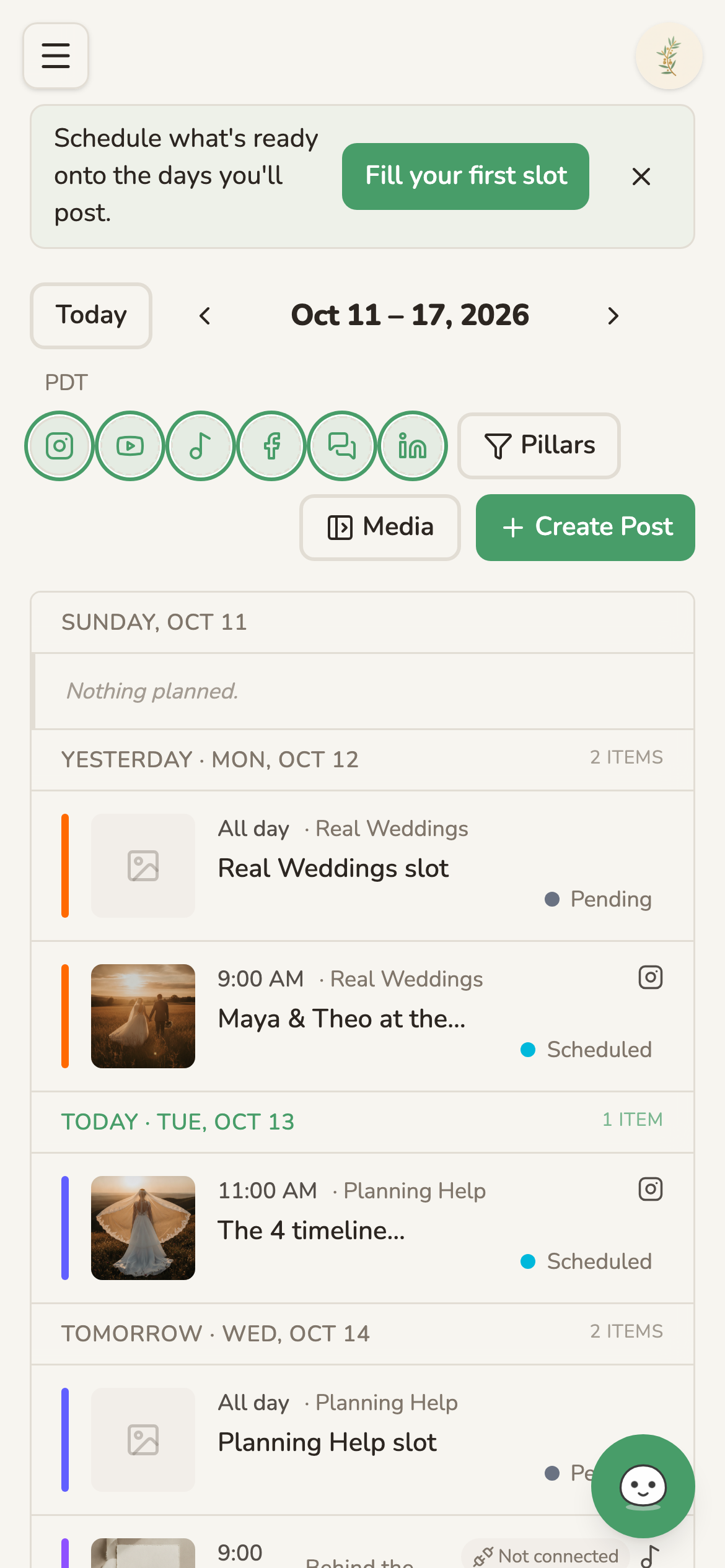
A week planned across three pillars, process content included.
Step 5: Let the comments tell you what to shoot next
When someone asks "wait, how did you do that part," that's the brief for your next process clip, not an interruption to clear before bed. Practical guidance on showing up imperfectly on video makes the same point from the platform side: the creators who keep the rough edges in are the ones viewers trust enough to keep asking.
The One Way This Backfires
A perfectly lit "messy" studio shot, with the mess arranged for camera, is its own kind of fake. Audiences who've gotten good at spotting AI gloss are just as good at spotting staged chaos, and a faked candid moment reads worse than an honest, polished one ever did.
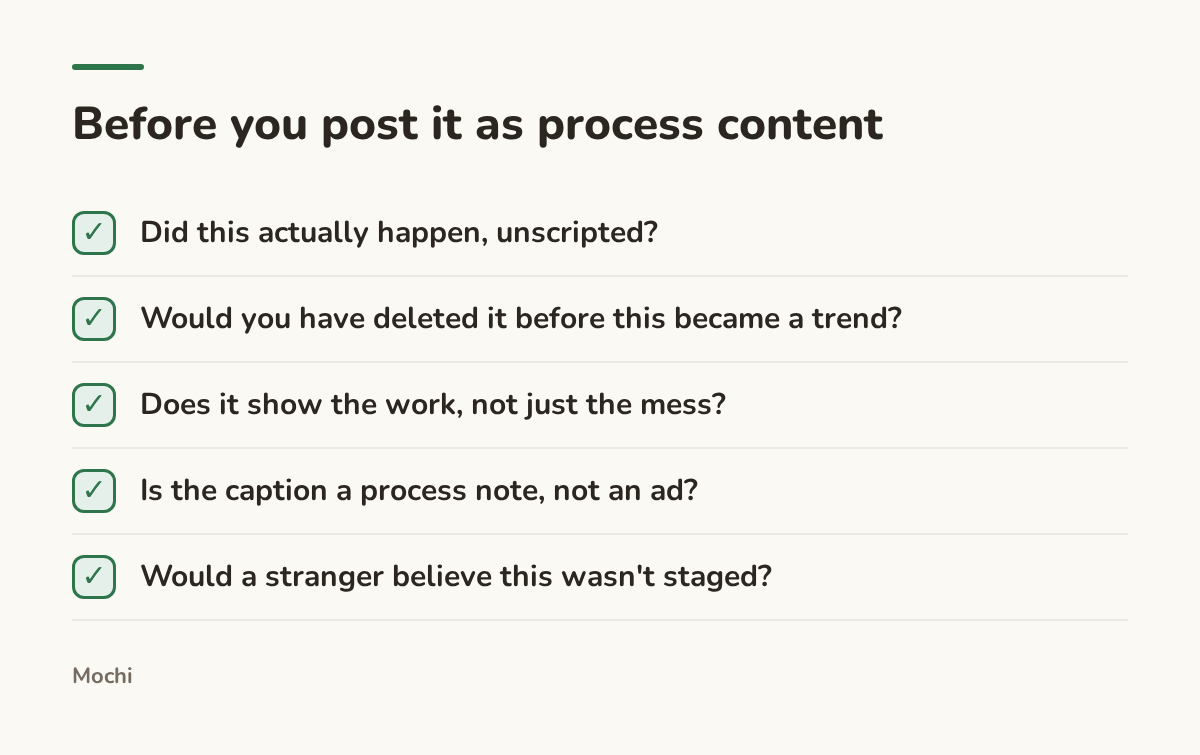
Process content isn't a loophole around the work of making something good. It's proof that the good thing had a person behind it. Post the take you'd normally delete and pay attention to what happens next.
What's the last clip you almost deleted that you should have posted instead?
Parte de una serie
El manual del creador
Oficio perenne para creadores en activo: marca, planificación de contenido y publicación, escrito por el equipo que construye Mochi.