 Mochi Labs
Branding a One-Person Creative Studio: A Plain Guide
A practical guide to branding a one-person creative studio: how to name it well, keep one visual mark, and write down how your work actually sounds.
Call yourself a "photography business" and nobody blinks. Call yourself a "studio" and people expect something more: a point of view, a reputation, maybe even a team standing behind the name.
Most one-person operations that use the word are just one person, a laptop, and a backlog of unanswered messages. That's not a problem. The word was never really about headcount.
What actually makes "studio" true is a shorter list than you'd guess: a name people repeat correctly after hearing it once, one visual mark that looks the same on a business card and an Instagram grid, and a way of talking about the work that doesn't shift with your mood that day. Mochi Labs had a name and a brand before it had much of a team behind either, and the same three things were what held while the rest got figured out later. Everything else is decoration.
Pick a name that survives being said out loud
A name has one job before it has any other: survive being said out loud, once, by someone who's never heard it before. If they have to ask you to spell it, or repeat it back wrong, it's working against you before a single post goes out.
Three tests worth borrowing
Research on naming companies lays out criteria worth borrowing for a one-person studio: is it clear, is it distinct from everyone doing adjacent work, and does it leave room for the practice to grow past what it does today.
Before: Jordan Lee Photography After: Low Light Studio
The first tells a stranger that a person takes pictures and nothing else. The second tells them something about how the work looks before they've seen a single frame, and it doesn't box Jordan into stills if video becomes part of the work next year.
A name that only describes what you do today is a name you'll outgrow. A name that describes how you do it tends to last longer.
Decide, on purpose, whether "studio" is the right word
"Studio" isn't the only option, and it isn't automatically the better one. A breakdown of what each label actually signals to a client is worth reading before picking one out of habit: a freelancer promises a person, an agency promises a team, and a studio sits in between, promising a consistent practice even when one person is producing all of it.
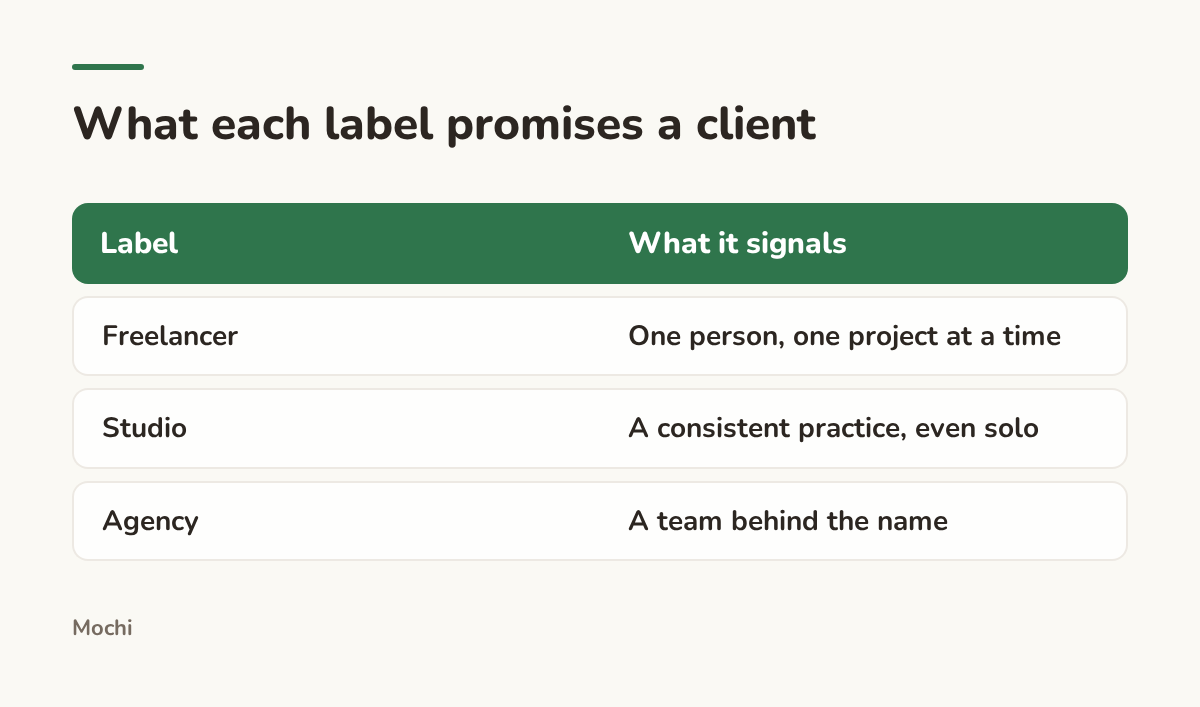
Pick the word that matches what you can actually deliver, not the one that sounds biggest.
Take an illustrator who used to sign work with just a first name and a hashtag. Nothing wrong with that at the start. But once there's a recognizable style, a backlog of commissions, and people asking "can your studio take on a project in March," the word has already arrived. Giving it a name just catches up to what clients are already calling it.
If nobody has ever used the word about your work unprompted, that's worth sitting with. "Studio" is a promise about consistency, not a synonym for "serious."
Build one visual mark and stop touching it
The mark doesn't need to be clever. It needs to be the same mark on your invoice, your Instagram grid, and the sign-off on an email, so that a client who's seen it twice recognizes it the third time without reading your name.
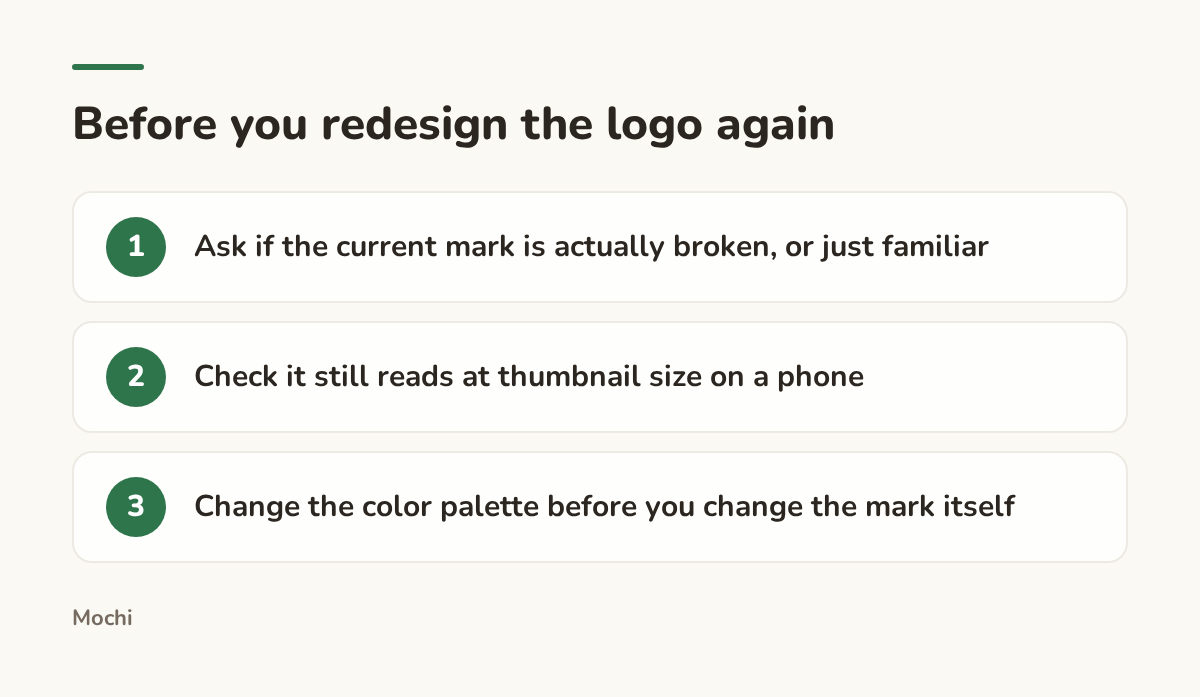
Consistency does more of the work than a redesign usually does.
Picture a ceramicist who redesigns her logo every time she feels stuck creatively. Each version is better than the last on its own terms, but a returning customer has now seen three different marks in two years and associates none of them with her. The fix isn't a fourth logo. It's picking the third one and leaving it alone for longer than feels comfortable.
A mark earns recognition through repetition, not through being redesigned until it's perfect. Perfect and repeated are different goals, and only one of them builds a studio people recognize on sight.
Write down how the work talks
A visual mark says what a studio looks like. Voice says what it sounds like, and it's the part solo creators skip because it feels like a document nobody but them will ever read.
A voice that lives only in your head is a voice that drifts: more formal in an email to a potential client, looser in a caption at midnight, different again when you're tired and just want the post done. A few written-down lines, what you sound like and what you don't, keep the drift from showing.
Before: Photographer based in Austin. Open for bookings. After: I shoot the five minutes before the ceremony, when nobody's posing yet.
The first line describes a service. The second one sounds like a specific person, and it's the kind of sentence a stranger remembers after they've scrolled past a dozen similar bios.
A framework for communicating personal value consistently makes a similar point from the research side: the value isn't in any single post, it's in the pattern a reader can recognize across many of them. One good caption doesn't build a studio voice. The same sensibility showing up in the fifth caption and the fiftieth does.
This is one place we built a shortcut into Mochi, because we needed it for our own channels before anyone else did: the Brand Playbook writes the voice down in one place, with examples of how it does and doesn't sound, so it's something to check a draft against instead of something to reconstruct from memory every time.
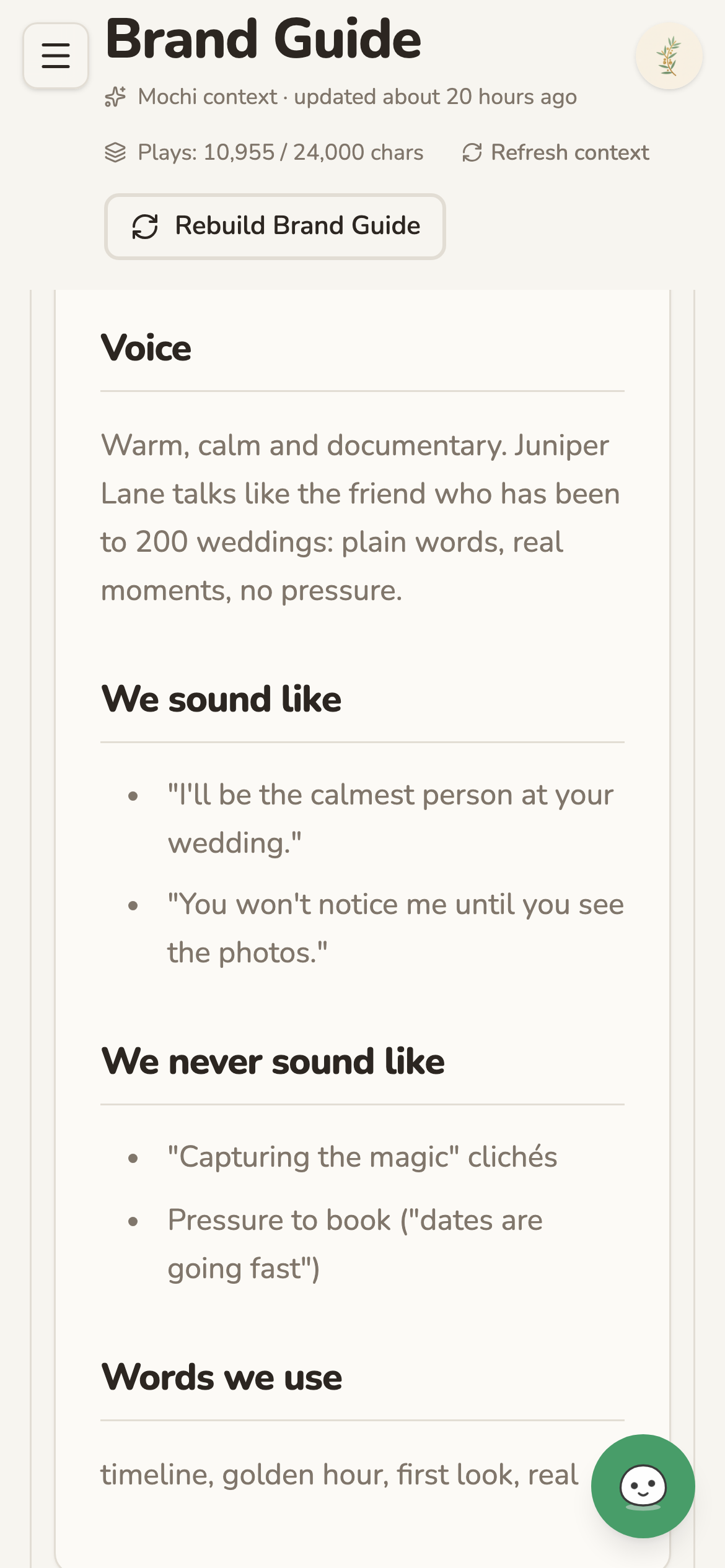
The brand's voice written down, with examples of how it does and does not sound.
Let the brand grow only when the work does
A studio identity isn't a one-time decision. The name, the mark, and the voice you picked when you were shooting one kind of job will get tested the day the work changes shape, a second service, a bigger client, a shift from stills to motion.
Auditing a brand periodically rather than overhauling it on instinct is the more durable approach: check what's actually stopped fitting before you change anything, instead of changing everything because one thing feels stale.
Before: A one-person photo and video studio for small weddings. After: A studio that plans a couple's wedding story in stills and in motion, start to finish.
The rewrite isn't longer for its own sake. It describes a practice instead of a service list, which is the whole difference between a studio and a freelancer with a nicer word on the invoice.
None of this requires a team, a rebrand budget, or a launch. It requires a name you'd be comfortable saying out loud to a stranger, one mark you leave alone long enough to be recognized, and a voice you've actually written down instead of trusting to memory. Get those three settled and the label holds its weight, no payroll required.
What would someone who's seen your work twice already call it, if they had to describe it in one line?
Part of a series
The Creator's Playbook
Evergreen craft for working creators: brand, content planning, and publishing, written by the team that builds Mochi.