 Mochi Labs
Buffer vs Mochi: Scheduler or Brand Agent?
Buffer vs Mochi, compared plainly: what a scheduler does, what an agent does, and which one fits a creator with a few channels and their own ideas.
Three channels. Ten scheduled posts per channel. A free plan that doesn't expire.
That's Buffer's standing offer, and as of October 11, 2026 it's still a genuinely useful one: three channels, ten scheduled posts per channel, 100 saved ideas, one user, 30 days of insights history, and five AI reply suggestions a week, all without a card on file.
We build Mochi, so we have a stake in this comparison. We're also the people who'll tell you straight when Buffer is the right tool and Mochi isn't, because the two aren't built to do the same job. Buffer schedules what you bring it. Mochi tries to work out what to bring in the first place. That difference is worth more than a feature list, so let's walk through what each one actually does.
What Buffer Actually Does
Buffer is a scheduler, and a well-built one. You write or paste a post, pick the channels and the time, and it goes out when you said it would. The free plan covers three channels, which is plenty if you're one person posting to Instagram, TikTok and one more.
Pricing, plainly
Pay, and the ceiling moves but the shape stays the same. Essentials runs $5 a month per channel ($60 a year), Team runs $10 a month per channel ($120 a year) with unlimited team members, and both lift you to unlimited scheduled posts under a 5,000-post fair-use cap. Notice the unit: per channel. Add a fourth channel to Essentials and the bill grows by $5, whether that channel gets one post a week or one a day.
What the AI Assistant does and doesn't do
Every Buffer plan, including the free one, includes an AI Assistant for refining and repurposing content, AI-drafted replies, and Takeaways, which are AI-written observations on how a post performed. All three work on what you give them. None of them go looking for what to give them in the first place.
What Mochi Actually Does
Mochi starts earlier in the process. Before it schedules anything, it scans the brand's site, socials and store, runs a short interview, and turns the result into what we call a Brand Playbook: the voice, the audience and the content pillars written down in one place, not kept in one person's head.
The playbook and the research behind it
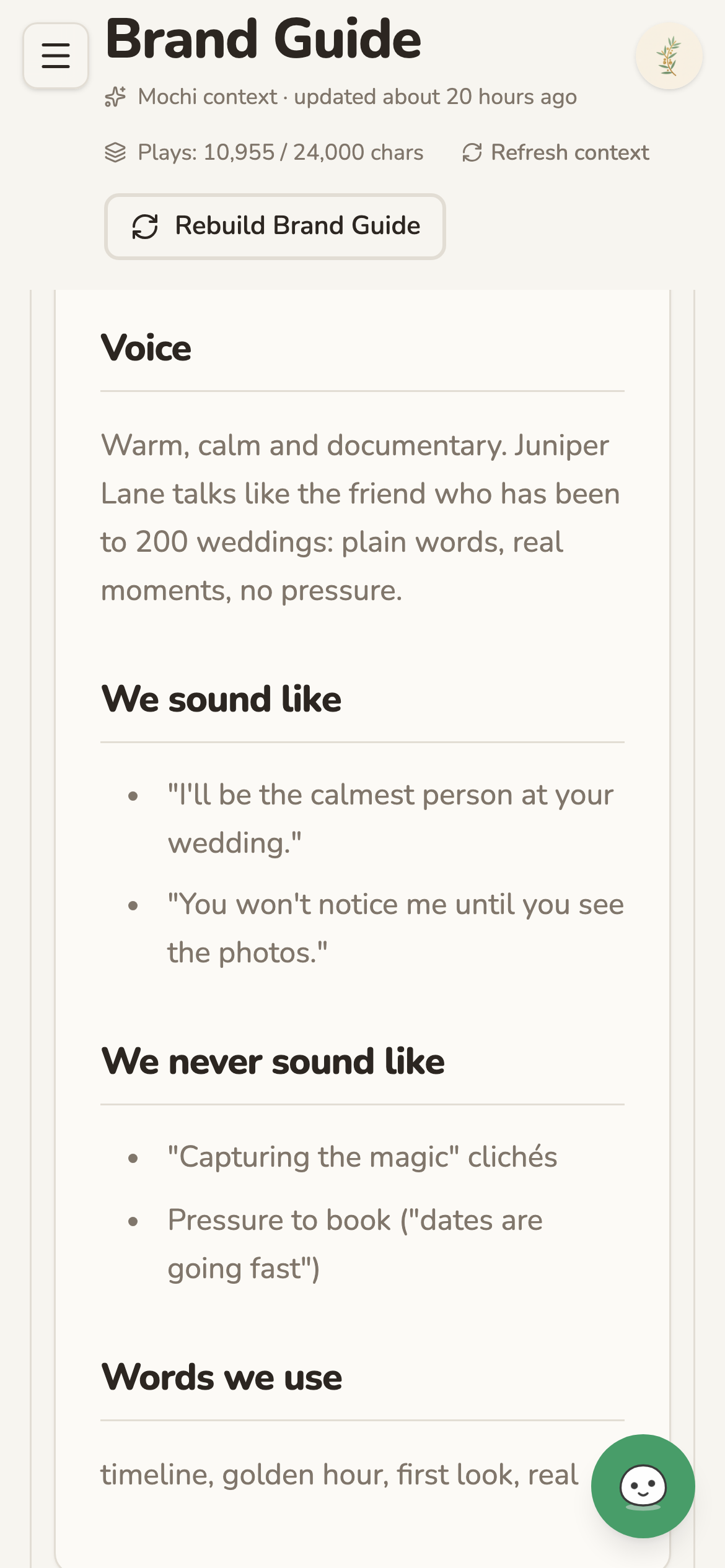
The brand's voice, written down instead of kept in one person's head.
From there, watch lists and research routines run on a schedule, trend reads and competitor checks that would otherwise eat an afternoon, and the output is a research document with sources attached. Mochi turns that into ideas, each scored against the brand and carrying its own brief, and only then does a calendar get filled and posts go out on schedule.
The inbox and the platforms
Pro adds an inbox: Mochi answers the easy DMs and comments in the brand's voice, and trigger words the creator sets can deliver a lead magnet, a discount code or a catalog item automatically. Six platforms are covered: Instagram, Facebook, Threads, TikTok, YouTube Shorts and LinkedIn. No X, no Pinterest, no Bluesky, and no ads management. Everything runs bilingually in English and Spanish.
What it costs
Pricing works by brand, not by channel. A $1, seven-day trial (150 credits, card required, rolls onto the plan you picked unless you cancel) gets you in the door. Starter is $29 a month for one brand, one seat, ten research runs a month on a weekly refresh, 500 credits, scheduled posting and analytics. Pro is $59 a month for one brand, three seats, fifty research runs a month on a daily refresh, 1,500 credits, and the inbox; extra brands run $9 a month each with 100 credits. The Studio layers a dedicated human content manager on top of Pro, priced by conversation rather than a listed number. Credits don't roll over, there's no annual plan, and billing is monthly throughout.
The Real Difference: a Scheduler vs an Agent
Here's the plain version of the difference, without either company's marketing gloss. A scheduler executes a plan you already have. An agent is supposed to help make the plan: it researches, it proposes, and only then does it execute.
What "agent" actually means here
Anthropic's own breakdown of agent architectures draws this line clearly: a workflow follows a fixed path coded in advance, while an agent decides its own steps toward a goal. That's the gap between Buffer's AI Assistant, which polishes a draft you hand it, and Mochi's research routines, which go looking for what to write about before any draft exists.
A concrete example
Take a wedding photographer who already knows exactly what she wants to post this week: three reels from Saturday's first look, queued across Instagram and TikTok at the times her audience is actually online. Buffer's whole job is right there, and it does that job well. Now take a ceramicist who hasn't looked at what's moving in the pottery corner of TikTok in weeks, doesn't have a spare evening to find out, and isn't sure her last five captions sounded like her at all. That's a different problem, closer to "what should I even be posting," and it's the one Mochi is built to sit inside of. A piece from a16z on agents reshaping per-seat software makes a similar point about the wider industry: the tools worth paying for are starting to be judged by what they decide, not just what they execute.
Pricing: Per Channel vs Per Brand
The unit each company bills by says something about what it's selling. Buffer bills per channel, so the price scales with how many places you post, not with how much thinking the tool does for you. Three channels on Essentials runs $15 a month; add a fourth and it's $20. Mochi bills per brand: Starter is a flat $29 a month whether you're posting to two of the six supported platforms or all six, because the work being priced is the research and the writing, not the number of destinations the post lands in.
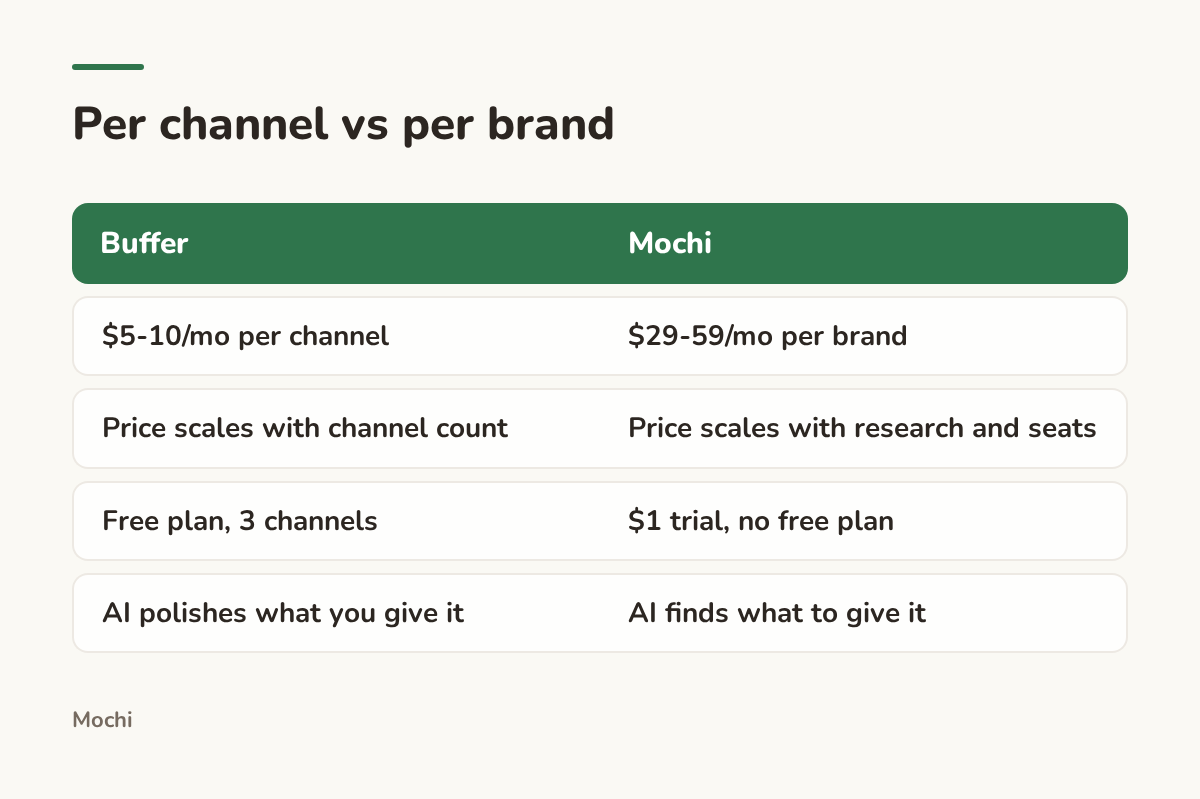
Two different things being billed.
Neither model is wrong, they're built for different things, and Stripe's own guide to per-seat, per-unit and usage-based pricing is worth a look if you want the fuller picture. If you're a solo creator on two or three channels with a steady supply of your own ideas, per-channel pricing is cheap, because you're barely using the unit that drives Buffer's bill. If the channels aren't the bottleneck and the ideas are, per-brand pricing charges for the part that's actually expensive for you. Mochi's pricing page lays out the trial and every tier plainly if cost is the thing you're actually weighing.
Who Each Tool Actually Fits
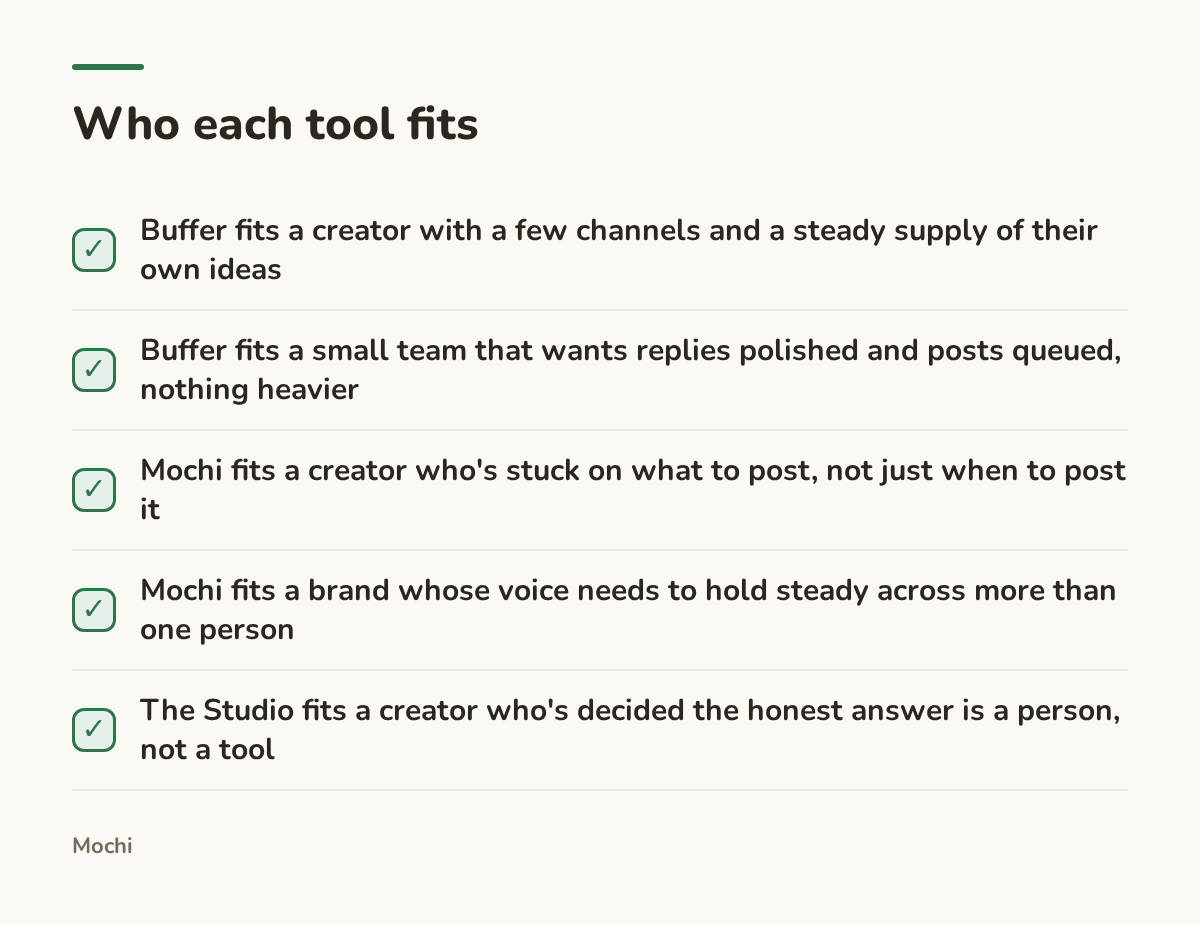
Two different problems, not two rankings of the same one.
Buffer fits a creator with a handful of channels and their own supply of ideas: you know what you're shooting, you know roughly when to post it, and you just need it queued and off your plate.
Mochi fits a creator who's stuck earlier than scheduling: unsure what the next ten posts should be, losing track of what's moving in their niche, or trying to keep one voice consistent across a brand that's grown past one person. The Studio tier fits a creator who's decided the honest answer isn't a tool at all, it's handing the channels to a person.
None of that makes one of these the right answer for everyone. It makes them two different answers to two different problems that happen to show up in the same search results.
The Bottom Line
Buffer will keep being the first scheduler most creators meet, and for a real slice of them it'll be the only one they ever need. The question worth asking isn't which tool wins, it's which problem you actually have: getting a plan out the door, or building the plan in the first place. Which one is actually eating your week?
Part of a series
Mochi vs. the Field
Honest comparisons of Mochi with the social media tools creators already use, and what is different about an agent that learns your brand.