 Mochi Labs
A Content Plan That Survives Being Run by One Person
A content plan for solo creators sized to your real weekly hours instead of an ideal posting cadence, so the plan still holds up on your worst, busiest week.
Three platforms. Five formats. One person.
That's the gap between most content-plan templates and the week you're actually about to have. The templates assume a calendar exists before anyone has to shoot, edit, caption, and post a single thing. You know better, because you're the one doing all four, probably between a client job and whatever else pays the bills this month, across every platform you're supposed to show up on.
So before you build another calendar that quietly falls apart by week three, ask a blunter question: how many hours do you actually have for content this week, not the week you wish you had?
A content plan for solo creators that actually survives
Most templates are written for a team: someone to shoot, someone to edit, someone to schedule, someone to answer comments. Independent research backs up what that mismatch feels like from the inside. A 2024 survey of independent creators found that close to half run every part of their business alone, and a large share report regular burnout from the workload. If you've ever built a six-post-a-week plan in January and quietly abandoned it by March, that's not a discipline problem. That's a plan built for staff you don't have.
A content plan for solo creators has to start somewhere else: not "what would a brand do," but "what can one person actually sustain." That changes almost every decision downstream of it, from how often you post to how you write a caption to whether you even need a new idea this week or can reuse last week's footage. The math is the same whether you're trying to keep up on Instagram, TikTok, YouTube Shorts, or LinkedIn: one person, finite hours, several places to show up.
Step 1: Count the hours you actually have
Start with a number, not a goal. Look back at the last month and count the hours you genuinely spent on content: filming, editing, writing captions, scheduling, answering comments. Not the hours you meant to spend. The hours you spent.
This matters because of something researchers call the planning fallacy: the tendency to plan from a best-case version of ourselves instead of our track record. We don't just guess wrong about how long one task takes. We guess wrong in a specific direction, toward optimism, every time, even when we know we did it last time too. The original research on task-time estimates found that people routinely blow past even their own worst-case estimate, not just their best-case one.
Take a wedding photographer who plans a content week assuming a free Tuesday evening to edit reels. Most Tuesdays, a client call runs long, an album proof needs revisions, or a shoot the next morning means an early night instead. The plan was never wrong about what to post. It was wrong about how many free Tuesday evenings actually exist in a season.
Count your last four weeks honestly, including the weeks that went sideways. Write the number down somewhere boring, a notes app, the back of an invoice, it doesn't matter where. That number, not your ideal number, is your actual weekly content budget, and it's the only number the rest of this plan should be built on.
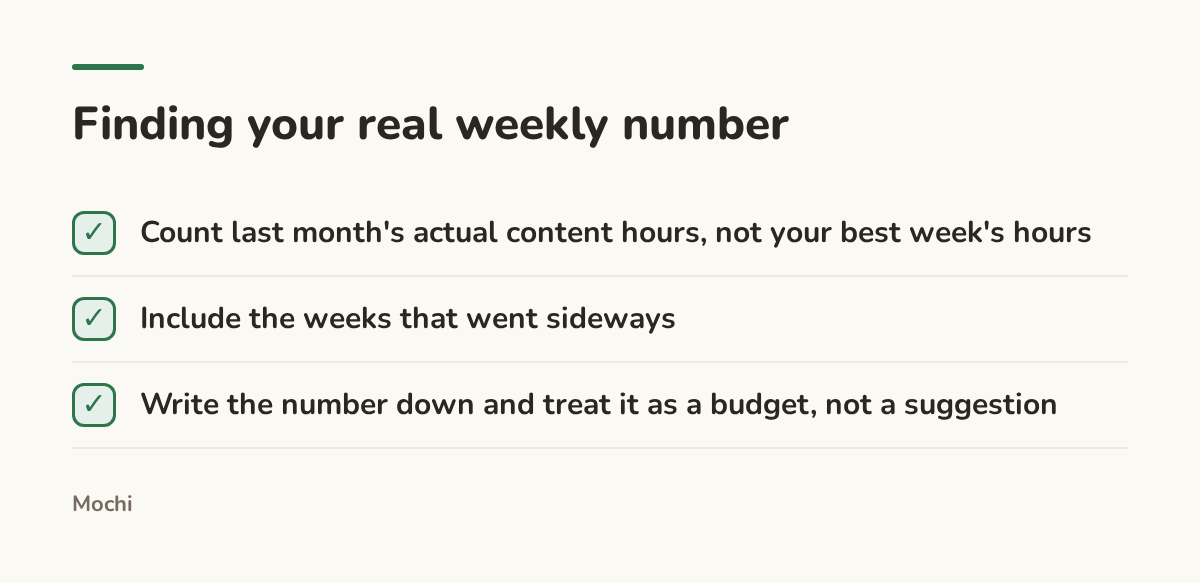
The number you count honestly is more useful than the number you hoped for.
Step 2: Pick a cadence your worst week can survive
Once you have a real hours number, size your cadence to it, not to what looks ambitious in a planning doc. If your honest number is four hours a week, a plan built on daily Reels isn't aspirational. It's a plan that fails by Wednesday, every single week, which is worse than posting less but actually finishing what you post.
Parkinson's law cuts both ways here. Work expands to fill the time available, but it also contracts to fit it. A musician who sets aside two fixed hours on a Sunday for the week's content tends to produce exactly what fits in two hours: one strong clip, cut three ways, instead of five mediocre ones started and never finished. The constraint isn't the enemy of good content. Loose, unbounded time usually is.
Pick the lowest cadence you could sustain through your worst month, not your best one. You can always post more in a good week. You can't un-fail a commitment you made for a bad one.
Step 3: Build pillars that reuse the same raw material
A pillar is supposed to save you time, not just organize your grid. If every pillar needs its own shoot, its own setting, and its own idea, you've built three content jobs instead of one plan.
Picture a videographer whose weeks run long during wedding season. Instead of treating "behind the scenes," "client results," and "tips for couples" as three separate shoots, she pulls all three from the same ceremony: a raw clip of setting up a shot becomes the behind-the-scenes post, a finished highlight becomes the results post, and one thing she noticed on-site, maybe how the light changed an hour before sunset, becomes the tips post. One afternoon of footage, three weeks of pillar content, because the pillars were designed around what one shoot actually produces.
Design your pillars backward from your production reality. Ask what a single session, shoot, or studio afternoon already gives you, then build pillars that can each draw from it, instead of inventing pillars that each demand a separate one. The question to ask before you name a single pillar isn't "what topics interest my audience." It's "what does one session already hand me, and how many of my pillars can it feed."
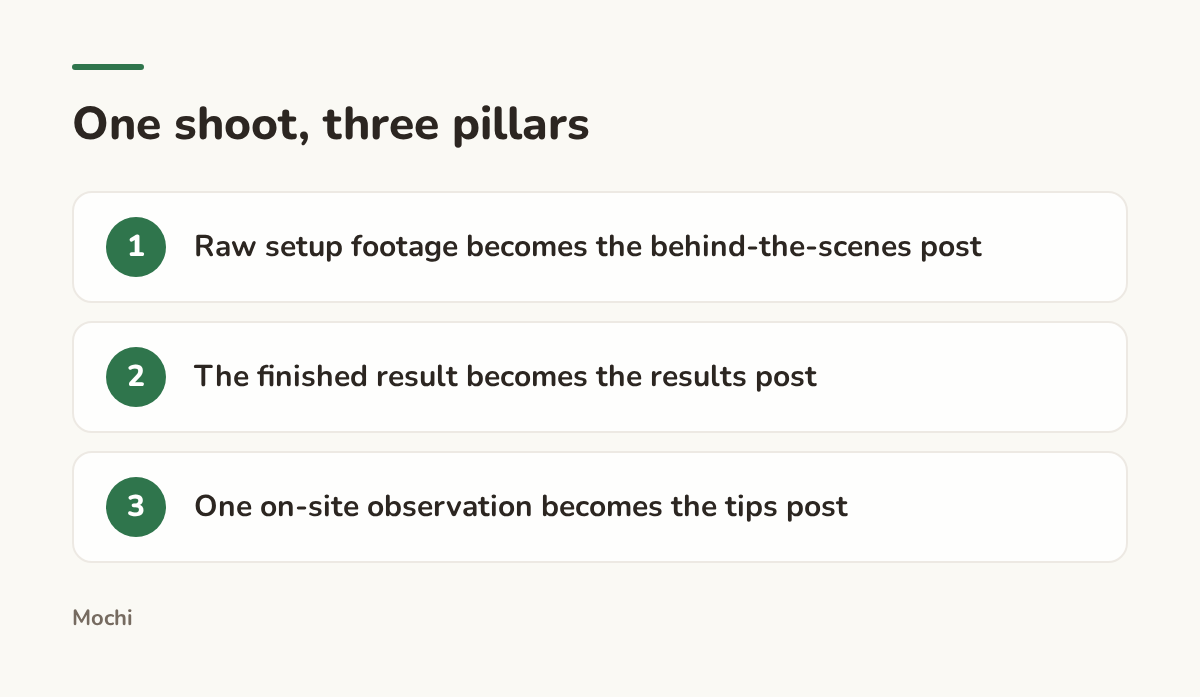
Pillars built around one session instead of three separate ones.
Step 4: Leave room for a bad week before it happens
Every solo plan eventually meets a week where the real world wins: a sick kid, a broken hard drive, a client emergency. A plan with zero slack treats that week as a failure instead of as the obviously predictable thing it is.
Survey data on creator burnout consistently points to workload and creative fatigue as the leading triggers, not lack of ideas. A plan that assumes every week will go to plan is, in that sense, actively building toward the thing it's supposed to prevent.
Build a minimum viable week into the plan itself: the smallest version of your cadence that still counts as having shown up. For a ceramicist who sells through Instagram, that might be one process clip from the studio floor, filmed on a phone, no script, no editing beyond a trim. It's not what a good week looks like. It's what a bad week still gets to count as, so the streak doesn't break and the whole plan doesn't get abandoned out of guilt.
Decide what your minimum viable week looks like now, while you're calm, not in the middle of the week that needs it.
Step 5: Write the plan somewhere it can survive contact with your week
A plan that lives only in your head gets renegotiated every single day, which is another way of saying it doesn't really exist. Write it down somewhere you'll actually see it again: a shared calendar, a note pinned to your desktop, a tool built for exactly this.
This is one of the places a tool like Mochi earns its keep. You can describe the week you want in plain language and have it come back as an actual plan against your pillars, ready to drop onto a calendar instead of staying a good intention in a chat window.
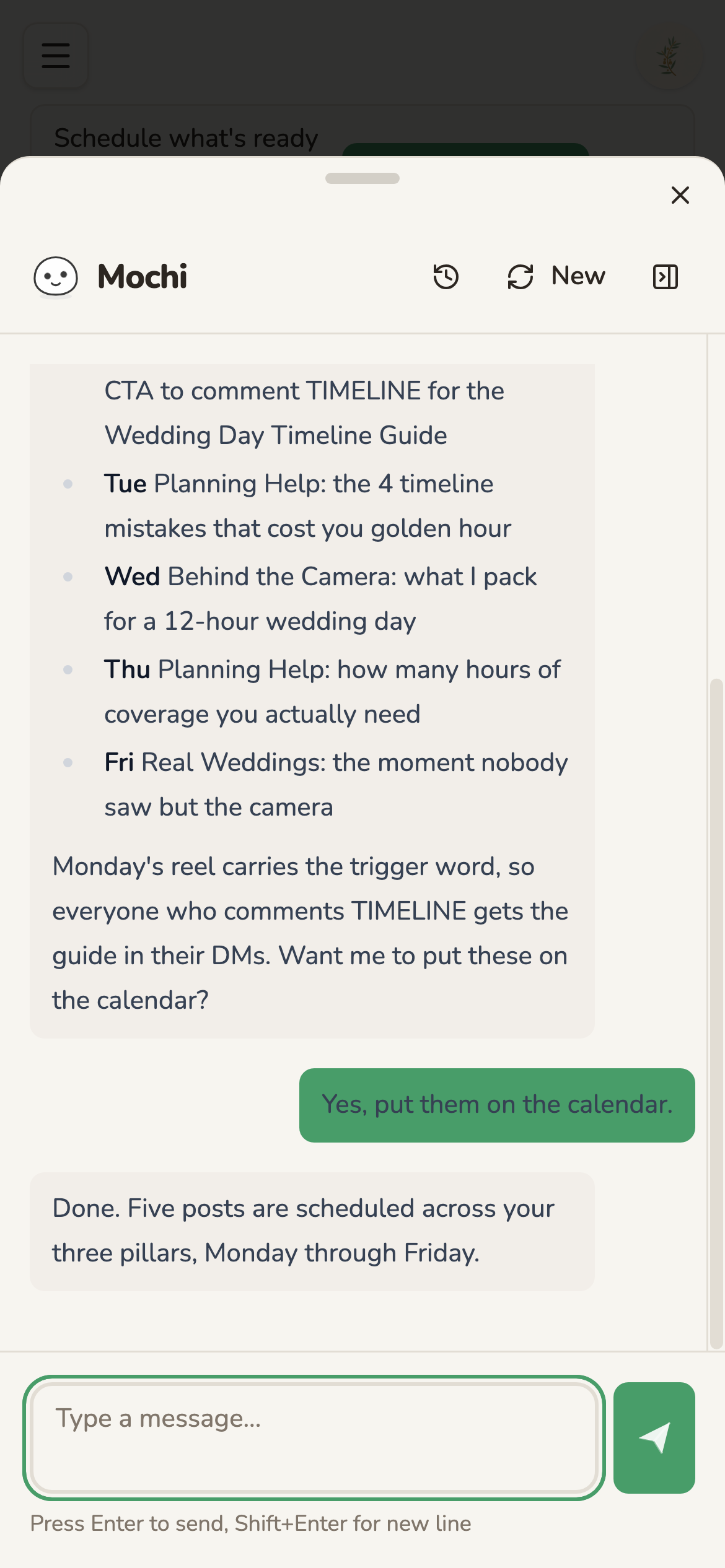
Asking for a week's plan in chat returns a pillar-by-pillar plan ready for the calendar.
Whatever you use, the test is the same: can you check it in ten seconds from your phone between a shoot and a client meeting? If checking the plan is itself a chore, you'll stop checking it, and an unchecked plan might as well not exist.
Step 6: Review monthly, not daily
A content plan isn't a contract. It's a working draft of your capacity, and your capacity changes: a slow season, a new client, a month where everything goes sideways at once. Reviewing daily turns every small miss into a crisis. Reviewing monthly turns the same miss into one line item: did this cadence hold, or did it need to come down.
Take a yoga instructor who posts three times a week most of the year, then drops to once a week during the two months she runs in-person retreats. The retreat months aren't a failure of the plan. They're exactly what the monthly review is for: catching that the current season needs a different number, adjusting the cadence on purpose, and going back to three times a week once the retreats end instead of either quietly ghosting her feed or burning out trying to hold a pace the season can't support.
Set one recurring date, the first of the month or the Monday after payday, whichever you'll actually keep, to ask three questions: Did I hit the cadence most weeks? Did the minimum viable week get used, and how often? Does the number from Step 1 still match my real hours, or has life changed enough to redo it?
A plan that gets revised honestly once a month will outlast a plan that gets written once and defended past the point it still fits your life.
The plan that survives is the boring one
None of this is exciting advice, and that's the point. The plans that actually make it past the third week aren't the ones with the most ambitious cadence or the cleverest pillar names. They're the ones sized to a real Tuesday instead of an ideal one, with a bad-week version built in before the bad week arrives.
Count your real hours. Pick a number your worst month can hit. Build pillars that reuse what you already shoot. Give yourself a minimum viable week. Write it down somewhere you'll actually look. Then revisit it like the working draft it is, not like a promise you broke.
What's the lowest version of your content plan, the one even your worst week could still pull off?
Part of a series
The Creator's Playbook
Evergreen craft for working creators: brand, content planning, and publishing, written by the team that builds Mochi.