 Mochi Labs
The Content Treadmill Is a Design Choice, Not a Personality Flaw
Creator burnout tracks posting consistency, not work ethic. Here's why platforms are built that way, and the batching system that survives a bad week.

Your streak breaks on a Tuesday. Nothing dramatic happens. You just don't post. By Thursday the algorithm has already started treating you like a stranger, and by Friday you're telling yourself a story about what the gap means: that you're lazy, that you don't have what it takes, that every other creator has found some system you still haven't.
That story isn't true. The platforms you post on are built to reward one specific behavior, frequent and recent, and they were never built to care whether that behavior is sustainable for the person doing it. A broken streak isn't a verdict on your character. It's a design working exactly as intended.
So let's name the thing plainly, then build a system that survives it.
Creator Burnout Tracks Posting Consistency, Not Your Work Ethic
Ask a working creator what's actually wearing them down, and workload is rarely the whole answer. It's the fear of the gap. Miss a week and the next thing you post starts from a colder audience than the one you left behind, through no fault of the post itself.
That fear has a mechanism behind it, and it isn't hidden. Meta's own explanation of how Instagram ranks a feed names recency and relationship history as two of the heaviest levers in what a feed actually surfaces. A post from this morning outranks a better post from last month, every time, because the system was built to weigh freshness over quality.
Why the Platform Sets the Cadence, Not You
TikTok's own account of how it recommends video describes a nearly identical logic: the system is tuned to keep surfacing what's active right now, not what performed well historically. Put Meta's version and TikTok's version next to each other and the pattern is obvious. Neither platform is hiding this. They're both telling you, in public documentation, that the clock you feel chasing you is a real clock, and it resets whether or not you're ready for it to.
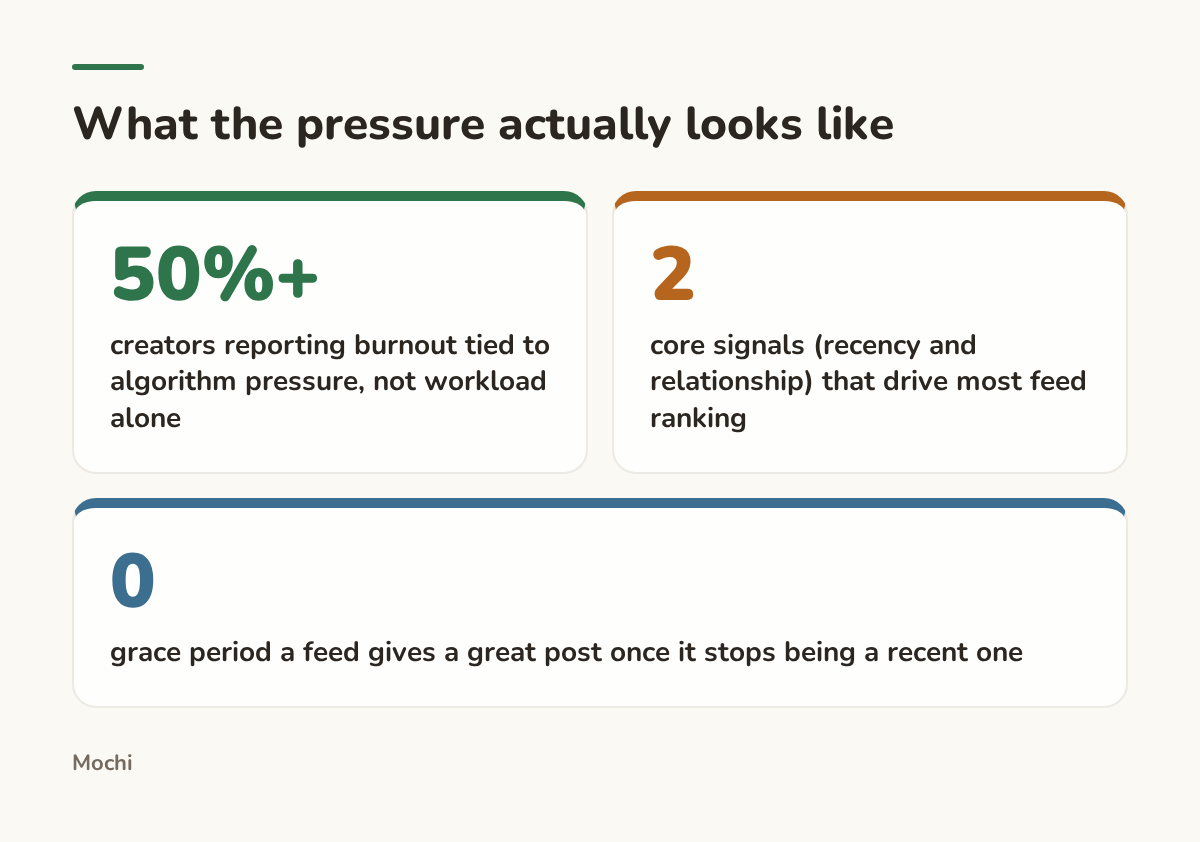
The algorithm resets on its own clock, not yours.
The Pressure Is Engineered, Not Incidental
Researchers who study how large platforms keep people posting and scrolling have catalogued the specific design choices that do it, and they describe those choices as the product working as intended, not a side effect of it (a recent taxonomy of these designs). Streaks, visible counts, and feeds that privilege the newest activity over the strongest activity aren't accidents. They're load-bearing parts of how the system decides what to show.
The toll shows up in survey data too. Research cited by Billion Dollar Boy puts more than half of creators at burnout levels, and names algorithm pressure specifically, not workload in general, as a driver of it (Over Half of Creators Face Burnout).
None of this means platforms are wrong to reward recency. Recency is a real signal of relevance to a reader. It means the fix was never "try harder to keep up," because trying harder is the thing that's burning you out in the first place. The fix is a production system that doesn't need your energy to match the platform's appetite every single week, including the weeks your actual work falls apart.
That system is batching. Here's how to build one that survives a bad week instead of just a good one.
Step 1: Separate Making the Work From Publishing It
The treadmill feeling comes from fusing two different jobs into one: the job of creating something, and the job of keeping a feed fed on a schedule. When both jobs happen on the same day, every rough week in your actual work, a cancelled shoot, a slow edit, a stretch with no ideas worth shooting, becomes a rough week on the feed too. The two problems compound instead of staying separate.
Batching just means doing those jobs on different days. You create in one sitting, enough for more than one post, and you publish on a schedule that has nothing to do with which day you happened to feel like it.
A bad week in your actual work should not have to become a bad week on your feed.
This single separation kills most of the panic on its own. A broken streak stops being a broken promise. It becomes a scheduling question, one you already answered three days ago, back when you still had the energy to answer it.
Step 2: Pick a Batch Unit That Matches Your Actual Week
Not every creator's output arrives on a weekly clock, and forcing a batch into one anyway is where most batching systems quietly fail before they start.
Before: Scrolling through last week's shoot every Sunday night, trying to find three things worth posting before Monday's deadline. After: One sitting, the day after every shoot, cutting a full pool of posts while the work is still fresh in your hands.
Take a wedding photographer whose best material arrives in bursts: a shoot every other weekend, then nothing to point a camera at until the next one. A batch unit tied to the calendar week fights that rhythm, forcing a blank Tuesday to produce something out of nothing. A batch unit tied to each shoot works with it instead: cut everything that gallery can support in one sitting, label each piece by pillar, and let the posting schedule draw from that pool on its own clock, long after the shoot itself is finished.
Pick whatever chunk of your actual output is big enough to cut into several posts at once, and batch around that, not around a grid that assumes everyone's work arrives on Mondays.
The unit changes by craft but the principle doesn't. For a musician, the natural unit is often a release or a studio session, not a week. For a videographer who works client to client, it's usually the project. Find the chunk your work actually arrives in, and build the batch around that chunk instead of around whatever the calendar happens to say.
Step 3: Build a Buffer, Not a Backlog
A backlog is everything you've ever made, sitting in a folder and quietly making you feel guilty every time you open it. A buffer is different on purpose: a small, deliberate stock of posts, three to five ahead, that exists for exactly one reason, so a bad week doesn't show up on the feed in real time.
Before: Posting a new clip the night before a show, then going quiet until the next show gets booked. After: Cutting five clips from one studio session and letting two weeks of posts run from that single afternoon, whether or not another show lands in between.
Picture a musician who only posts the night before a gig. The feed goes dark the moment the gig calendar does, because the posting schedule and the gig schedule were never actually separate. A buffer breaks that link: cut from the last session while it's fresh, publish from the buffer on a rhythm that doesn't care whether the next gig is booked yet.
A buffer exists for one reason: so a bad week never has to show up on the feed in real time.
Research on task-switching backs up why this matters more than it looks like it should on paper. Every time you stop mid-week to scramble a post into existence, you pay a real cost in refocusing, a cost that has nothing to do with the post itself and everything to do with how your attention works. That cost compounds across a week already full of interruptions from the actual job. A buffer removes the scramble before it starts, instead of asking you to get faster at it.
This is the one place a tool earns its keep instead of adding something new to check. We built Mochi's calendar to hold that buffer for us: once a batch is drafted, a full week of posts sits there already, split across our content pillars, waiting on its own schedule instead of our memory.
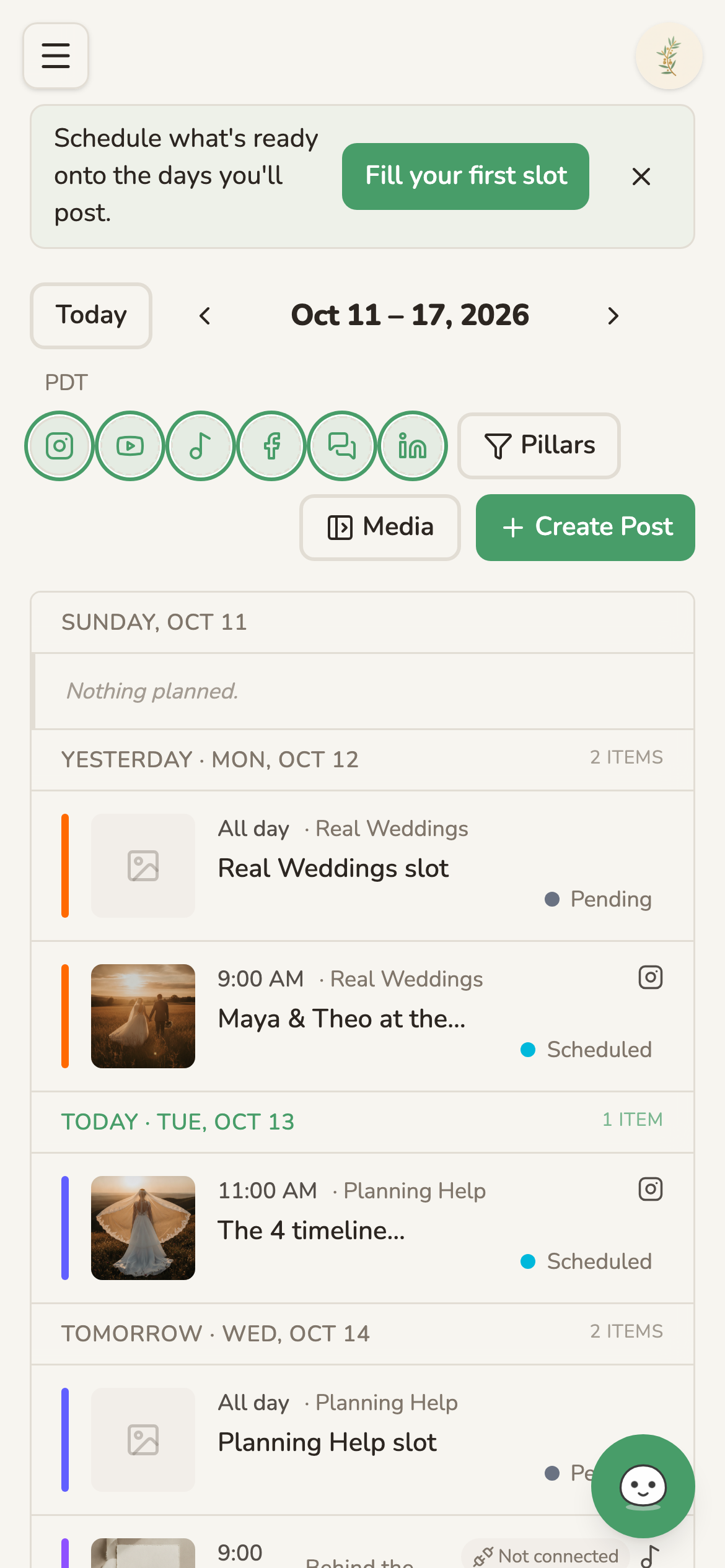
A week of posts already sitting on the calendar, spread across three pillars.
Step 4: Write the Bad-Week Plan Before the Bad Week Happens
Every working creator already knows which weeks are going to be rough. A slow season, a busy month at a day job, a stretch with travel booked, these aren't surprises. They're on the calendar already, which means the plan for surviving them can be written now, while nothing is actually on fire.
Before: A corporate gig runs long, the week's posts don't get made, and the streak breaks in a way that feels like a personal failure. After: A standing list of five posts that need nothing new, pulled straight from the buffer and published without a single new edit.
Picture a DJ who knows that wedding season books out every weekend in June and goes almost silent in February. The rough week isn't a surprise. The plan for it gets written in a calm month: which buffer posts cover the gap, which pillar gets an older strong piece rerun with a fresh caption, and which week simply posts less, on purpose, without apology attached to it.
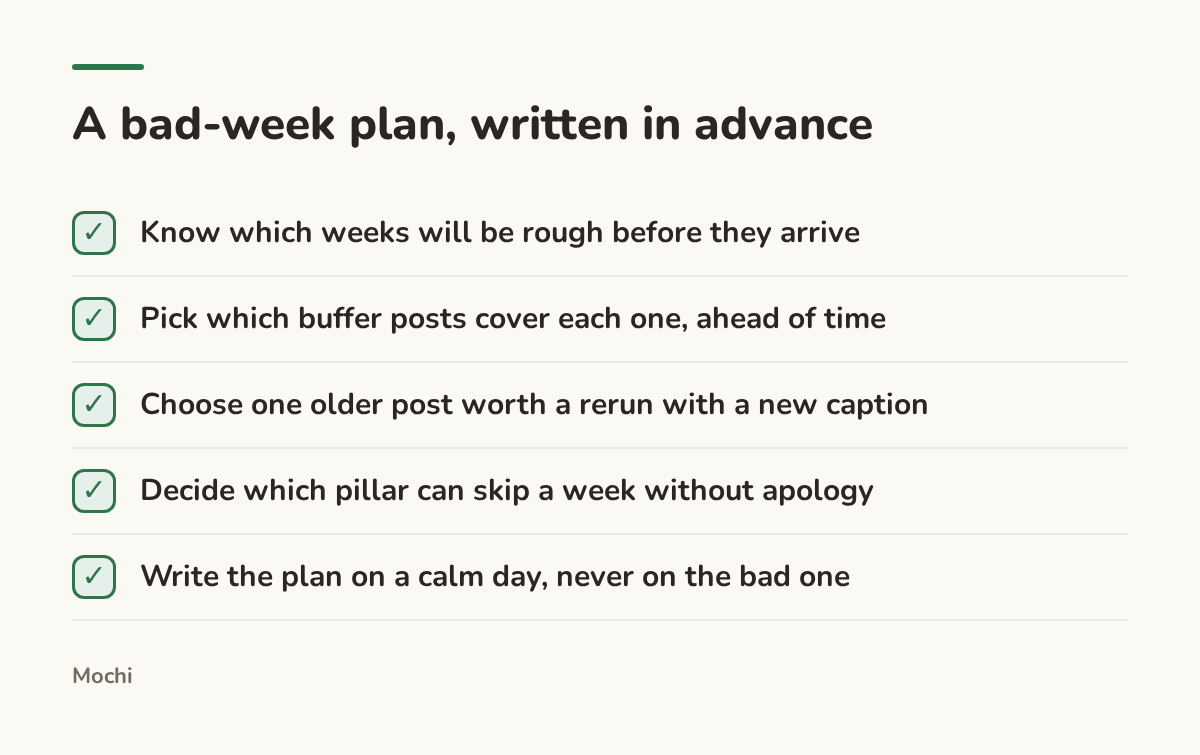
Write your own version of that list this week, while you have the distance to think clearly about it. The entire point of a bad-week plan is that you never again have to think clearly about it during the week that's actually bad.
None of this erases the platform's appetite for frequency. That part isn't changing because we want it to. What changes is whether that appetite runs through your nervous system every single week, or through a system you built once, on a calm day, when you had the room to build it properly. A broken streak stops being a verdict on your character and goes back to being what it always should have been: a scheduling gap, already covered by work you did three weeks ago.
What would next week look like if the content already existed before the week even started?
Part of a series
The Creator's Playbook
Evergreen craft for working creators: brand, content planning, and publishing, written by the team that builds Mochi.