 Mochi Labs
FeedHive vs Mochi: What Each AI Credit Actually Buys You
FeedHive vs Mochi, compared on what an AI credit actually pays for, the Creator-plan caps that catch people out, and who each tool really fits.
You open a pricing page, see a credit count, and have no idea what it buys until you've already paid for a month. That's the real question behind "FeedHive vs Mochi": not which logo looks nicer, but what a credit is actually worth once you're inside the account.
Both tools are built around AI and both meter it with credits. Past that, they're solving different problems. FeedHive is a scheduler with AI features bolted on for writing, images, hashtags, and prediction. Mochi is an agent that starts from a Brand Playbook it builds about your work, then researches, drafts, schedules, and replies from that. The prices below are as each company lists them on its own pricing page, verified October 11, 2026.
FeedHive vs Mochi: what a credit actually buys
What FeedHive's credits buy
FeedHive's credits cover four kinds of AI work: the AI Writing Assistant for captions and post copy, AI image generation, AI hashtag generation, and AI performance prediction, a forecast of how a post is likely to do before you publish it. Scheduling itself isn't charged. The Creator plan gives you 2,500 of those credits a month for €15, and the launch bonus doubles that for your first three months.
That's a reasonable amount of AI help if you're writing one caption at a time and want a hashtag list or a quick image to go with it. Where it gets thin is once you lean on performance prediction regularly: running a forecast on every post before you schedule it eats into the same pool as the writing and the images.
What Mochi's credits buy
Mochi spends its credits on a narrower set of things, but each one does more upfront work. A credit pays for drafting a post from the Brand Playbook (so the draft already sounds like you, not a blank prompt), and for an inbox reply, Mochi answering a DM or comment in your voice (Pro plans only). Research is metered on its own separate allowance, not credits: 10 runs a month on Starter with a weekly refresh, 50 runs a month on Pro with a daily refresh.
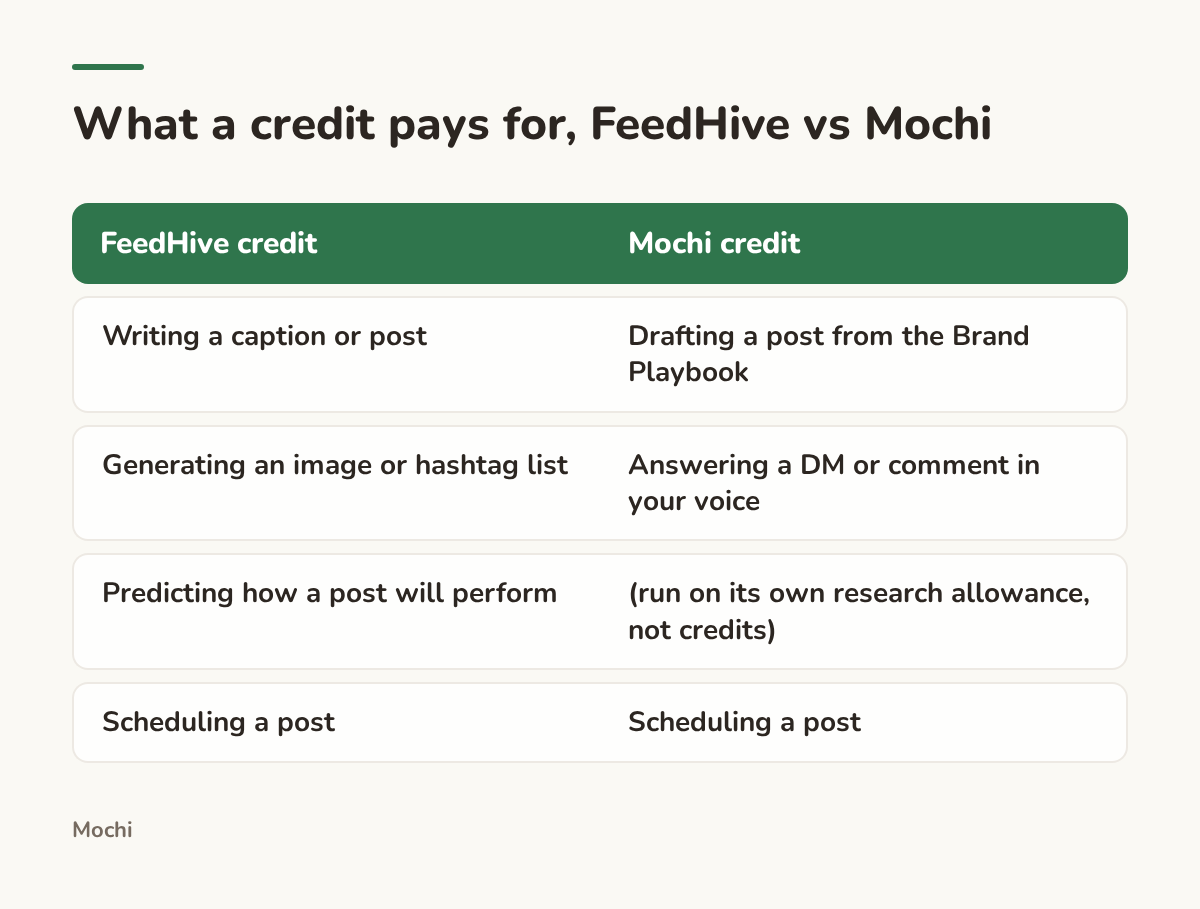
Scheduling itself is free on both.
The practical difference: FeedHive's credits are spent per piece of content you ask it to touch. Mochi's are spent on the agent doing recurring work in the background, research and replies, on top of the drafting.
If you want the general mechanics behind metered AI usage, this breakdown of how AI credit systems are priced is a useful primer before you commit to either plan.
The Creator-plan catch
FeedHive's cheapest paid tier, Creator at €15 a month, comes with real ceilings: 30 scheduled posts, a 14-day scheduling horizon, and 20-day history. Once you hit 30 posts scheduled, or try to plan something more than two weeks out, you're done until next month or until you upgrade to Brand at €22.
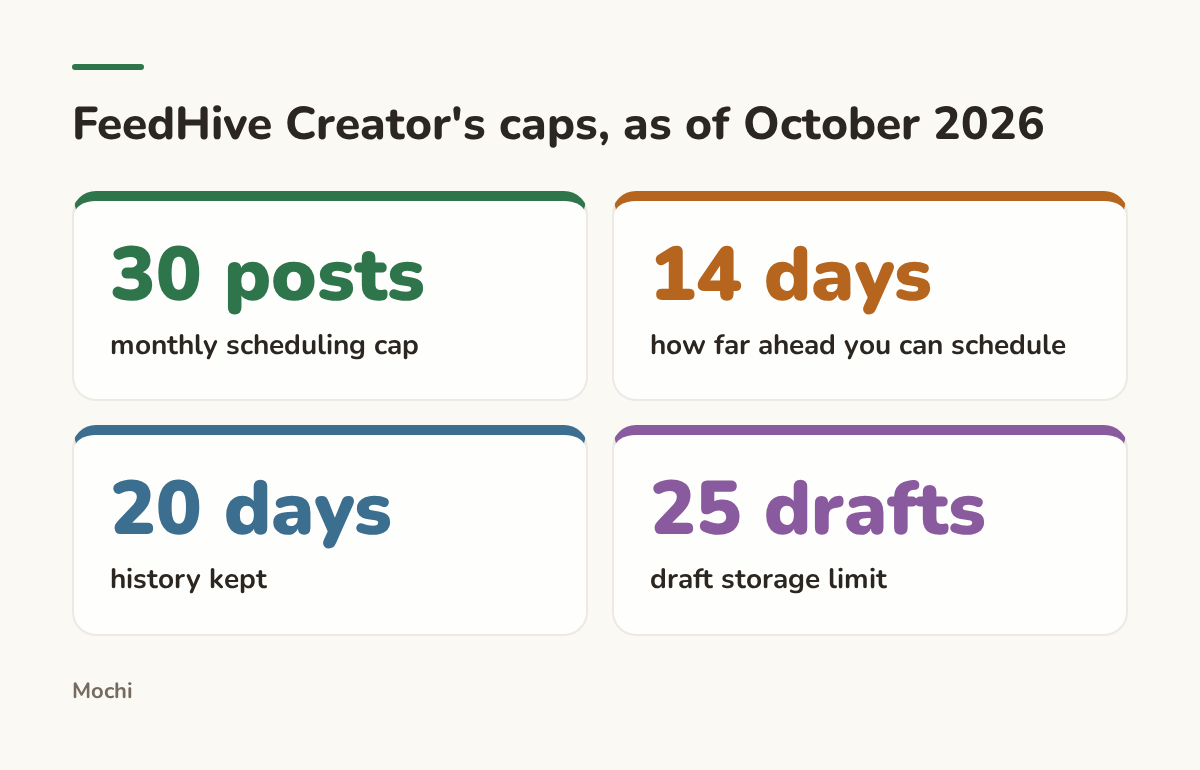
Mochi's Starter plan, at $29 a month, doesn't put a number on how many posts you can schedule or how far out you can plan them. You get one brand, one seat, 10 research runs a month, and 500 credits a month, but the calendar itself isn't boxed in by a post count or a horizon. If your posting plan runs six weeks ahead because you batch around a shoot or a release, that's the kind of limit worth checking before you pay, not after.
How Mochi spends credits differently: the inbox
Neither tool's credits are only about writing. Mochi's Pro plan ($59 a month) puts comment and DM replies on the same meter as drafting, and adds trigger words: a comment containing a keyword you choose triggers an automatic reply carrying a lead magnet, a discount code, or a catalog item, in your voice.
We built this because replying to the same question under every post is a real cost of running your own channels, and it's not something FeedHive's credit menu touches at all. FeedHive's four AI features are about producing posts, not handling what comes back after you publish.
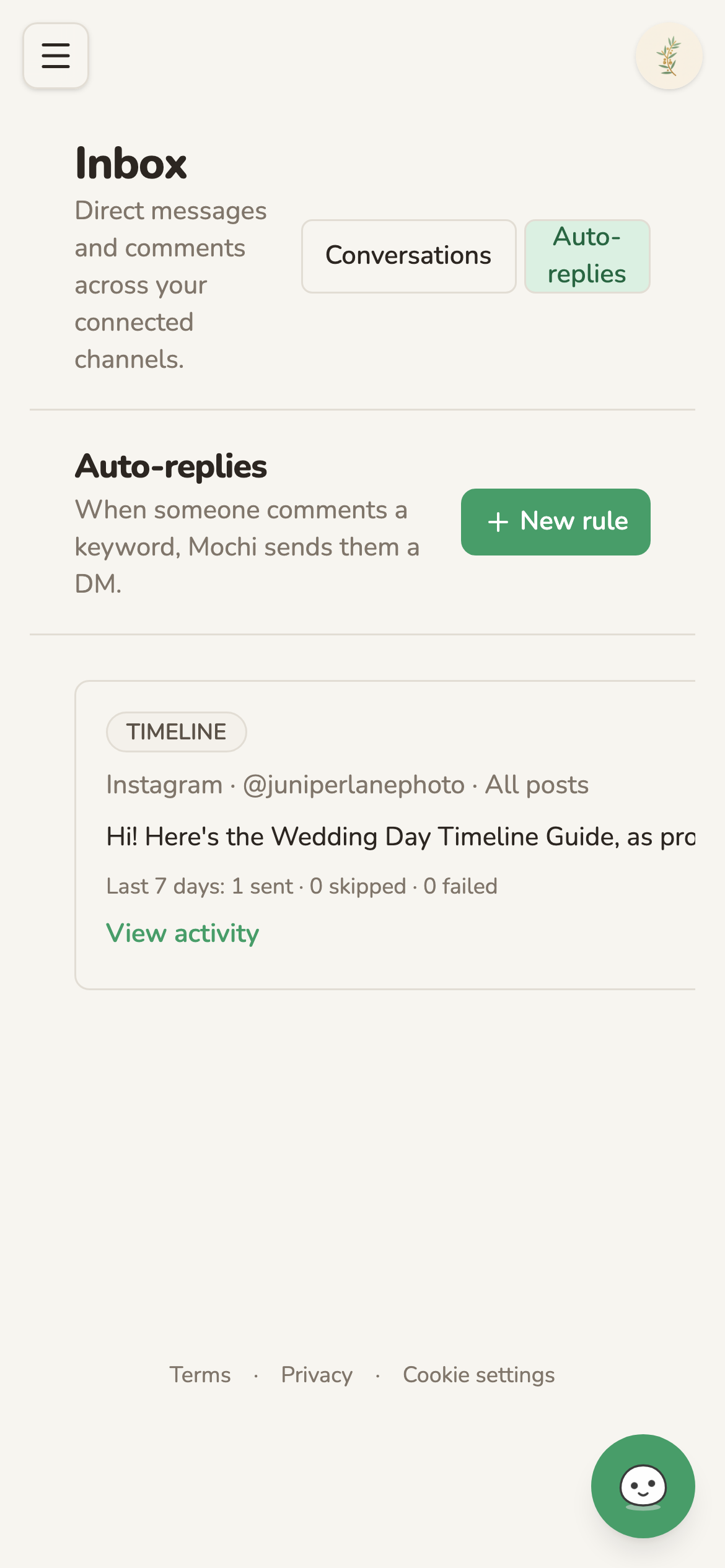
A comment containing TIMELINE triggers a DM with the Wedding Day Timeline Guide, and the card counts what it sent.
Where FeedHive pulls ahead: the platform list
It's worth being straightforward here. FeedHive posts to ten platforms: Instagram, LinkedIn, TikTok, X, Facebook, YouTube Shorts, Threads, Pinterest, Google Business, and Discord. Mochi posts to six: Instagram, Facebook, Threads, TikTok, YouTube Shorts, and LinkedIn.
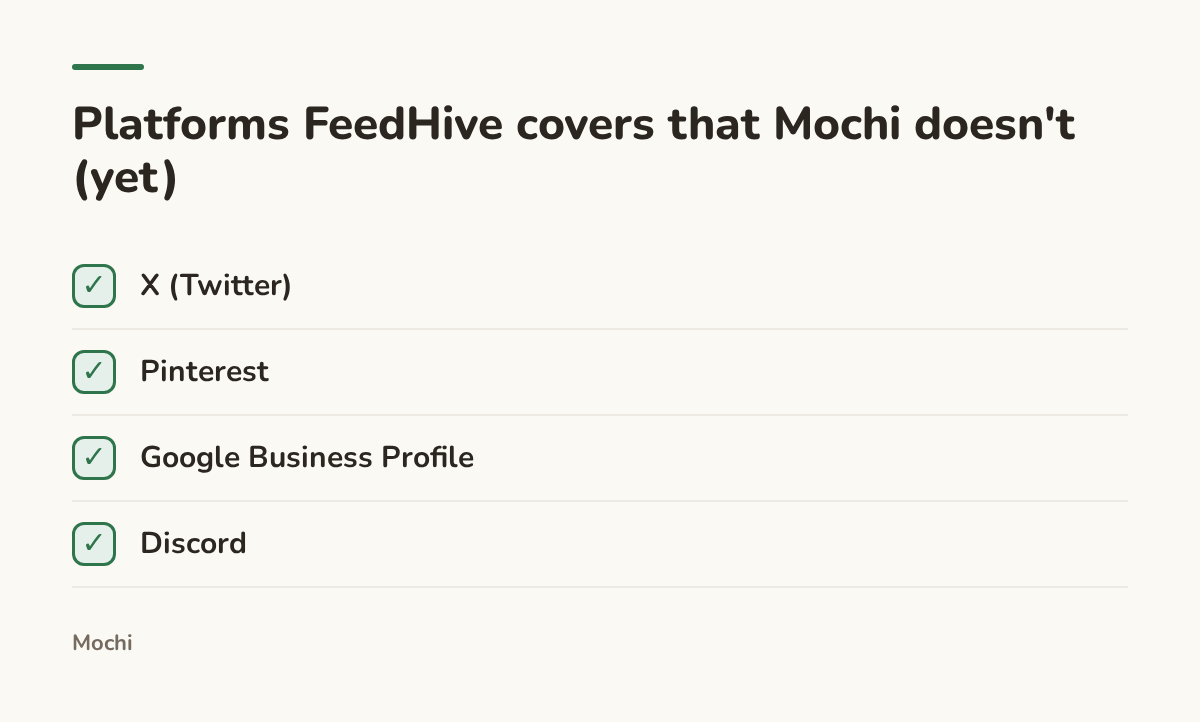
If a meaningful part of your audience lives on X, Pinterest, or Discord, that gap matters more than any credit math. Mochi doesn't post to those yet, and we'd rather say so plainly than have you find out mid-trial.
Price, currency, and trying each one first
FeedHive prices in euros, Mochi in dollars, so a direct conversion will drift with the exchange rate rather than tell you much. What's comparable is the shape of each offer. FeedHive gives a 7-day free trial with no card charge mentioned, plus a launch bonus doubling AI credits for three months. Mochi's trial is $1 for seven days with 150 credits, a card is required, and it rolls onto whichever plan you pick unless you cancel first.
Neither company lists a permanently free plan. Both bill monthly at every tier shown; Mochi doesn't offer an annual discount at all, and its credits don't roll over month to month, so an unused balance resets rather than banks.
If you're already weighing the cost against what you'd get back, Mochi's pricing page lays out the plans, the credit top-ups, and the trial terms in one place.
Who each is actually for
If you post mostly to X, Pinterest, Google Business, or Discord, or you just want AI help writing and designing individual posts inside a familiar scheduler, FeedHive's platform list and feature set cover that directly. Mochi doesn't reach those platforms, full stop.
If your channels are Instagram, Facebook, Threads, TikTok, YouTube Shorts, or LinkedIn, and the part that burns you out is the research and the replies as much as the writing, Mochi's credits are built to spend on that recurring work rather than one post at a time. The Starter plan's lack of a hard post cap or scheduling horizon is also worth weighing against FeedHive Creator's 30 posts and 14 days, if your planning habit runs longer than two weeks.
Either way, read the caps before the trial, not after. What does your actual posting rhythm need more: a wider platform list, or an agent that keeps researching and replying while you're not looking?
Part of a series
Mochi vs. the Field
Honest comparisons of Mochi with the social media tools creators already use, and what is different about an agent that learns your brand.