 Mochi Labs
How to Find Your Tone of Voice When You're the Brand
A practical guide for solo creators: how to find a tone of voice that holds up across captions, video intros, and DMs, with no company style guide to lean on.
You sound like yourself in a text to a friend. Then you open the caption box, and the person writing disappears.
Why does that happen?
Most advice about finding a brand voice assumes a company behind it: a few founders, a marketing hire, a shared document everyone reads before they type a word. You don't have that. You have a camera, a feed, and whatever you can type between jobs. The brand isn't a separate thing you invented, it's you, which makes the problem both easier and harder. Easier, because the raw material already exists. Harder, because there's no committee to blame when a caption goes flat.
Here's the shape of what actually works. Start with the voice you already have instead of inventing one from a mood board. Learn to tell tone from voice, so you can sound calmer in a DM and looser in a reel without turning into two different people. Translate the voice across formats instead of pasting the same lines everywhere. Write down just enough of it to survive a rushed Tuesday. And check, every so often, that it still sounds like you when you're tired, annoyed, or answering a comment you didn't ask for.
Step 1: Find the Voice You Already Have
You don't need to invent a personality for your feed. You need to notice the one you already use when nobody's grading it: a voice memo to a friend, a caption you wrote at 11pm and almost didn't post, the way you explain your own work when someone asks about it in person. That's closer to your real voice than anything a worksheet produces.
Take a DJ who talks fast and specific in interviews: who names the exact track that saved a bad set, who laughs at their own mistakes in front of a room. Online, that same person posts polished, impersonal recap clips with stock captions, "another one in the books," nothing a stranger couldn't have written. The gap isn't a style problem. It's a voice that only shows up in one room. The fix isn't writing cleverer captions, it's letting the interview version into the caption box.
A useful exercise: pull three places you've already talked about your work in your own words. A caption, an email to a client, a comment reply. Read them side by side. The words that repeat, the jokes you reach for, the way you soften or don't soften a hard truth, that's the voice. The Finding Your Voice as a Writer guide from the American Society of Journalists and Authors makes the same case for anyone who writes for a living: voice isn't manufactured, it's noticed in work you've already made, then used on purpose.
Step 2: Separate Tone From Voice
Voice is who you are on a page. Tone is how that voice adjusts to the room it's in, and confusing the two is what makes creators think they have to pick one personality and apply it everywhere, rigidly, even where it doesn't fit.
A useful way to split them comes from research on the four dimensions of tone of voice: how funny or serious a piece of writing is, how formal or casual, how respectful or irreverent, how enthusiastic or matter-of-fact. None of those sliders change who you are. They change how loud each part of you gets, depending on what you're writing and who's reading it.
Picture a wedding photographer whose voice is warm and a little wry. That part doesn't move. But the tone shifts hard between a reel caption shot from the dance floor at midnight (funny, casual, enthusiastic) and a reply to a nervous couple asking about a reschedule (still warm, but serious, barely a joke in sight). Same person, same values. The sliders just moved to fit the moment, and a couple reading both messages would recognize the same photographer in each one.
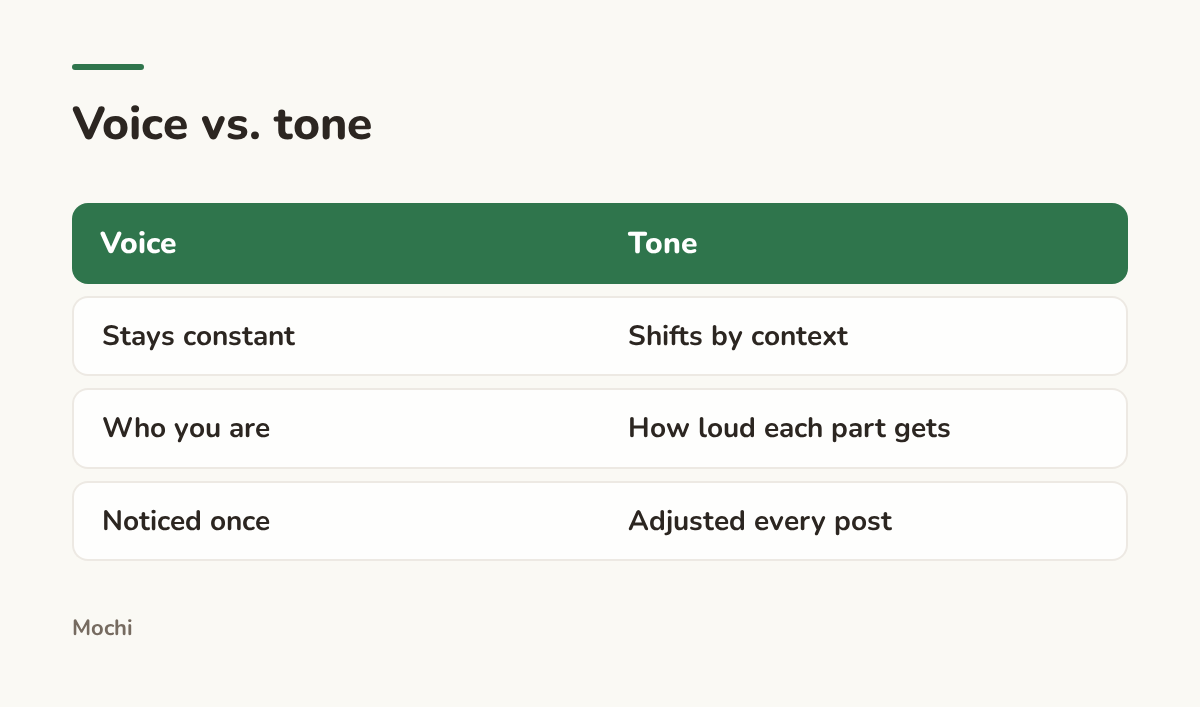
The sliders move. The person underneath doesn't.
Step 3: Translate the Voice Across Formats, Not Just Repeat Lines
A caption, a video intro, and a DM reply aren't the same room, even though you're the one standing in all three. A line that reads fine as a caption can sound stiff spoken on camera, and a line that sounds natural out loud can read as rambling once it's typed. Translating your voice means keeping the person recognizable while the sentence changes shape to fit the format. It isn't copying the same words into every box and hoping they land the same way twice.
Research comparing how people present themselves on Facebook, LinkedIn, and TikTok backs up why this adjustment is normal rather than a sign you're being inconsistent: everyone shifts presentation by platform, not just creators chasing a brand. The part worth guarding isn't whether you adjust. It's whether the adjustment still reads as the same person underneath. (source)
Video intros
A video intro is spoken, so it has to sound like something you'd actually say out loud, not something you'd write at a desk.
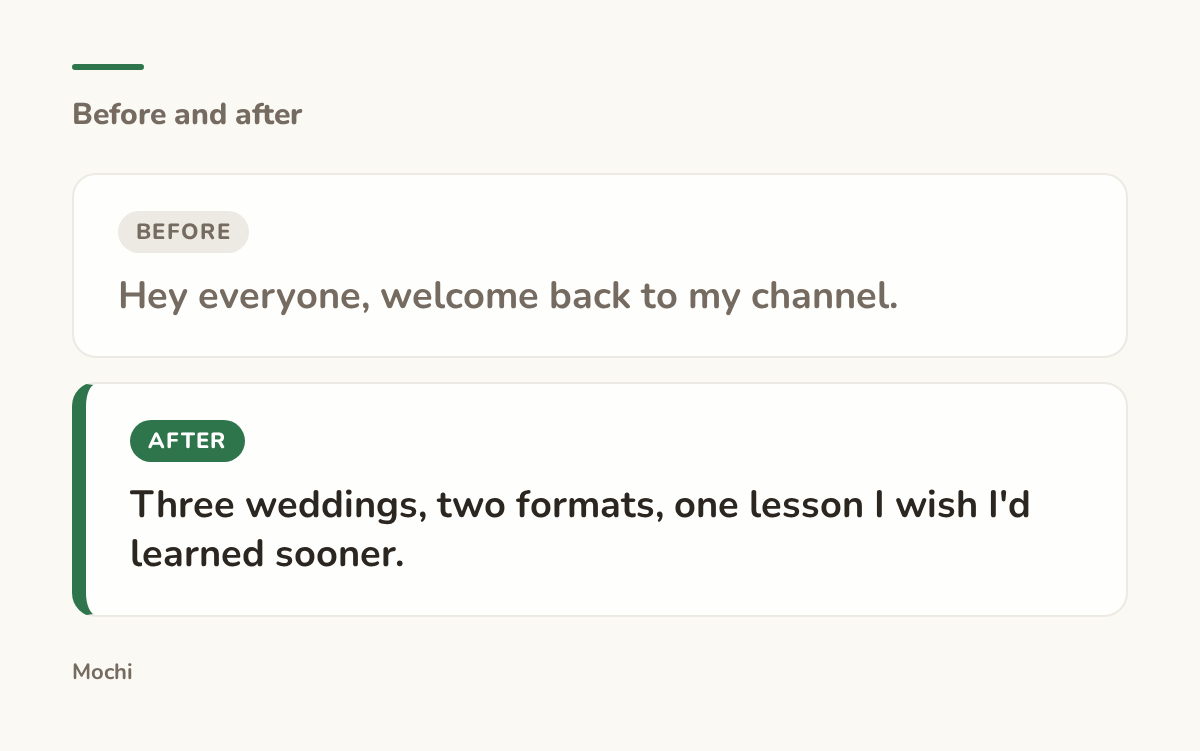
Before: Hey everyone, welcome back to my channel. After: Three weddings, two formats, one lesson I wish I'd learned sooner.
One disappears into every other intro. One tells you what this video is actually for.
The rewrite works because it names a stake before it names the subject, the same move that makes any opening line worth finishing. A greeting is something every channel's intro already says. A specific lesson is something only this video has, and it's a line only the person who lived it could write.
Captions
A caption has more room to think out loud than an intro does, so use it instead of defaulting to an announcement.
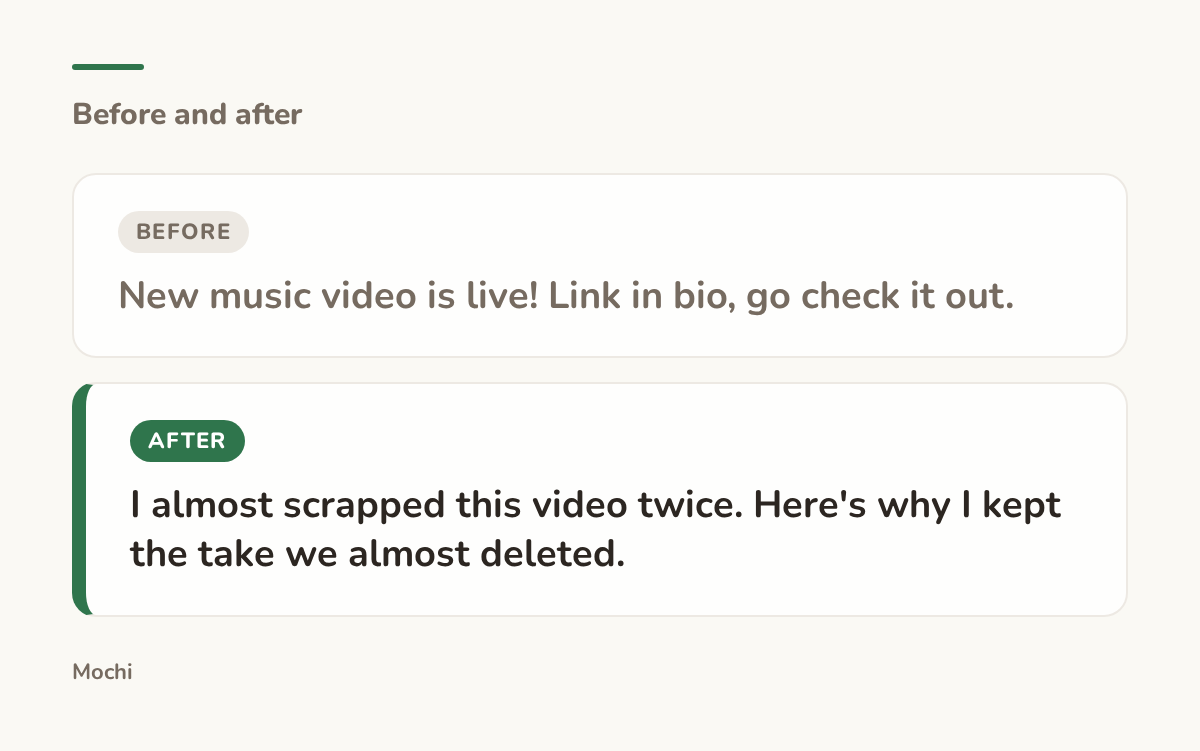
Before: New music video is live! Link in bio, go check it out. After: I almost scrapped this video twice. Here's why I kept the take we almost deleted.
The second version gives a stranger a reason to care before it asks for a click.
Notice what changed isn't the energy, it's the information. Both lines could be read in the same excited tone out loud. Only one of them tells you something you didn't already know from the thumbnail.
Direct messages
DMs are the room where tone gets tested fastest, because someone's waiting on the other end, often about money, a booking, or a problem that needs a real answer.
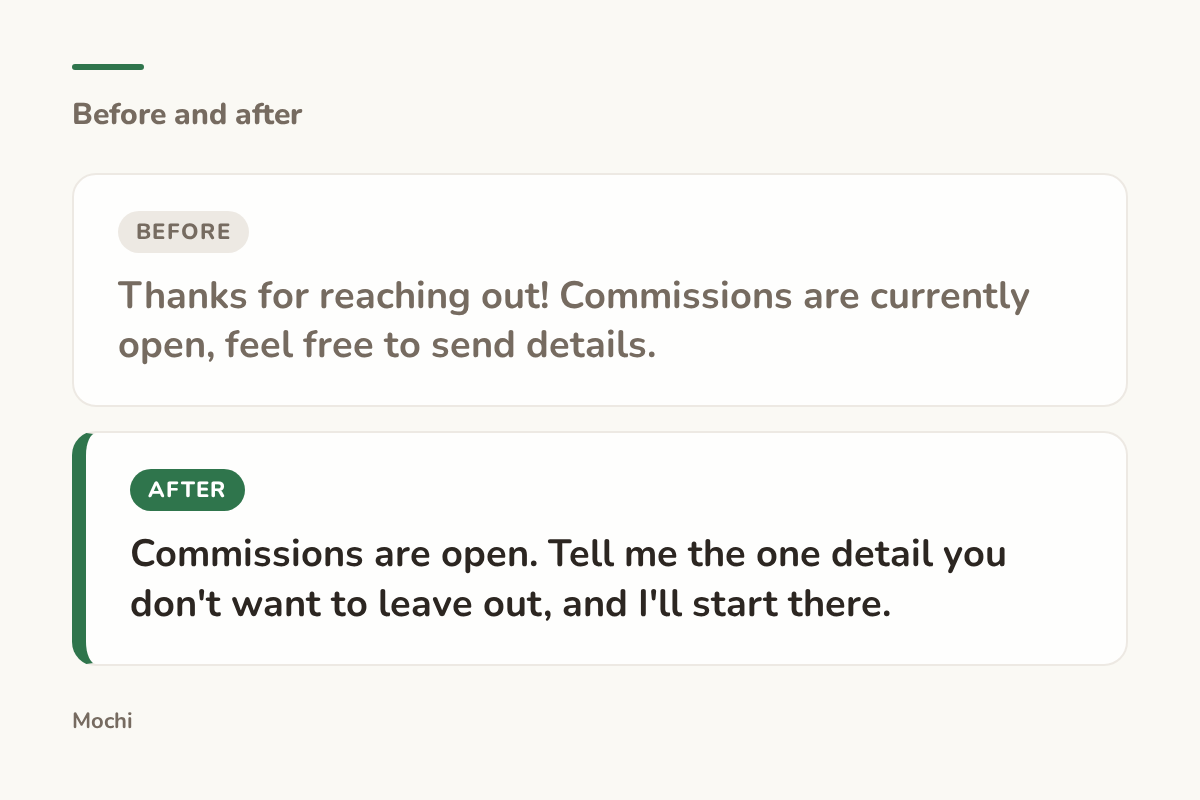
Before: Thanks for reaching out! Commissions are currently open, feel free to send details. After: Commissions are open. Tell me the one detail you don't want to leave out, and I'll start there.
Same information, sent two ways. One reads like a form. One reads like the artist.
A pattern sits underneath all three pairs. The voice doesn't get louder or quieter moving from format to format, it gets more specific. Generic is what a voice sounds like right before it disappears entirely.
Step 4: Write It Down Somewhere You Won't Lose It
Not a brand guideline a marketing team would produce. Not ten pages. Just enough to catch you on a bad day: three or four lines about words you actually use, a phrase you'd never say out loud even under deadline pressure, a joke you can make about yourself that a stranger couldn't make about you. The specific part matters more than the thorough part. A single page you'll reread beats a long document you'll open once and never again.
Where it lives matters too, because the version that only exists in your head is the first thing to go on a rushed Tuesday, right when you need it most.
This is the one spot we built a tool for ourselves: Mochi's Brand Playbook starts with a short interview and a scan of what you've already posted, then writes the voice down in plain language, words you do and don't use, a tone that flexes by context, sitting next to the calendar where you'll actually see it before a post goes out rather than buried in a drive you forget to open.
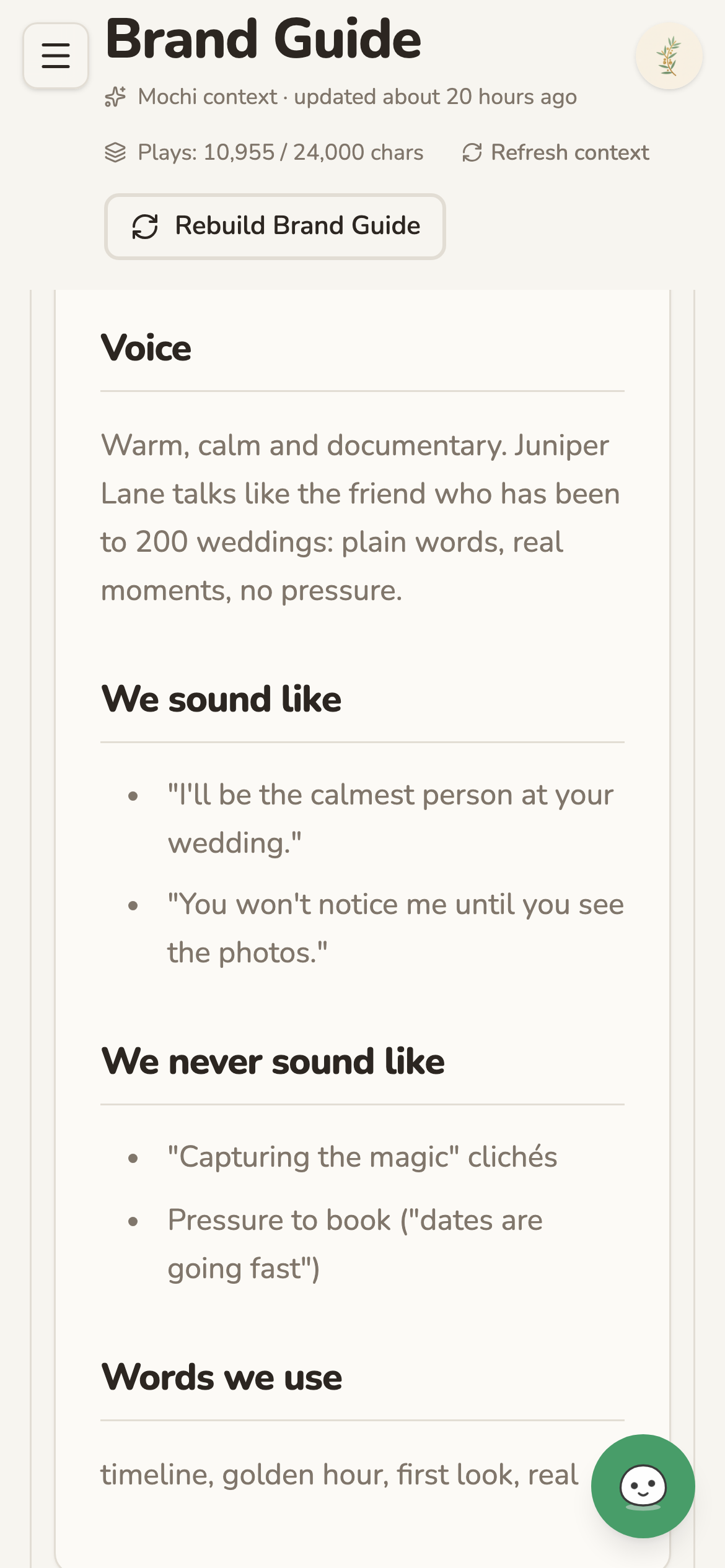
The brand's voice, written down the way it actually sounds, with examples of how it does and doesn't talk.
Step 5: Check the Voice Holds Up Under Pressure
The real test of a voice isn't the caption you wrote with time to think it over. It's the one you wrote in forty seconds between calls, or the reply to a comment that got under your skin.
Research on tone of voice backs up why this matters past just sounding nice: UX studies find that specific tone choices change how trustworthy and friendly a brand reads to a stranger, not only how much they enjoy reading it. A voice that holds up under pressure reads as more consistent, and consistency is what gets read as trust.
There's a version of this that matters past any business case too. A peer-reviewed study on authentic self-expression online found it's associated with greater subjective well-being, not just better engagement numbers. Sounding like yourself consistently isn't only a tactic for getting noticed. By that research, it's also better for the person doing the posting.
Test it on the hard days specifically, not the easy ones. Write the caption, the comment reply, the video intro when you're tired and behind schedule, then reread it an hour later with fresh eyes. Does it still sound like you, or like whoever you turn into when a deadline is breathing on you? Harvard Business School's framing of personal authenticity describes this as keeping what you value, how you talk about it, and what you actually do lined up, three things that drift apart fastest exactly when you're rushed.

Sounding Like Yourself, On Purpose
None of this works if you treat your voice as a script to copy into every box. Find the one you already have before you invent a new one. Learn which parts are the constant and which parts are allowed to move. Translate it instead of repeating it, write down just enough to survive a bad week, and check, now and then, that the tired version of you still sounds like the rested one.
The brand was never a separate thing to build. It was already talking. What's the last caption, DM, or video intro you wrote that sounded exactly like you, and would you still recognize it on a day you weren't trying?
Part of a series
The Creator's Playbook
Evergreen craft for working creators: brand, content planning, and publishing, written by the team that builds Mochi.