 Mochi Labs
Your Bio Is a Pitch, Not a Business Card
Your bio isn't a label, it's a pitch. Here's how to write a creator bio that earns a follow, with real before-and-after rewrites for musicians and DJs.
Someone lands on your profile. They've already half-decided, from the last post or the thumbnail, whether they're curious. Your bio is the only thing standing between that flicker of curiosity and the back button.
Most creator bios fail at that exact moment, and it's almost never the wording. When we sit down to fix a creator's bio, the problem is usually that nobody ever asked it to do a job. It reads like a label on a file folder: name, craft, location. A label doesn't make anyone stay. A pitch does.
How to Write a Creator Bio That Actually Earns a Follow
A bio and an elevator pitch solve the same problem: you have one breath to make a stranger want the next five minutes of a relationship with you, not just the information you're handing over right now. Harvard Business Review's breakdown of the elevator pitch makes a point worth borrowing directly: a good pitch opens a conversation, it doesn't try to close one. Your bio isn't where you prove you're qualified. It's where you make someone curious enough to tap "follow" and find out.
That reframing changes what goes in the bio. A résumé lists what you've done. A pitch tells a stranger what they get if they stick around, specifically, not vaguely, and in language they'd actually use themselves. "Photographer based in Austin" is a label. "I shoot weddings like you'll actually want to remember them, not pose for them" is a pitch. Same photographer, same city, a completely different promise.
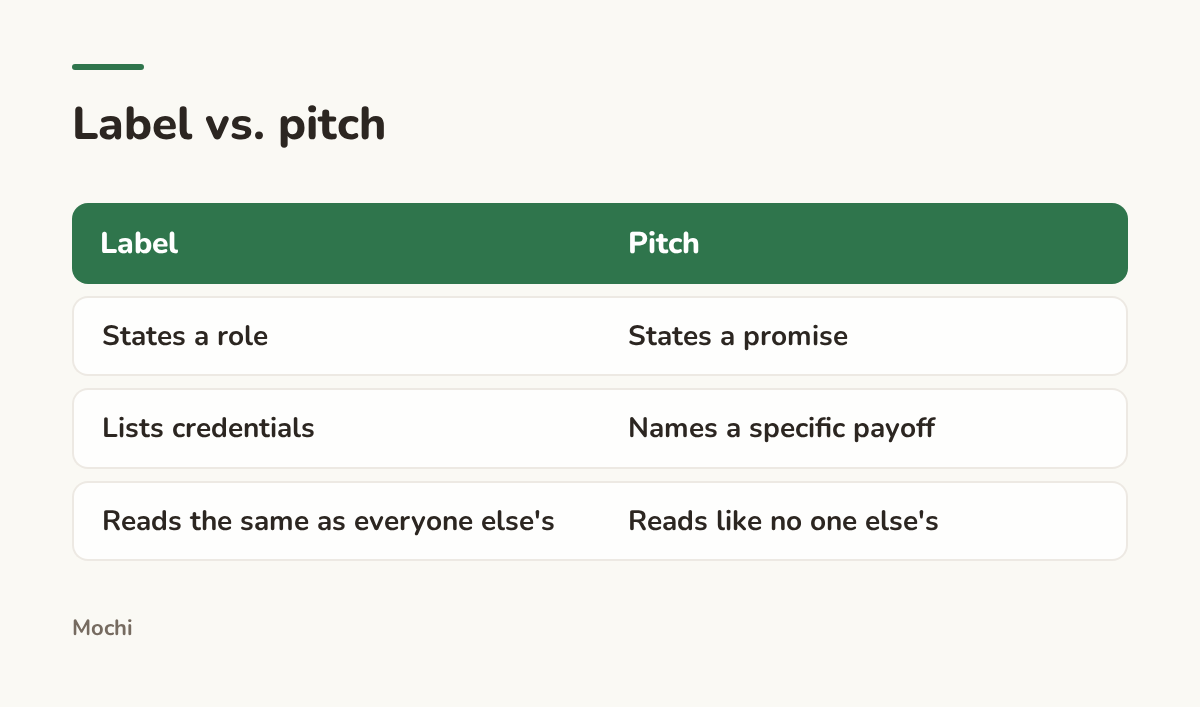
Two bios, two different jobs.
The One-Line Test: Why Should I Stay?
Here's the test we hold every bio against before anything else: if a stranger read only the first line, would they know why to keep looking? Not who you are. Why they should care.
The research on attention backs up why this matters more than it feels like it should. Nielsen Norman Group's research on how long visitors stay on a page found that people decide whether a page is worth their time within the first several seconds, well before they've read past the opening line. A bio is a more extreme version of the same page: there's no scroll to rescue a slow start, no second paragraph to redeem a flat first one. The first line either earns the second or there isn't a second.
Research on first impressions in psychology backs up the stakes further: first impressions form fast and are stubborn once they set, which means a vague opening line doesn't just fail to help, it actively works against every post that follows, because the viewer has already decided who you are before they've seen your work.
Rewriting the Bio, Line by Line
A bio rewrite isn't a wording exercise. It's three separate decisions, made in order, and most creators skip straight past all three to word choice.
Step 1: Name the specific thing, not the general job
"Musician" tells a stranger almost nothing; there are millions of musicians. The job of the first line is to narrow that down to the one thing this account is actually for, the thing a stranger couldn't get from any other account with the same job title.
Before: Singer-songwriter. Music is my life. After: I write breakup songs for people who are still mad, not sad yet.
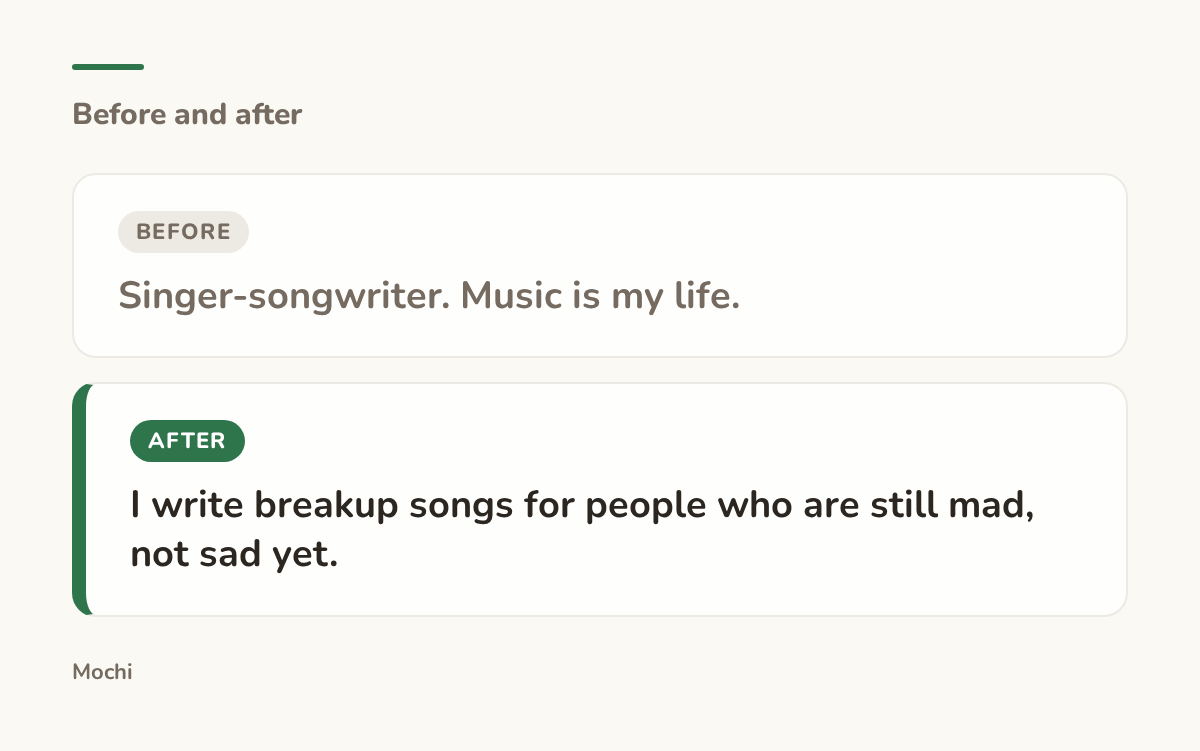
Before: Singer-songwriter. Music is my life. After: I write breakup songs for people who are still mad, not sad yet.
The rewrite works because it does something the original can't: it tells a stranger exactly which breakup song they're about to get, and it sounds like one line from an actual person rather than a job title copied off a form.
Step 2: Say who it's for, out loud
A lot of creators write bios that describe themselves and skip the part that actually recruits a follower: naming who the work is for. A viewer scans a bio looking for themselves in it. If they're not in there, they move on.
Before: Wedding photographer. Based in the Pacific Northwest. After: For couples who'd rather forget the camera was ever there.
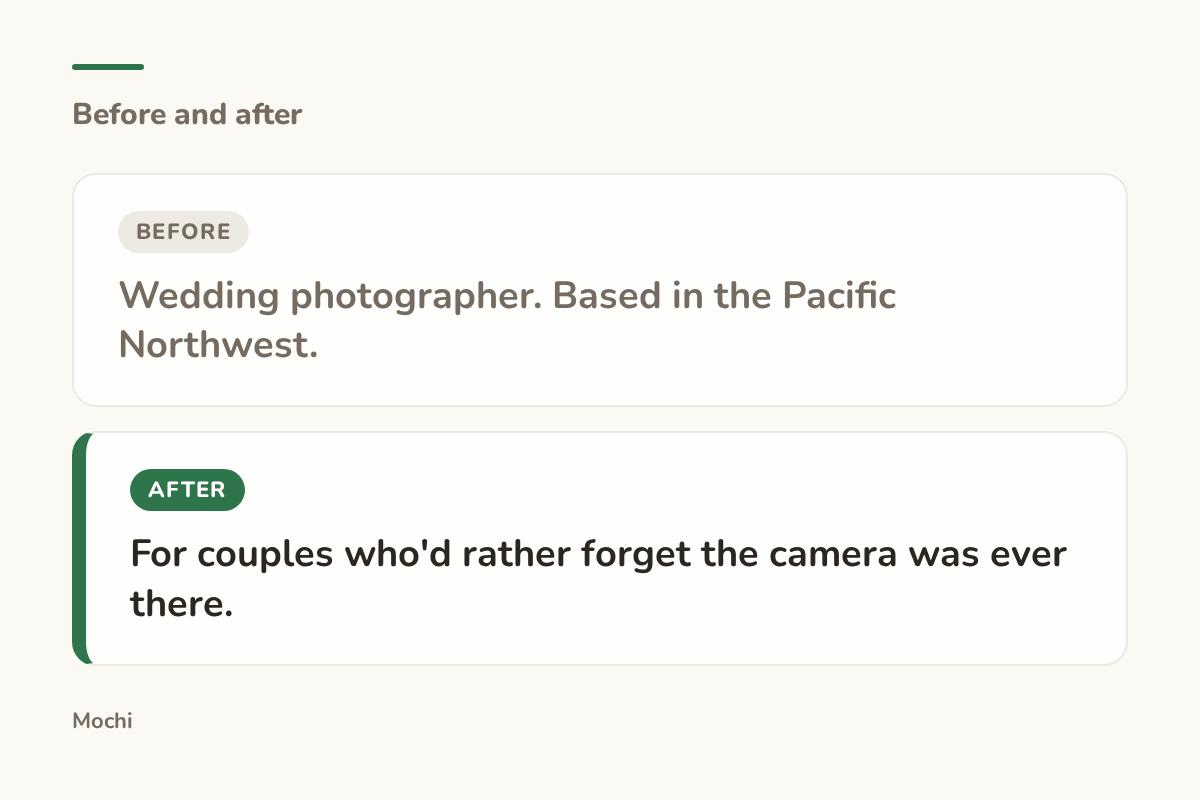
Before: Wedding photographer. Based in the Pacific Northwest. After: For couples who'd rather forget the camera was ever there.
Notice the second line never says "candid" or "documentary style," the usual industry words. It describes the feeling a couple wants and lets them recognize it. An engaged couple scrolling photographer bios reads that line and knows, immediately, whether this is their photographer, which is the entire point of the sentence.
Step 3: Give the bio a job after the follow
A bio that only describes stops working the moment someone's curious. It needs to tell them what to do with that curiosity: watch the pinned video, check the link, DM a word. Picture a DJ whose sets blur genres no one else touches; a bio that just says "DJ / producer" wastes the one line that could point a curious listener straight at the set that proves it.
Before: DJ / producer. Bookings via email. After: I play sets where disco meets dembow. New one's pinned, press play before you scroll past.
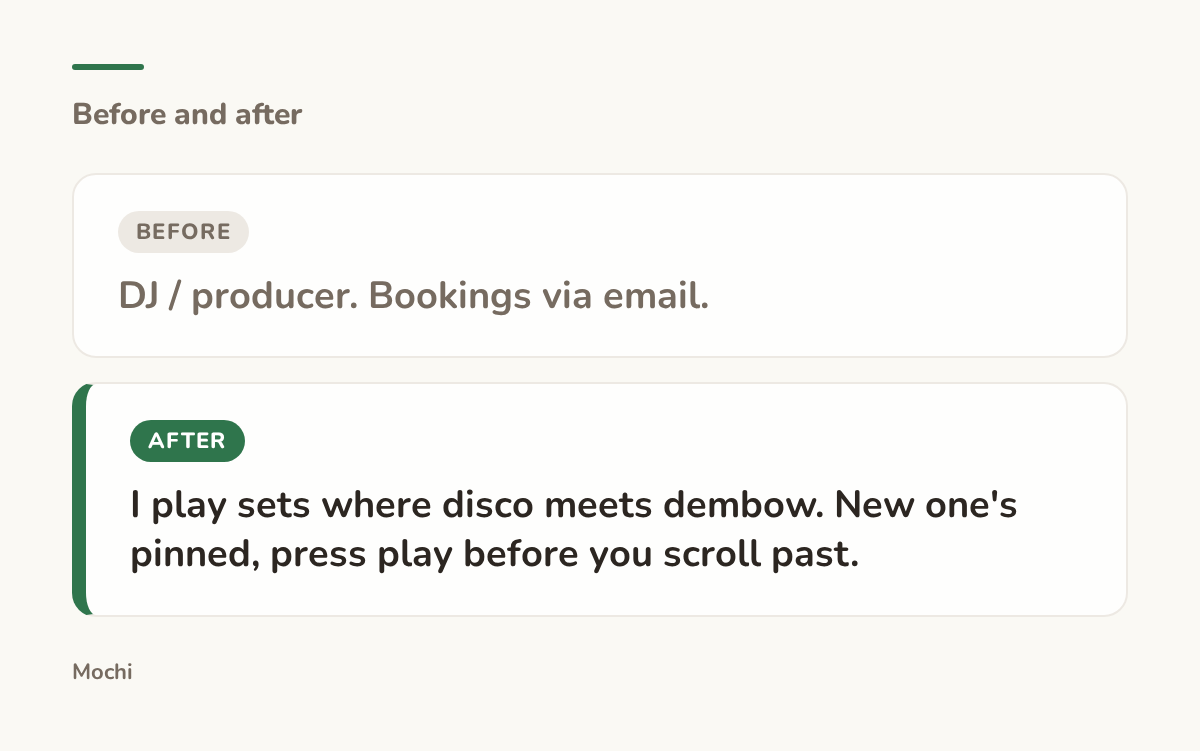
Before: DJ / producer. Bookings via email. After: I play sets where disco meets dembow. New one's pinned, press play before you scroll past.
The rewrite is longer, and that's fine. A bio's job is not to be short, it's to be worth reading to the end. The "After" line also does something the "Before" line never could: it tells a curious stranger exactly where to look next, instead of leaving them to guess.
The Same Bio Reads Differently on Every Platform
The three decisions above hold everywhere, but the space you have to make them in changes by platform, and a bio written for one often reads wrong on another.
Instagram and Threads
Instagram's bio has room for a short pitch plus a line of specifics (location, medium, a credential if it's earned), and Threads inherits whatever's already in the Instagram bio for most accounts, so the two rarely need separate drafts. The limiting factor isn't character count, it's that both are read on a phone screen in roughly two seconds of scanning, so the pitch line has to come first, not last.
LinkedIn's "about" section allows for far more room, up to roughly two thousand characters, and that extra space is exactly where creators go wrong: they use it to list every credential instead of opening with the same one-line pitch and only then backing it up with context. The pitch line still comes first. The extra space is for evidence, not a substitute for it.
TikTok
TikTok's bio is the shortest of the group and the least likely to be read before someone's already watched a few videos, which means its real job is confirming what the videos already promised, not introducing a stranger to you cold. A specific line still beats a vague one, it just has less room to work with.
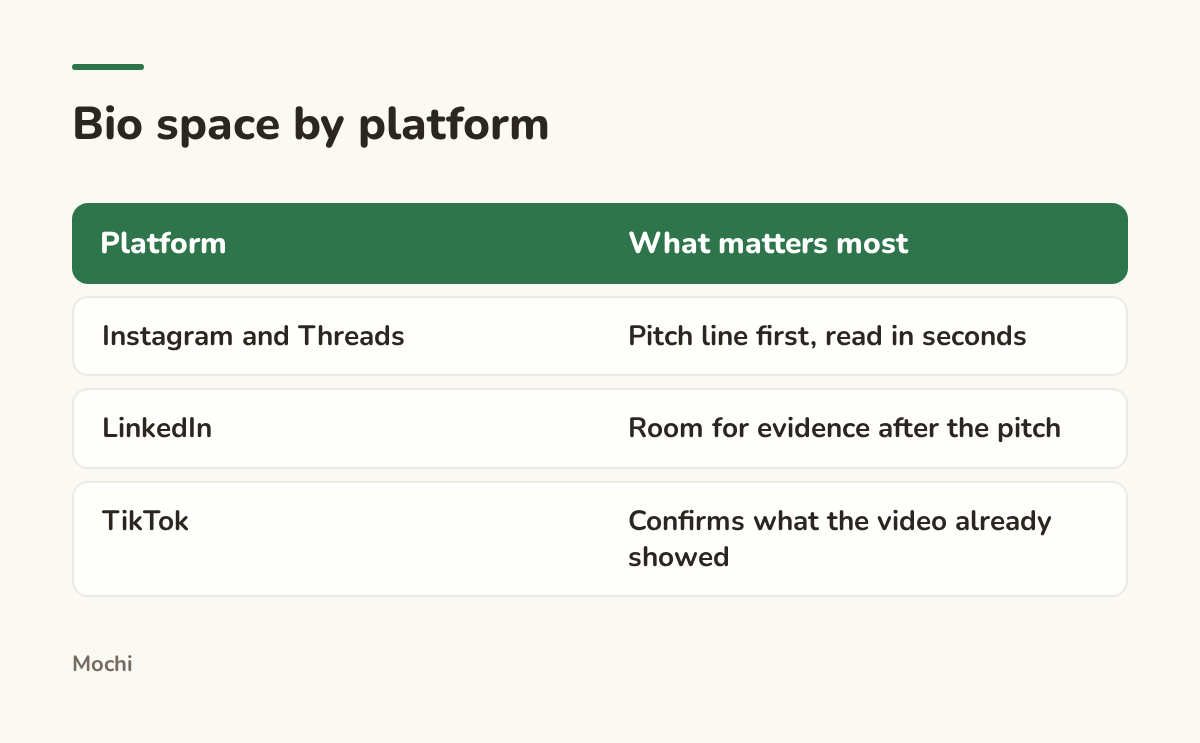
Same pitch, different amount of room to make it.
Research on originality in profile writing is a useful gut check across every one of these platforms: profiles that read as distinctly original, rather than generic, were rated as more memorable and more appealing by the people reading them. A specific bio isn't just more honest about who you are, it's measurably more interesting to the stranger deciding whether to stay.
Mistakes That Quietly Undercut a Bio
A few habits show up across a lot of the bios we're asked to fix, and none of them are about talent or taste.
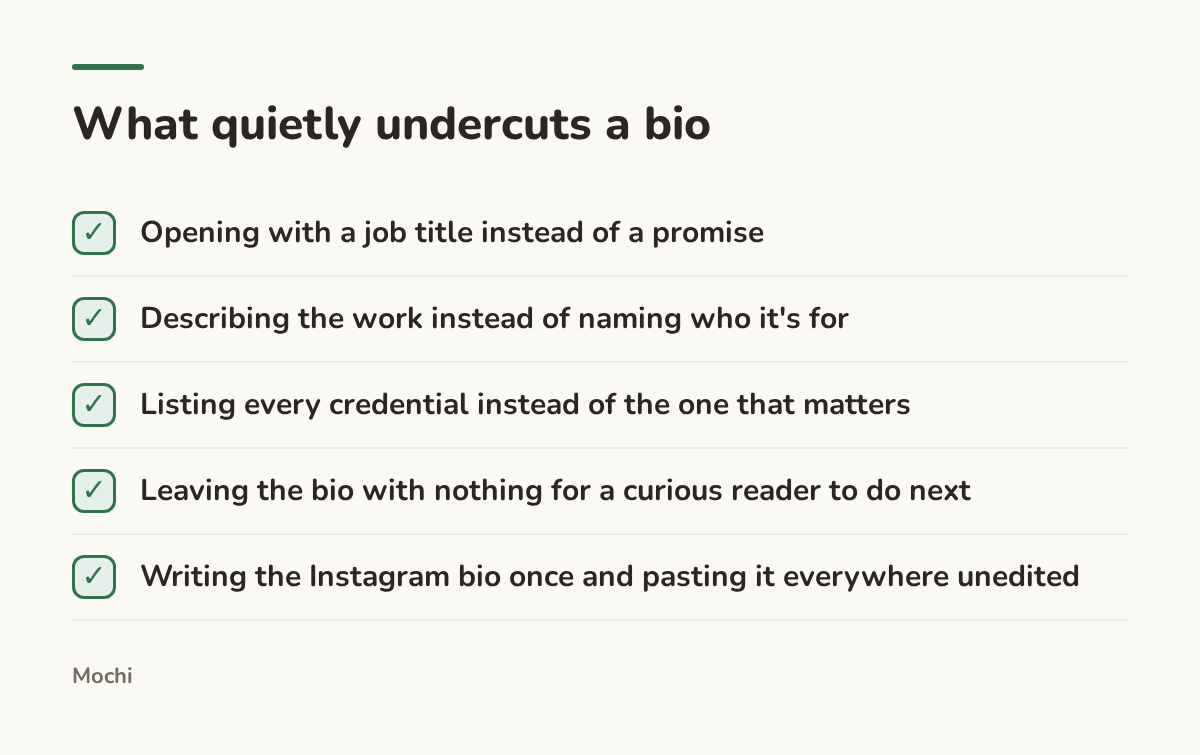
Small habits, same outcome: a stranger scrolls past.
Any one of these is fixable in the time it takes to read this far. The habit worth building is rereading the bio as a stranger would, cold, with no context about who you are, and asking whether that one line would make a stranger stop.
Writing the Voice Down So It Doesn't Drift
Once a bio actually sounds like a pitch, the next problem is keeping every other caption and comment reply sounding like the same person wrote them. That's the part that drifts fastest, especially across a busy month or a few collaborators. It's also a big part of why, when we build a creator's Brand Playbook in Mochi, the voice gets written down in plain language, with examples of how the brand does and doesn't sound, rather than left to memory.
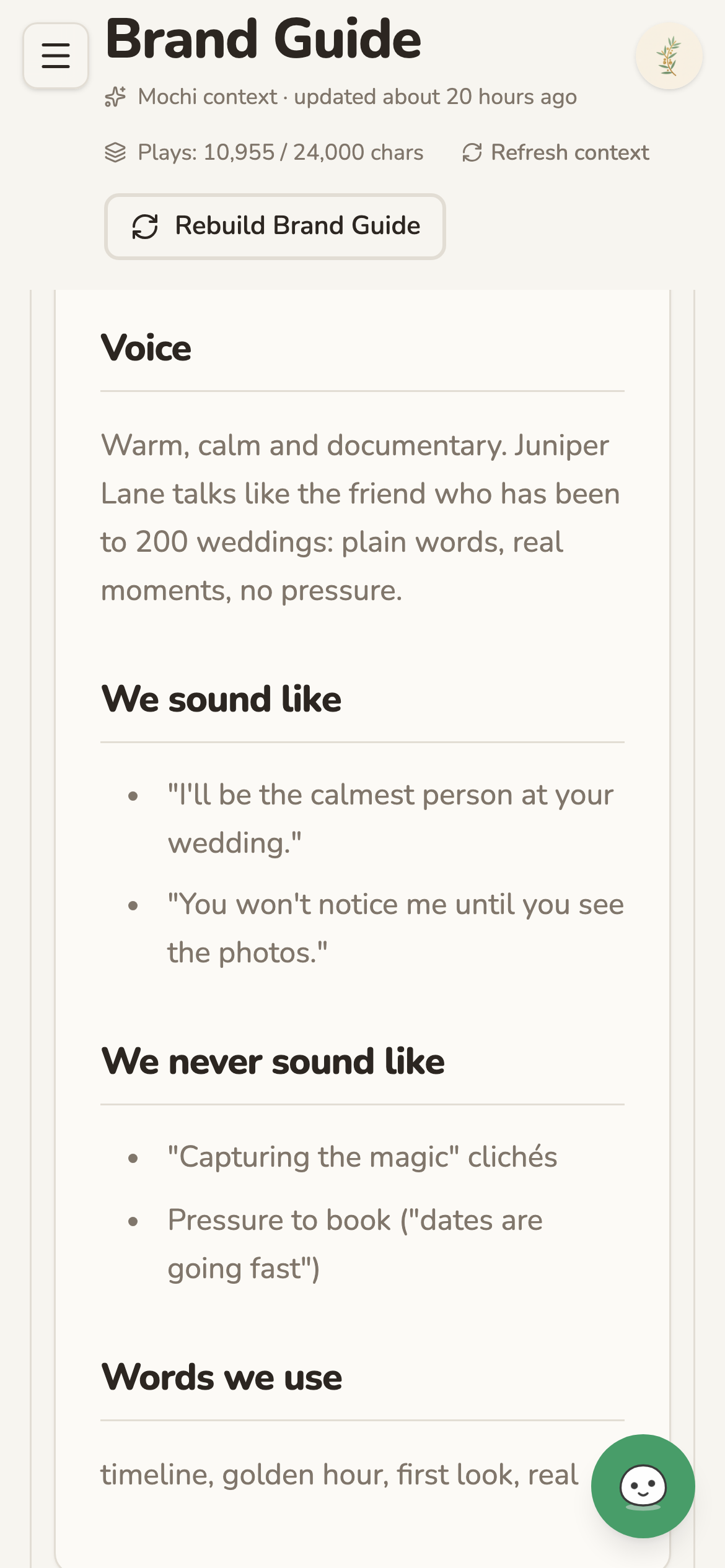
The brand's voice, written down with examples of how it does and doesn't sound.
A bio is the most compressed version of that voice. Get the voice right once, in the playbook or just in your own notes, and the bio stops being a separate writing problem. It becomes the shortest possible version of something you've already defined.
A good bio doesn't announce who you are. It makes a stranger curious enough to find out for themselves, in your work instead of your words. Read your own bio again, cold, as if you'd never seen the account before: would that line make you stay?
Part of a series
The Creator's Playbook
Evergreen craft for working creators: brand, content planning, and publishing, written by the team that builds Mochi.