 Mochi Labs
How to Write a Video Hook That Holds Without the Bait
A practical guide to how to write a video hook: real before-and-after rewrites, formulas worth retiring, and what the retention graph actually tells you.
A thumb is already moving toward the next video before yours has made its case.
Three seconds, maybe four. That's roughly how long you have before a scroll decides for the viewer instead of you.
The real question isn't whether people have short attention spans. It's whether your opening gave them a reason to stay.
Every creator who posts short-form video runs into the same wall eventually: the hook. Search for help and you'll find lists of "scroll-stopping" templates, fill-in-the-blank lines meant to work on any video about anything. Some of them do, for a few weeks, until the audience gets used to the trick and the line stops pulling its weight. What holds up longer is a method, not a template: name a real stake, make it concrete, and deliver on it in the first frame. Research on the neuroscience of curiosity backs this up: attention gets captured by a specific gap in what someone knows, not by a vague tease that there's a gap somewhere. A hook is a promise. The rest of the video is you keeping it.
Why the First Few Seconds Carry the Whole Video
Platforms measure this directly now, which is part of why it's worth taking seriously instead of treating it as folklore. A video's early retention curve, the percentage of viewers still watching a few seconds in, is one of the clearest signals a creator gets about whether an opening is doing its job. A flat drop in the first beat means the opening didn't earn the next one, and no amount of good footage later in the video gets a second chance to fix that.
This is also why so many creators overcorrect into bait. If three seconds decide everything, the temptation is to promise anything, no matter how disconnected from the actual video, just to buy that first beat. It works once. A viewer who feels tricked by the payoff doesn't come back to find out if the next one is honest, they just scroll faster past your name next time. A hook that holds without bait has to do two things at once: earn the first three seconds and still be true by the tenth.
We treat the opening line as a bet we're making with the viewer's time, not a formality to clear before the "real" content starts. That framing changes what you write. A bet needs stakes. "Here's a tutorial on lighting" has none. "Your footage looks flat, and here's why" has one, immediately, in a way the viewer can check against their own experience in the time it takes to read it.
The Four-Step Shape of a Hook That Holds
Before the specifics, here's the shape the rest of this piece follows: name the stakes before the subject, promise something concrete instead of a vague tease, make the first frame deliver on that promise, and check the result against what the platform actually tells you about where people left.
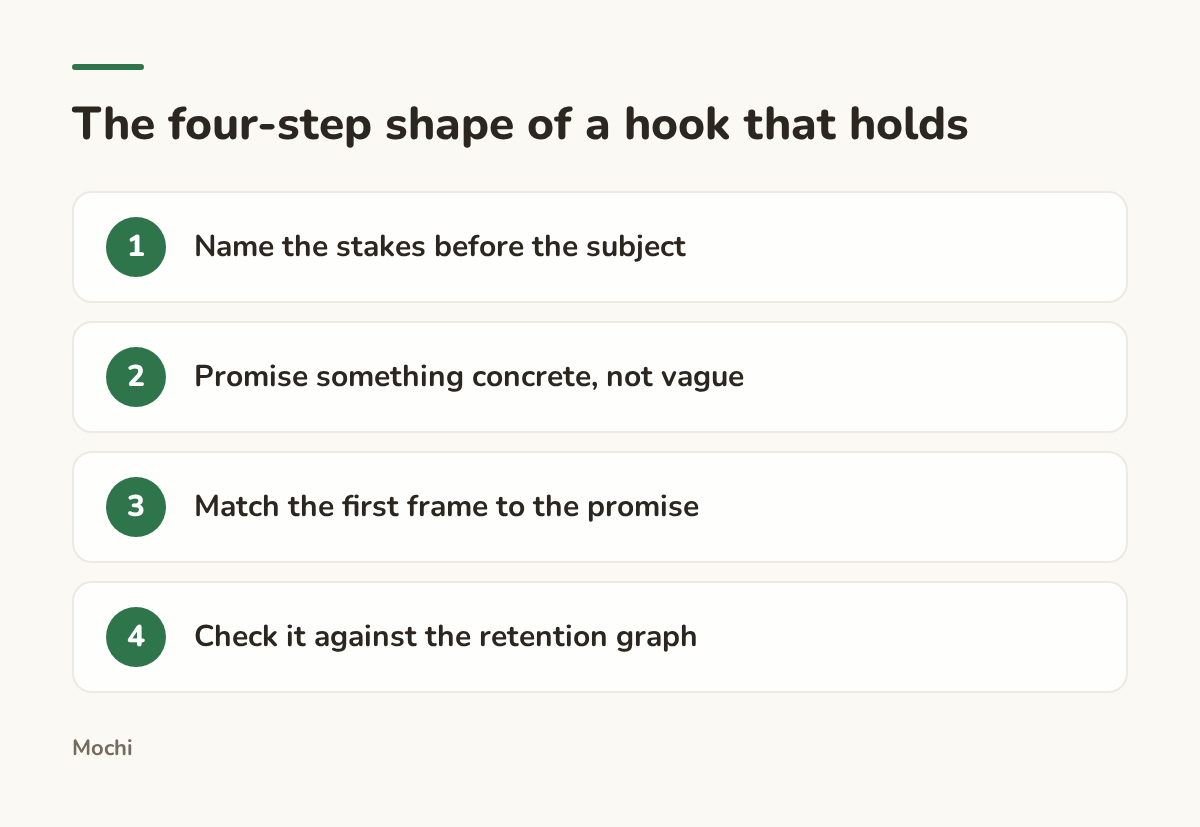
Four checks, run in order, before you hit record.
Step 1: Name the Stakes Before the Subject
Most weak openings lead with the topic: "Today I'm talking about color grading" or "Welcome back, let's get into it." The topic is for you. The stakes are for the viewer, and they come first.
Picture a wedding photographer whose reels usually open with "Here's how I edit my photos." Swap the order and lead with what's actually on the line: "Three edits that make couples cry when they see their gallery, and one that makes them ask for a refund." The second version doesn't describe the video, it tells the viewer what they stand to lose or gain by watching.
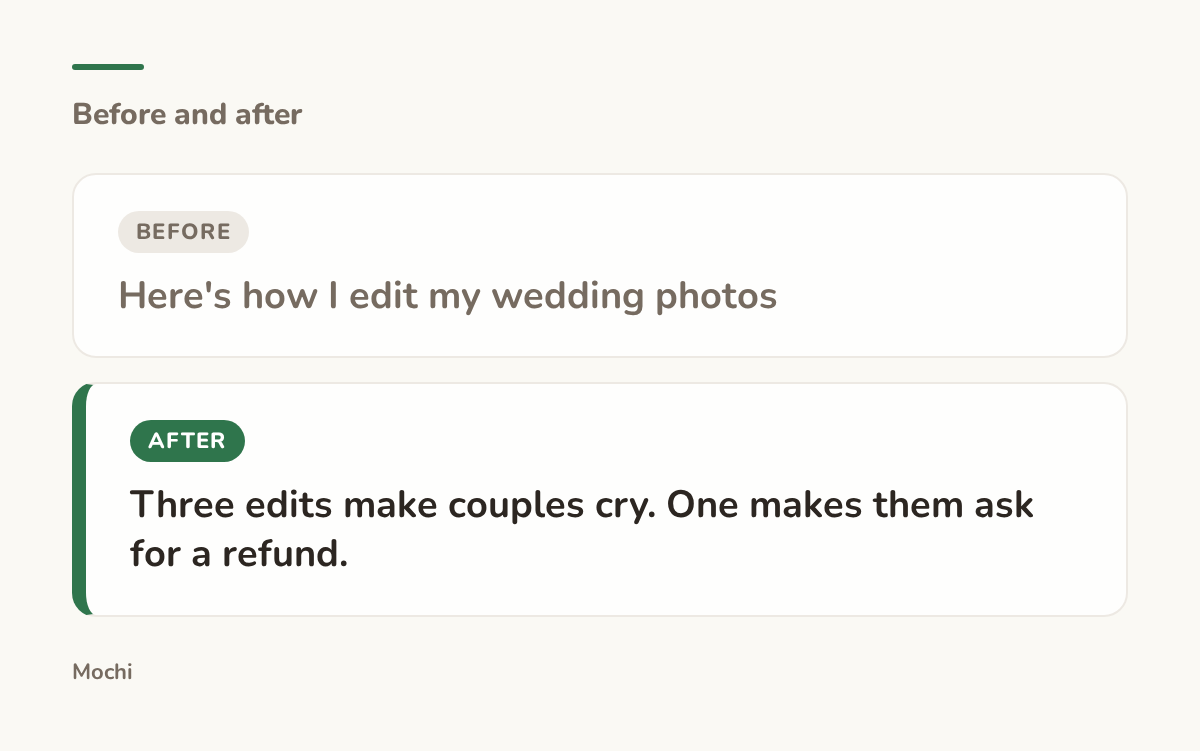
Before: Here's how I edit my wedding photos After: Three edits make couples cry. One makes them ask for a refund.
Same topic, different stakes.
The rewrite works because it replaces a category ("editing") with a consequence (tears, or a refund request). A category is something you can skip past because you already think you know what's in it. A consequence is specific enough to make someone wonder which one applies to them.
The same swap works outside weddings. A fitness coach whose video opens with "Let's talk about squat form" is leading with a category too. "This squat mistake is why your knees hurt, not your shoes" leads with a stake instead, and it's one a viewer can check against their own body before the video even gets to the fix.
Step 2: Promise Something Concrete, Not Vague
This is where a lot of advice about "curiosity gaps" goes wrong. The instinct is to tease as little as possible, on the theory that mystery keeps people watching. In practice, a hook that's too vague reads as empty rather than intriguing, and people scroll past things that feel empty. A 2026 study on knowledge-gap illustrations found that making the gap in someone's knowledge visible, not just implied, is what actually spikes their interest in closing it. Vague doesn't do that. Specific does.
Take a DJ whose usual opener is "You won't believe what happened at this wedding." That's a tease with no content in it, the viewer has no way to guess what kind of thing "won't believe" refers to, so there's nothing to latch onto. A concrete version: "The groom's mom tried to take the mic mid-set, and here's what we did instead." Now there's a scene, a conflict, and a specific question (what did they do?) instead of a generic one (what happened?).
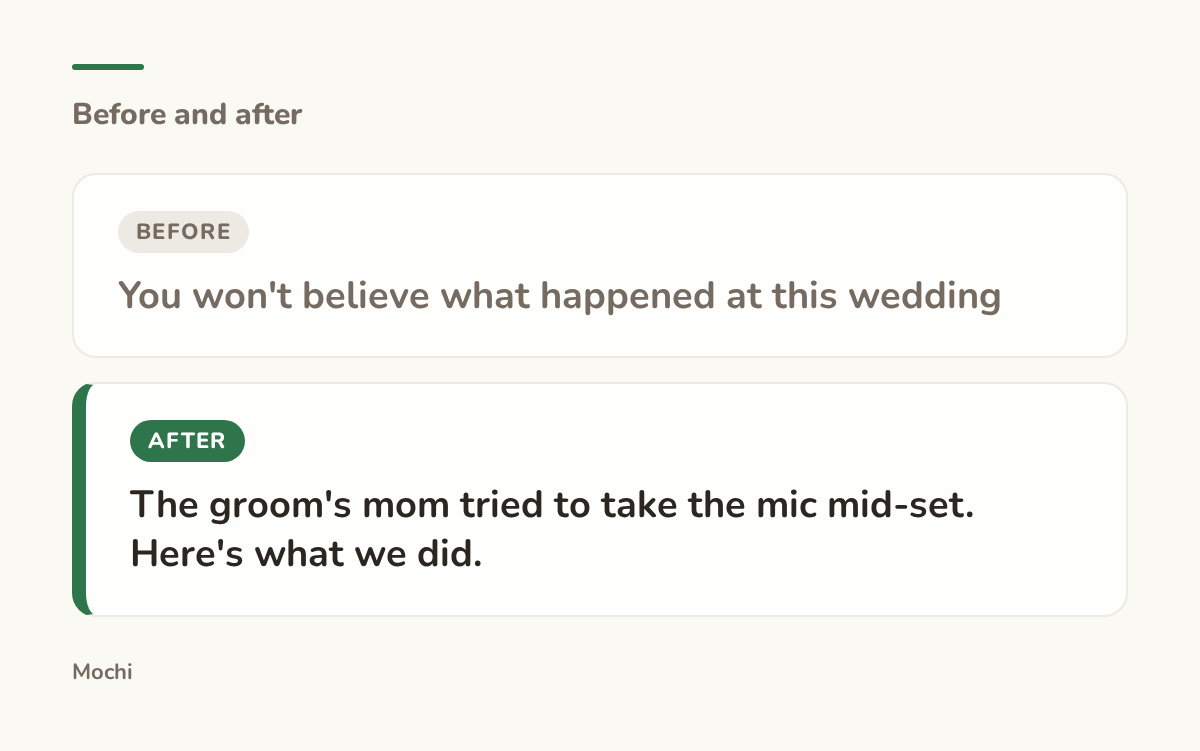
Before: You won't believe what happened at this wedding After: The groom's mom tried to take the mic mid-set. Here's what we did.
A visible gap beats an implied one.
The rewrite works because it gives the viewer a real scene to picture before it asks them to wonder about the ending, instead of asking them to wonder about everything at once.
Separate research on headline concreteness backs the same point from the other direction: when a tease is too vague, people are more likely to decide it isn't worth the click at all, not less. Vague doesn't buy mystery. It buys an easy pass.
Step 3: Match the First Frame to the Promise
A strong line with a mismatched first frame still loses the viewer, just one beat later. If your hook promises a before-and-after and your first frame is you adjusting a tripod, the promise and the footage are fighting each other.
Picture a painter who narrates "This painting almost got thrown out" over a static shot of a finished canvas resting calmly on an easel. The words promise drama, the image shows calm. Match them instead: open on the half-finished piece mid-scrape, paint knife still in frame, same line over it. Now the first frame is evidence for the claim instead of a contradiction of it.
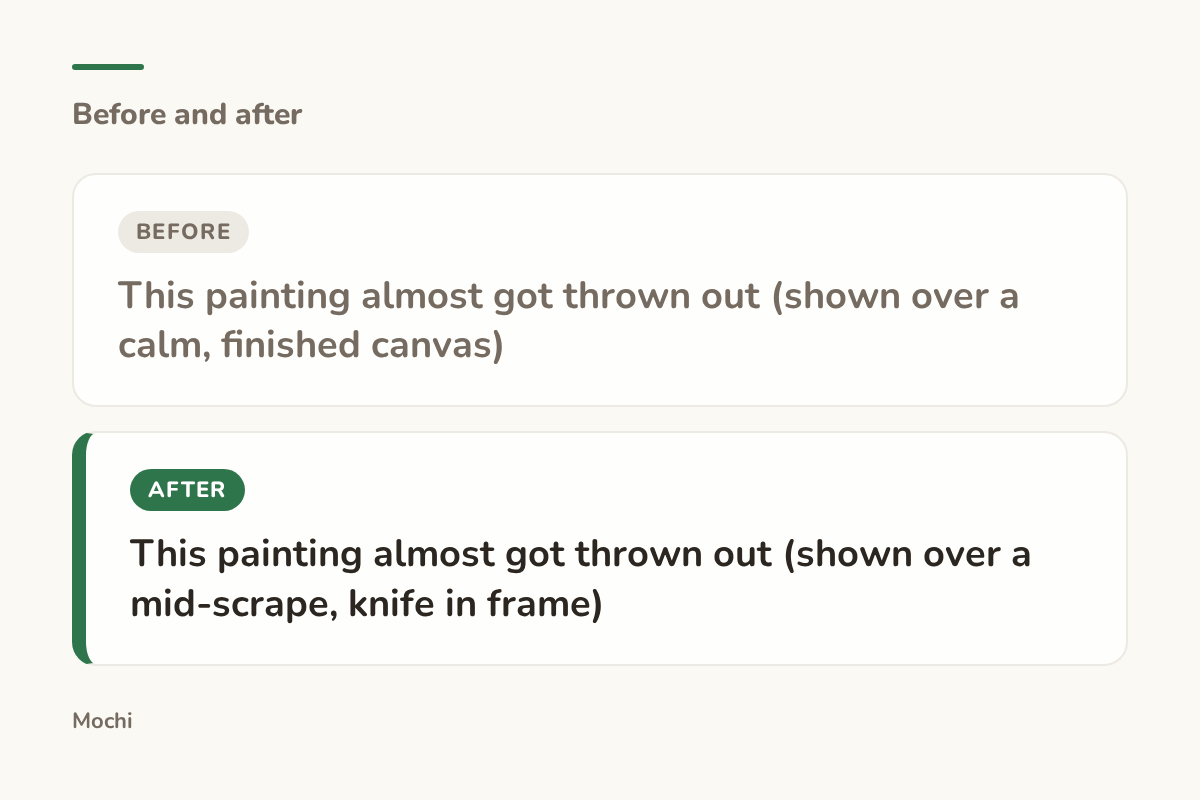
Before: This painting almost got thrown out (shown over a calm, finished canvas) After: This painting almost got thrown out (shown over a mid-scrape, knife in frame)
The image has to back up the line, not just sit under it.
The rewrite works because the first frame now does what the words claim is happening, instead of illustrating a calmer moment from later in the process. A viewer who feels that gap between the line and the image, even without naming it, reads the whole video as slightly off, and that instinct is usually right.
Step 4: Check It Against the Retention Graph
Writing the hook isn't the end of the job. The platform tells you, fairly precisely, whether it worked. YouTube's own guidance on reading key moments walks through how the intro section of the retention curve reflects whether an opening held or lost people, which is a more honest judge than how the line felt while you were writing it. Instagram has moved the same direction: Reels now surfaces retention and skip-rate data directly to creators, so you don't have to guess whether a hook earned the next three seconds or just felt clever in the caption box.
Read the graph plainly. A steep drop in the first few seconds means the hook, not the editing or the topic, is the problem, nothing later in the video can fix a promise that didn't land. A steadier curve after a rough start usually points at pacing further in, not the opening. Separating those two problems matters, because the fix for a bad hook is a different line, and the fix for bad pacing is a different cut.
Picture a videographer who posts the same behind-the-scenes clip twice, a week apart, with two different opening lines over the same footage. One leads with "Here's a look at my process." The other leads with "I almost missed this shot, here's what saved it." The second version tends to hold more of the audience past the first few seconds, because it gives the retention graph something specific to reward instead of a generic frame to scroll past. Testing two openings against the same footage, instead of changing the whole video, is the fastest way to find out which part of a weak hook is actually the problem.
Hook Formulas Worth Retiring
A few formulas show up constantly because they're easy to write, not because they still work.
"Wait for it" promises a payoff without naming what kind, which asks for trust a stranger scrolling past hasn't earned yet. "You won't believe this" has the same problem from a different angle. "Let me tell you about the time..." opens with narration about narration, which delays the actual stake by a full sentence the viewer didn't agree to sit through. "This one trick" borrows the shape of a promise without the content of one, so it reads as an ad even when it isn't. And the old justification for all of these, that people have an eight-second attention span so you'd better grab them however you can, doesn't hold up: there's no solid research behind that number, and treating viewers as incapable of attention is a worse starting point than treating them as busy and selective, which they actually are.
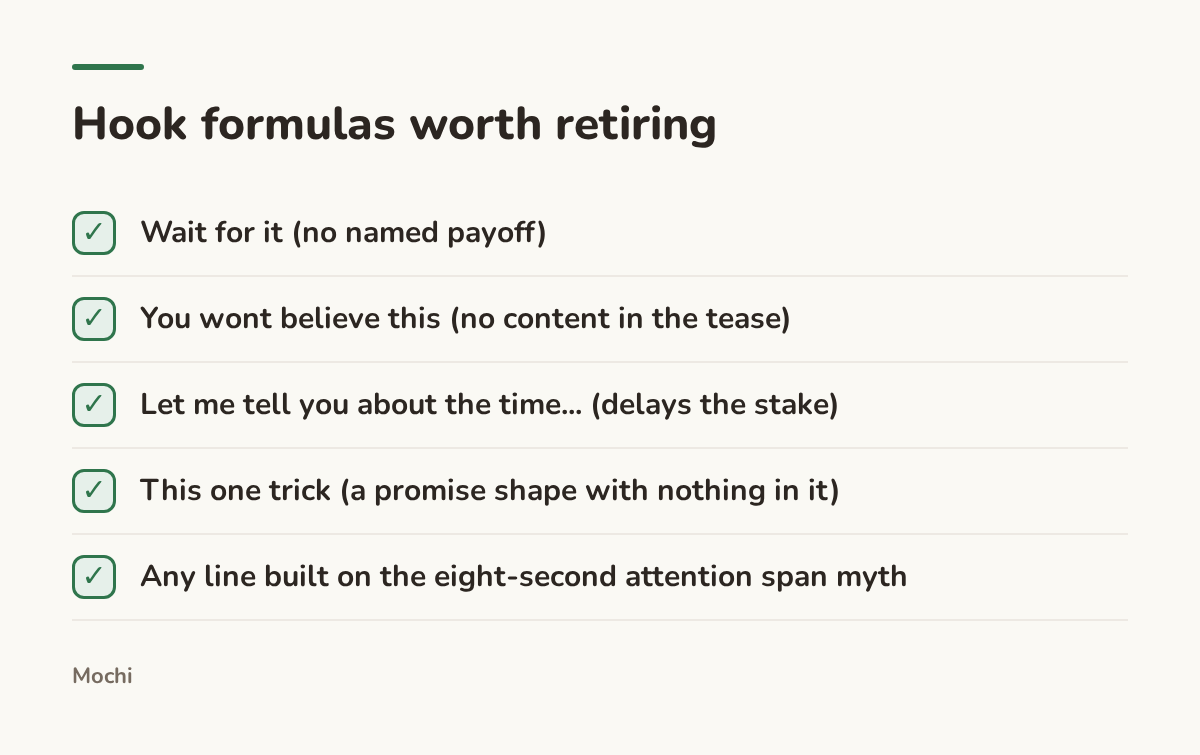
Easy to write isn't the same as still working.
None of these are morally wrong, they're just worn smooth. A viewer who has scrolled past "wait for it" many times this month has learned to associate that phrase with nothing arriving. The formula trained its own resistance, one scroll at a time.
How This Works in Mochi
Writing a hook in isolation from the rest of the post is part of why so many hooks drift vague: the line gets written before anyone's decided what the video is actually for. In our own process, that's one thing a tool like Mochi is built to prevent. Every idea in Mochi's queue carries its own brief on the same page, with the hook sitting next to the key points and the call to action it's supposed to lead into, so the opening line gets written with the ending already decided instead of bolted on afterward.
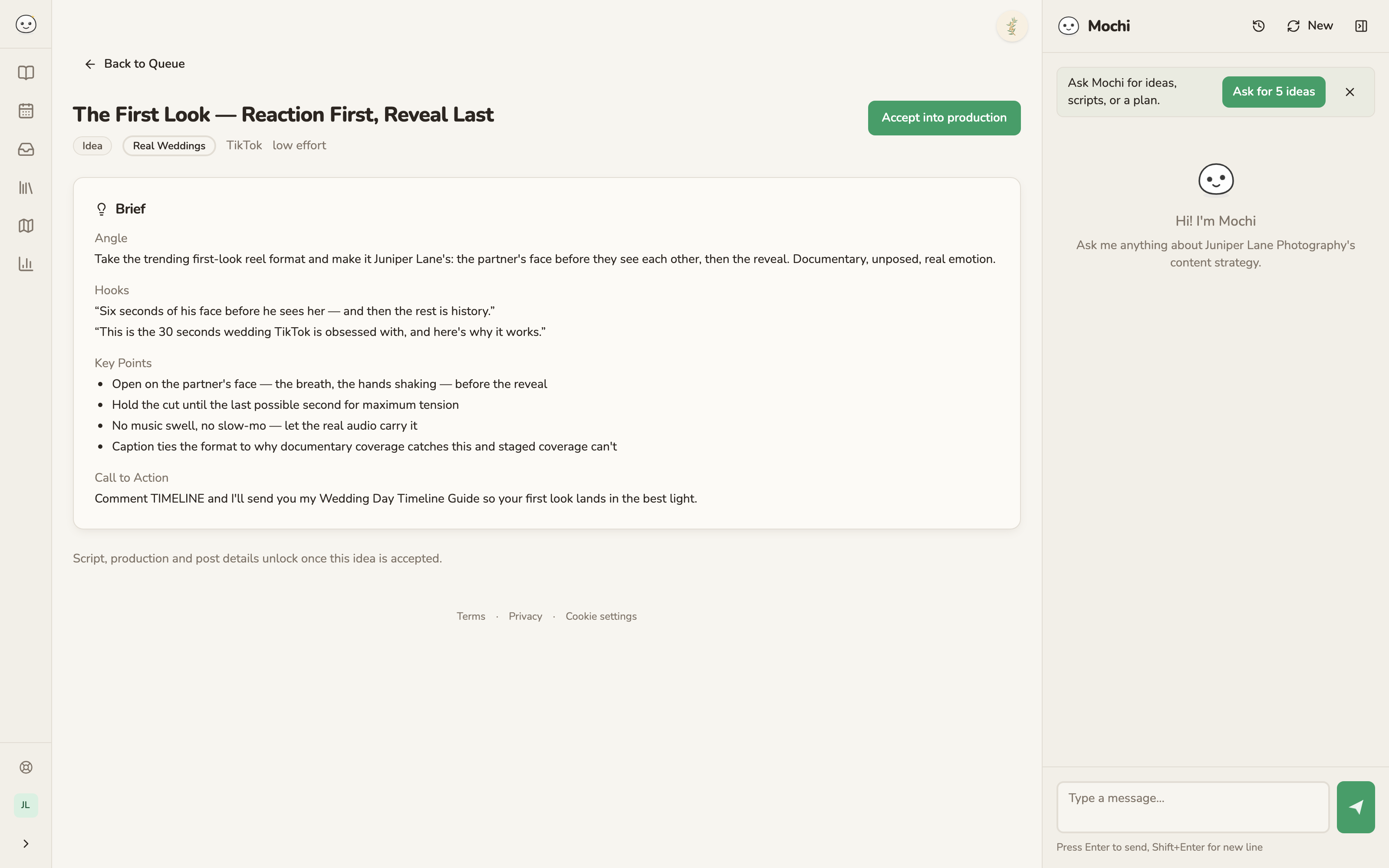
An idea's brief keeps the hook next to the key points and the call to action it's building toward.
Before You Hit Record
A hook isn't a trick you bolt onto a video to compensate for a weak topic. It's the first and clearest promise the video makes, and everything after it either pays that promise off or doesn't. Name the stake before the subject. Make the promise specific enough that a stranger can picture it. Shoot the first frame so it backs up the line instead of contradicting it. Then let the retention graph, not your gut, tell you whether it worked.
What's the last hook you wrote that you'd actually want to be held to?
Part of a series
The Creator's Playbook
Evergreen craft for working creators: brand, content planning, and publishing, written by the team that builds Mochi.