 Mochi Labs
Instagram Broadcast Channel Strategy for 2026: Stop Treating Your Closest List Like a Diary
A practical 2026 guide to Instagram broadcast channel strategy: how to swap mood posts for a value-first, low-frequency rhythm that actually moves your closest fans to act.
Who is actually on your broadcast channel right now? If you had to guess, it's your most invested fifty people, or your most invested five hundred: the ones who turned notifications on for you specifically, not for anyone else on the platform. That's not a feed. That's a room you earned your way into.
So why does it read like a diary?
Open almost any creator's broadcast channel or Close Friends list and you'll find the same drift: a mirror selfie, a "feeling grateful today," a voice memo about traffic on the way to a shoot. None of it is bad on its own. All of it is a missed room. A closest list is the bottom of your funnel, not an overflow valve for whatever's on your mind, and 2026 is the year that distinction stops being optional.
What Counts as Your Closest List Right Now
The term "broadcast channel" covers more ground than most creators realize, and the mechanics matter because they decide how a post should behave.
Instagram's Broadcast Channels and Close Friends
Instagram's broadcast channel structure is one-to-many and admin-only: you post, your list reads, and only you can start a thread. Close Friends works differently. It rides on Stories, it's two-way, and the people on it can reply the way they'd reply to anyone's story. Both are closest-list tools. Only one of them is built to be a broadcast in the strict sense.
Not Just Instagram
If your audience lives partly off Instagram, the same bottom-of-funnel thinking applies to WhatsApp Channels, which work as a private, one-way broadcast kept separate from your regular chats. Telegram has run a version of this even longer: its channels are admin-only broadcasts with no cap worth worrying about for most creators. Different app, same room, same rules for what belongs in it.
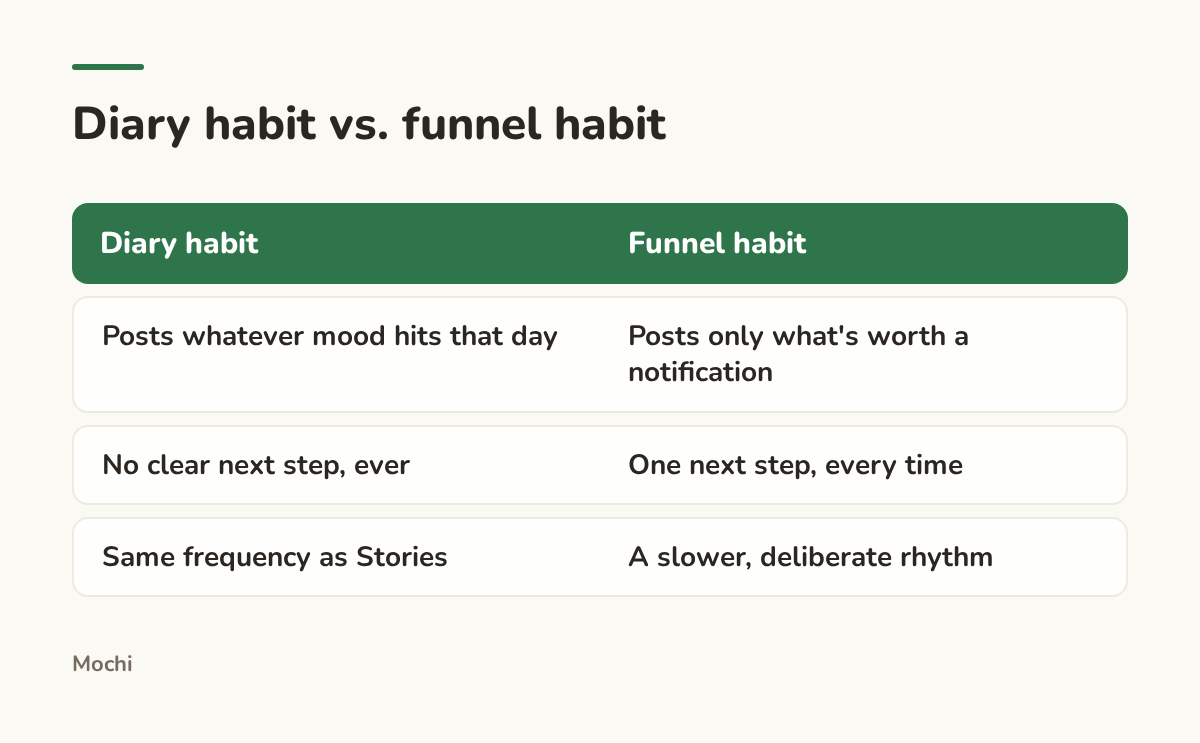
The gap is rarely talent. It's habit.
Why Your Closest List Keeps Turning Into a Diary
Here's the quiet trap: a closest list feels private, so it starts to get treated like a group chat with your friends instead of the most valuable inch of real estate you have with an audience. Take a wedding photographer whose broadcast channel opens with a photo of her coffee and a "happy Monday." Sweet, harmless, and completely forgettable by Tuesday. Nobody unsubscribes over it. Nobody acts on it either.
The fix isn't to post less warmly. It's to ask one question before you send anything: if a stranger had to guess why this person is on my closest list and not my main feed, would this post answer that? If the honest answer is "it wouldn't," the post belongs somewhere else, or nowhere at all. It's a habit we watch for on our own channels as much as anyone else's: the moment a send stops earning its place, the list starts leaking trust instead of building it.
Set a Value-to-Offer Ratio You Can Defend
A closest list only stays worth opening if most of what lands in it is worth keeping. A useful working rule: for every post that asks for something, book a session, buy the print, grab early tickets, send three or four that give something first. A behind-the-scenes decision, a shortcut, an answer to a question you get constantly. That ratio is a judgment call, not a law, but it's the direction that holds up: value first, offer second, never the reverse. The logic tracks with what independent researchers keep finding about content people actually find useful. Nielsen Norman Group's content strategy research consistently shows that readers reward material built around their own needs over material built around the sender's.
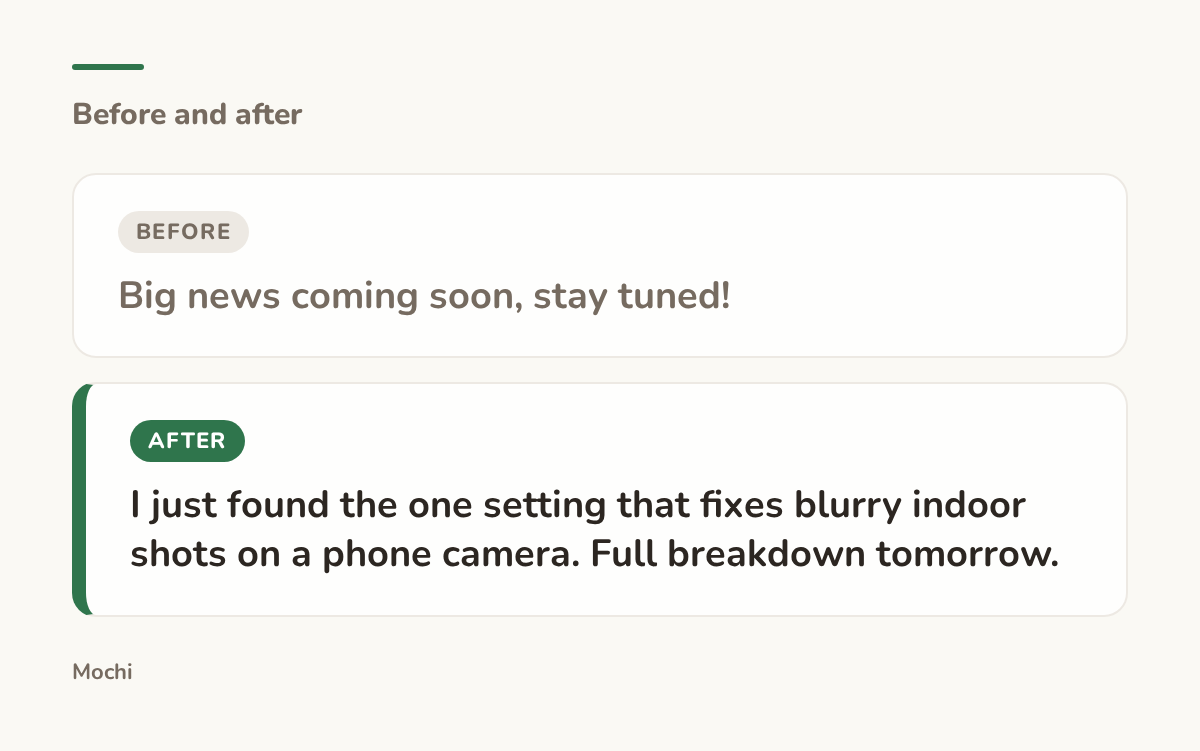
Before: Big news coming soon, stay tuned! After: I just found the one setting that fixes blurry indoor shots on a phone camera. Full breakdown tomorrow.
The first line teases. The second one pays rent.
The tease-with-nothing-in-it post is the single most common failure on a closest list. It spends the trust of a notification on a promise instead of a payoff.
Pick a Broadcast Channel Posting Frequency You Can Actually Hold
Posting frequency on a broadcast channel isn't the same question as posting frequency on your main feed, and treating it that way is where a lot of creators overcorrect. A main feed wants consistency at volume. A closest list wants to stay rare enough that a notification from it still means something. Somewhere around two to four sends a week tends to be the range creators can hold without either going quiet or turning the channel back into noise. Start lower and add a send only when you have something worth the ping, not on a fixed calendar square.
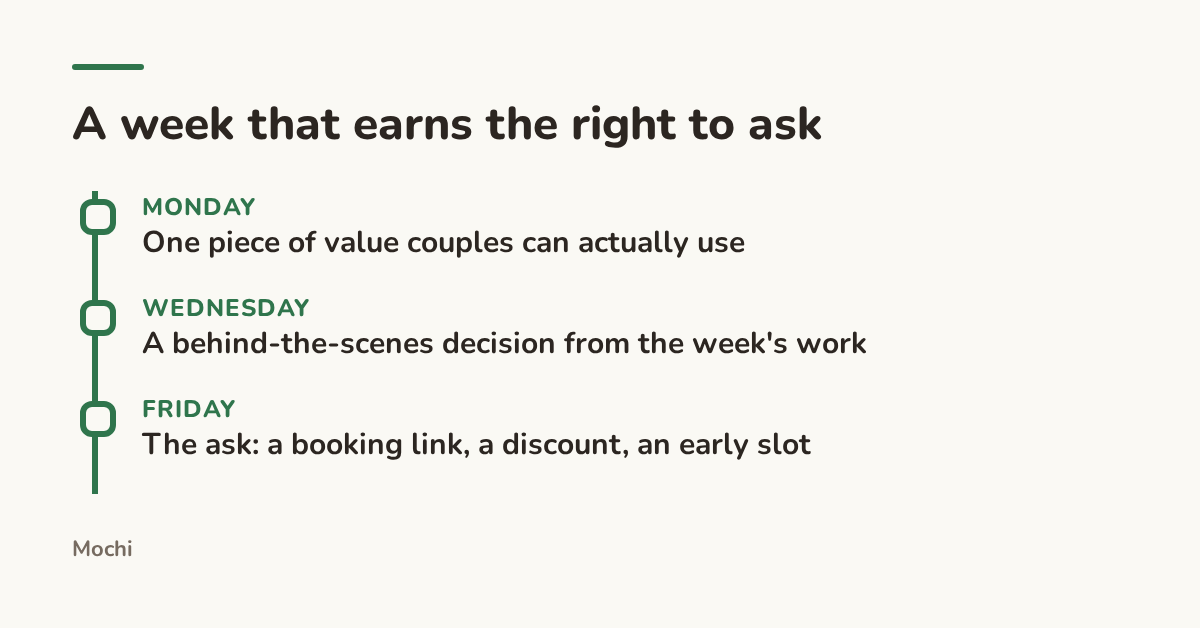
Three sends. One of them has a request in it.
A DJ building a closest list for bookings could run the exact same week: a value send about reading a room's energy on Monday, a behind-the-scenes clip of building a set on Wednesday, and an open-dates post with a direct booking link on Friday. The rhythm matters more than the subject.
Give Every Post a Next Step
Every post on a closest list should end somewhere. That's the actual definition of a call to action): a clear, specific instruction for what the reader does after they finish reading. "Reply with your city," "tap the link for the guide," "first five people to reply get the early price." A post with no next step isn't a broadcast, it's a status update, and the two read completely differently to someone who gave you their notifications on purpose.
We build this discipline into Mochi itself. Every idea in the queue carries its own brief: hooks, key points, and a call to action already attached, so the next step is written before you ever sit down to post it.
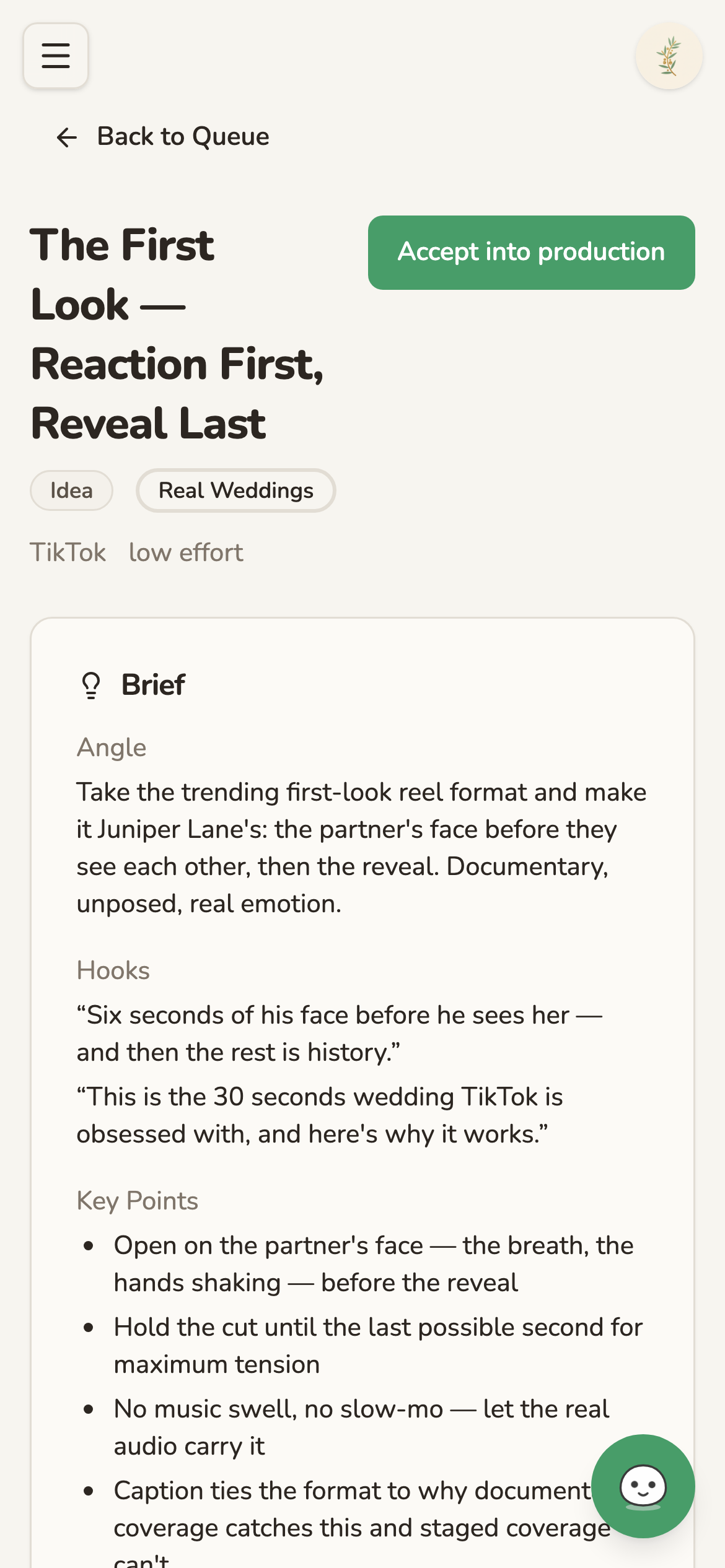
An idea's brief carries its call to action from the start, not as an afterthought at the end.
That's the same discipline worth borrowing for a broadcast channel even if you're writing it by hand: decide the next step before you write the first line, not after.
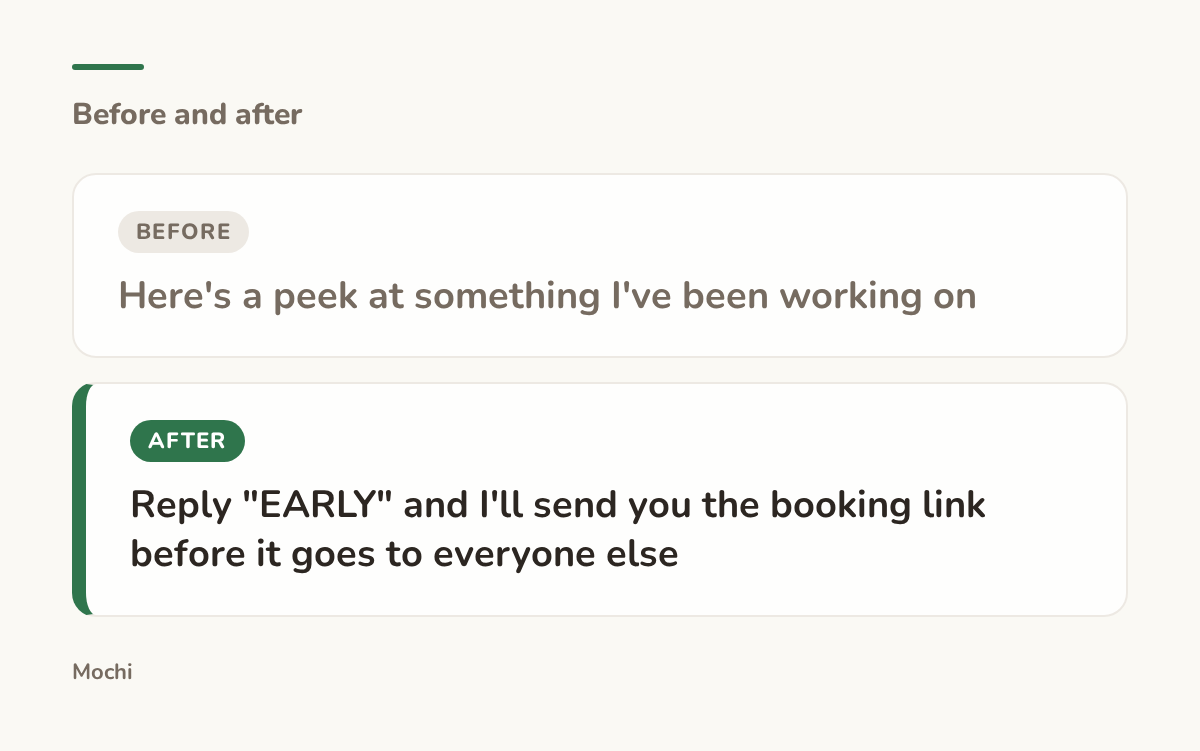
Before: Here's a peek at something I've been working on After: Reply "EARLY" and I'll send you the booking link before it goes to everyone else
The second version gives the reader a literal, physical thing to do.
What This Looks Like Across Platforms
The mechanics shift by app, but the bottom-of-funnel logic doesn't. A musician running a Telegram channel for release drops can treat it exactly like an Instagram broadcast channel: value sends about the process, then one clear pre-save link when the single is ready. A fitness coach running WhatsApp Channels for class bookings can run the same two-to-four-a-week rhythm, because the platform changed but the room didn't.
What actually separates a loyal closest list from a big, loose audience is closer to Kevin Kelly's old 1,000 True Fans idea than to growth math: a small number of people who show up for everything is worth more than a large number who show up for nothing in particular. A broadcast channel is where you find out whether you've built that smaller, truer group, or just a bigger version of your main feed.
Common Mistakes That Turn the Funnel Back Into a Diary
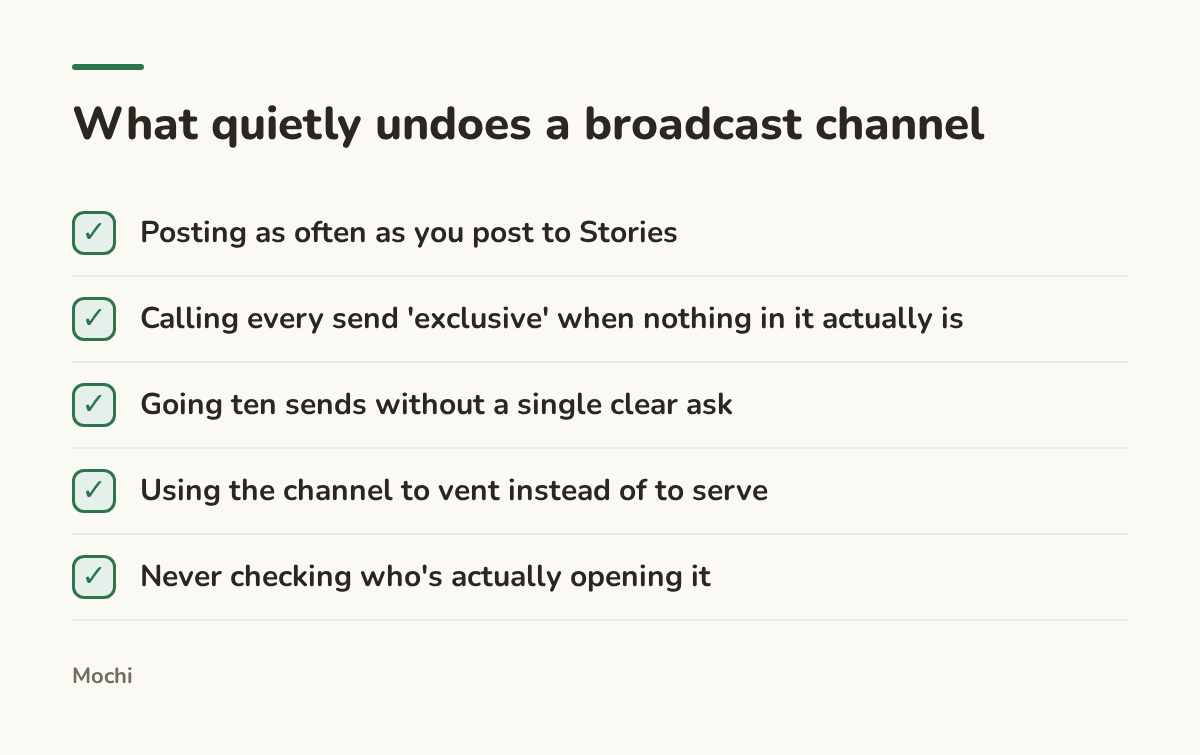
Any one of these and the list starts to feel optional.
That last mistake is the easiest to miss. A closest list that nobody opens anymore isn't failing loudly, it's failing quietly, one skipped notification at a time, until it's just a number next to your name that used to mean something.
The Short Version
A broadcast channel earns its place by being rare and useful, not by being constant. Keep most of what you send worth keeping, give the rest an honest ask, hold a rhythm you can actually sustain, and never send something without a next step attached. Do that consistently and the room stops being a diary nobody reads and starts being the place where your closest fans actually act.
What would the last ten posts in your closest list tell a stranger about what you're actually offering them?
Part of a series
The Creator's Playbook
Evergreen craft for working creators: brand, content planning, and publishing, written by the team that builds Mochi.