 Mochi Labs
Instagram for Cafes: A Complete Guide
A complete guide to Instagram and TikTok for cafes: what to photograph, how to caption it, and how to keep a posting rhythm you can actually sustain.
· We keep this page up to date, so bookmark it and come back.

Someone walks past your cafe every day for a week before they walk in. What decides the day they finally do is rarely the sign out front. It's whatever they saw on their phone the night before: a shot of steam curling off a flat white, a regular laughing at the counter, a reel of someone pulling a shot at 6 a.m. before the first customer arrives. A cafe's Instagram and TikTok aren't decoration on top of the business. For a lot of cafes, they're the window display that actually gets seen.
This guide covers both platforms end to end: what to photograph, what to write, how often to post, and how to keep doing it once the opening rush of enthusiasm wears off. Instagram gets its own section, TikTok gets its own, and the last part is about the part nobody asks about until they've burned out on it: the rhythm.
Instagram for cafes
Instagram is still where most cafes build the feed a stranger checks before deciding to walk in. That means the bar for a single photo is higher than it looks: it has to work as a still image, on a small screen, competing with everything else in someone's scroll.
Build a feed people want to sit in
The research on this is more specific than "pretty photos help." A study on coffee shop interiors found that how photogenic a cafe's physical space is, and how much that space invites people to actually take photos in it, feeds directly into whether someone decides to visit (the link between cafe interiors, photo-taking, and visit intention). In plain terms: the feed and the room are the same project. If a corner of your cafe doesn't photograph well, that's not just a design note, it's a content gap.
That said, be careful what you're optimizing for. A piece of independent reporting out of Bengaluru looked at how closely cafes were chasing "Instagrammable" interiors and found a city's cafes starting to look like the same five reference photos (Bengaluru's cafes are beginning to look alike). The lesson isn't to avoid good light and good tiles. It's that the thing worth photographing is still the thing that's actually yours: your specific mugs, your regulars, the view out your specific window. Third-wave coffee culture already pushes toward careful presentation and visible craft (more on that movement); your job is to point a camera at the version of that only your cafe has.
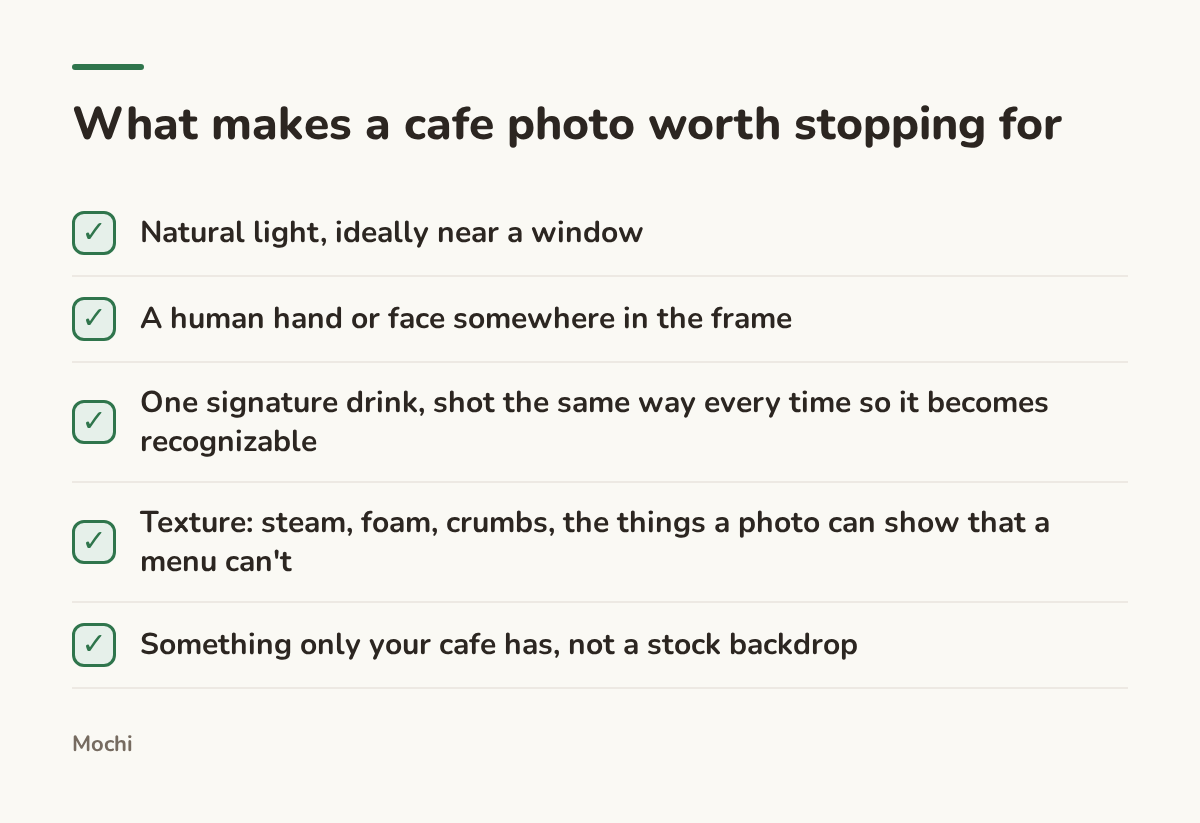
Five things worth checking before you post the photo.
Write captions that sound like your counter, not your marketing
Most cafe captions fail for the same reason: they read like they were written by someone who has never actually worked a shift. "Come try our delicious new seasonal latte!" could be any cafe anywhere. The fix is to write the caption the way you'd actually say the sentence out loud to a regular.
The second version tells a small true story instead of making an announcement, and it gives someone a reason to ask a follow-up question in the comments.
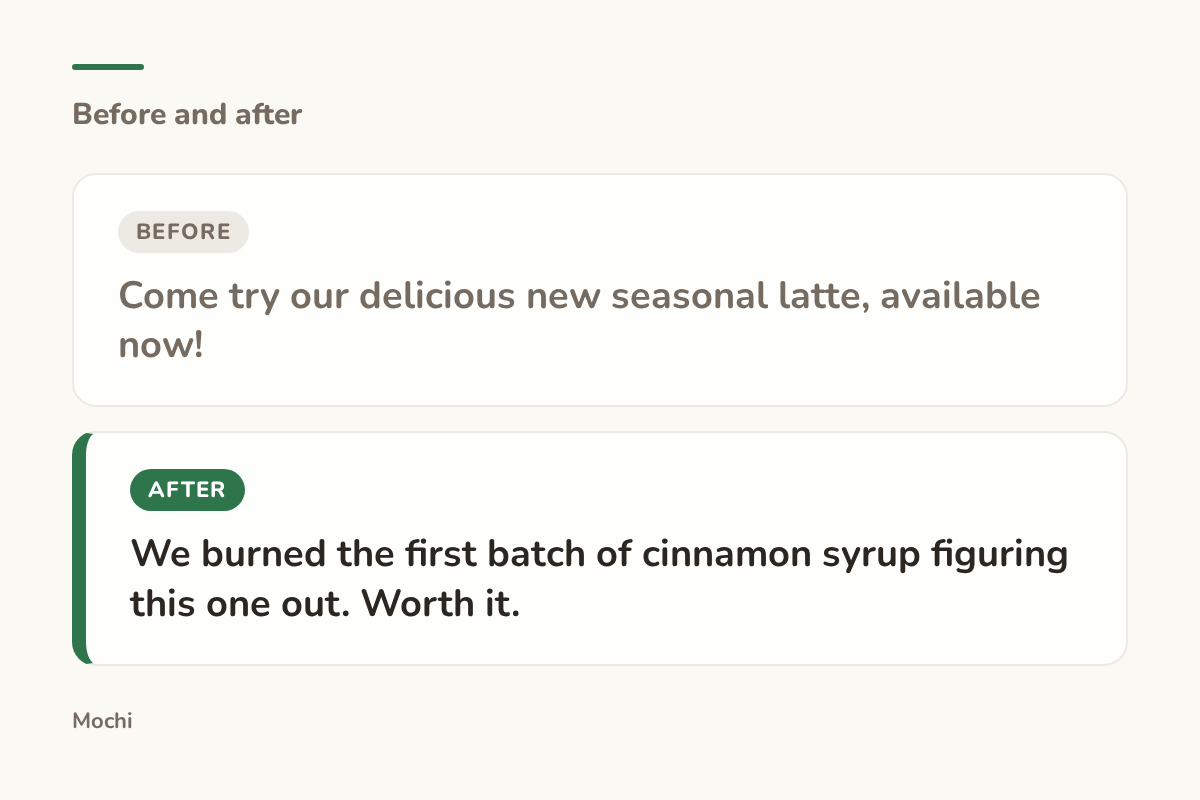
Before: Come try our delicious new seasonal latte, available now! After: We burned the first batch of cinnamon syrup figuring this one out. Worth it.
Here's a second pair, this time for a plain daily post rather than a launch.
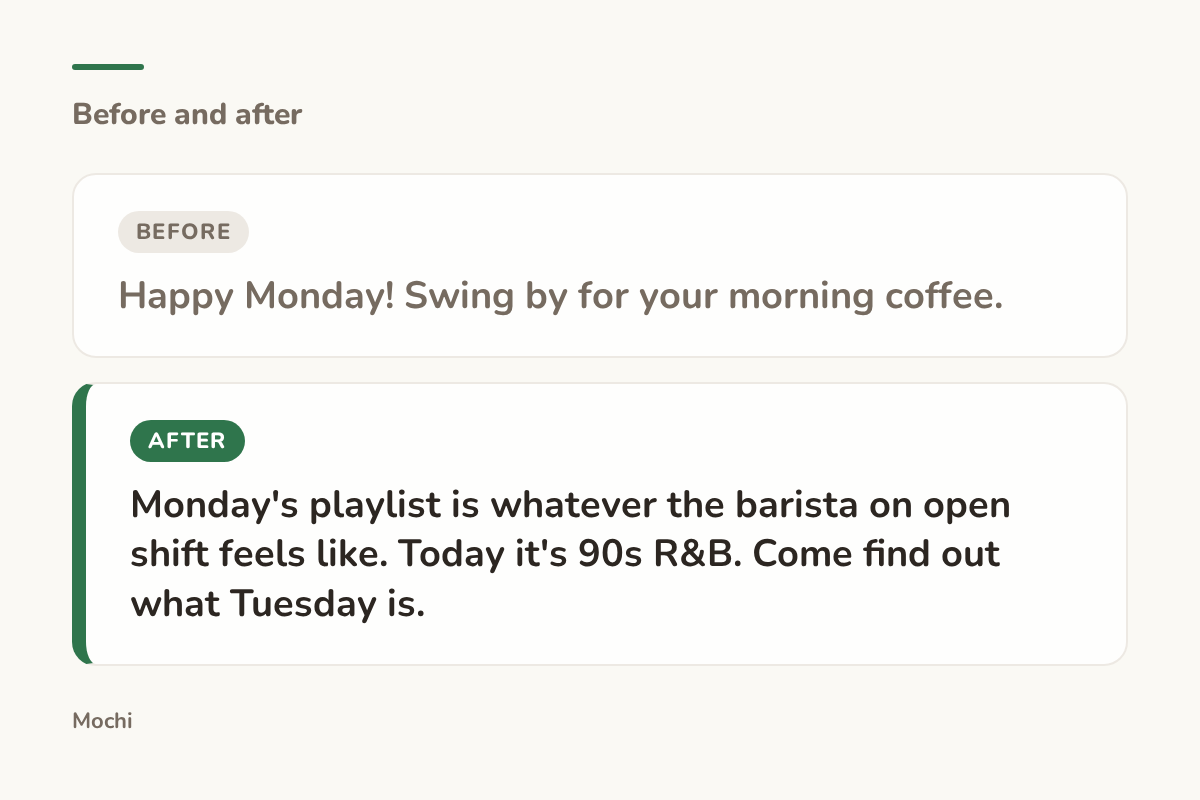
Before: Happy Monday! Swing by for your morning coffee. After: Monday's playlist is whatever the barista on open shift feels like. Today it's 90s R&B. Come find out what Tuesday is.
Both rewrites do the same thing: they trade a generic invitation for one specific, slightly odd detail. A stranger scrolling past has no reason to remember "swing by for coffee." They might remember the burned cinnamon syrup.
Use location tags and hashtags on purpose
A location tag puts your cafe in front of someone who might genuinely be standing nearby when they open the app, which is a different job than a hashtag does. Use it on every post, not just the ones that feel important enough.
Hashtags still matter, just not as volume. Instagram's own documentation on how hashtags and hashtag pages work is worth reading once if you've never looked at it closely (Instagram's hashtag help page); the short version is that a handful of specific tags (your neighborhood, your city, "specialty coffee," the actual drink name) tend to do more than a wall of generic ones like #coffee or #cafe, which are too broad to put you in front of anyone nearby.
Get your regulars in the frame
Picture a regular who orders the exact same oat milk cortado every Tuesday at 8:15. Feature her by name in a caption once, just a line like "Maria's usual, every Tuesday like clockwork," and there's a good chance she screenshots it, maybe even reposts it to her own story. That's not guaranteed, but it costs you nothing to try, and it turns someone who already loves your cafe into the person introducing it to people you'd never reach on your own.
The same logic applies to staff. A short clip of the person who makes your latte art, talking about why they draw the same pattern every time, tends to land better than a staged team photo, because it's a real person instead of a job title.
TikTok for cafes
TikTok rewards something Instagram mostly doesn't: footage that looks like it was shot five minutes ago by someone who works there, not footage that looks produced. That's a genuinely different muscle than the one you use for a curated grid.
Raw process beats polished product, and here's why that makes sense
TikTok's own guidance for food and beverage businesses points somewhere compatible: an 80/20 mix where most of what you post gives people value, entertainment, or a look behind the counter, and only a small share is directly promotional (TikTok's food advertising guide).
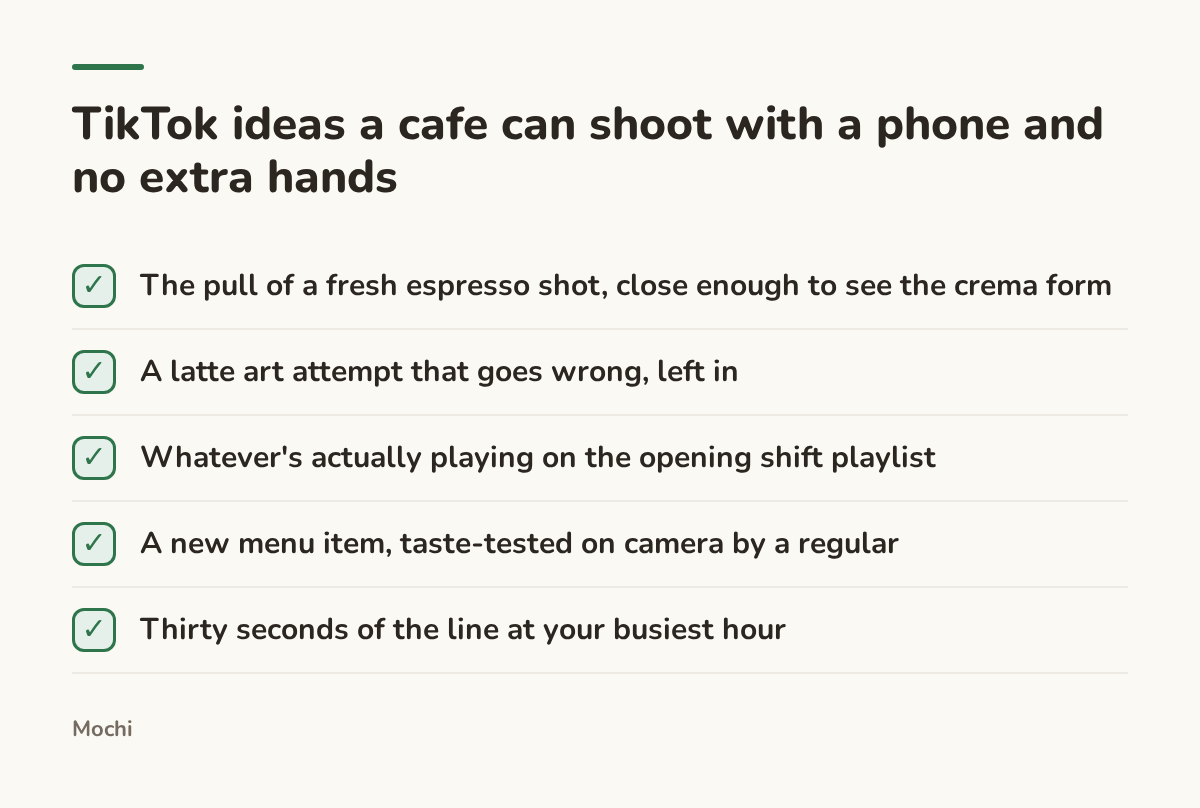
None of these need a script.
Duets and trends, used like a tool, not a costume
Picture a cafe that duets a customer's video complaining, half-joking, about how long their oat milk order takes. Instead of getting defensive, the cafe responds on camera, timing the order and showing exactly why it takes that long (because the milk is steamed fresh for every single cup). A duet like that tends to travel further than the original clip ever could on its own, because it's a direct, in-the-moment reply rather than a separate post asking for attention. The lesson travels past this one example: a trending sound or format is only worth joining if there's something true about your cafe to hang on it. If there isn't, skip the trend.
What to post on a day you only have ten minutes
Not every day has a story in it, and that's fine. On a slow day, the honest move is a single, short, unscripted clip: the espresso pull, the playlist, the regular at the corner table reading the same book for the third week running. The ten-minute version, posted, beats the perfect version still sitting in your drafts.
Building a rhythm you can keep
Most of what goes wrong with a cafe's Instagram and TikTok has nothing to do with creativity. It's logistics. Posting falls off during the week a shipment gets delayed or a staff member quits, and once it stops for ten days, starting again feels harder than it should.
The fix that actually holds is picking a rhythm that matches your week instead of a number that looked good in someone else's advice post. A cafe that gets its syrup delivery on Mondays might shoot process content that day, post a regular's story midweek, and save the polished seasonal-launch post for the weekend rush. The schedule follows the actual week instead of sitting on top of it.
Part of keeping that rhythm is simply knowing what's coming before it arrives: a competitor's new seasonal drink, a local coffee trend starting to show up on your customers' own feeds, the first cold morning that makes everyone suddenly want a hot chocolate again. Watching for that manually, every week, on top of actually running a cafe, is its own job. This is the kind of thing a tool like Mochi is built for: a research routine that runs on a schedule and hands you a short read of what's moving in your category, instead of you doom-scrolling competitor accounts between orders.
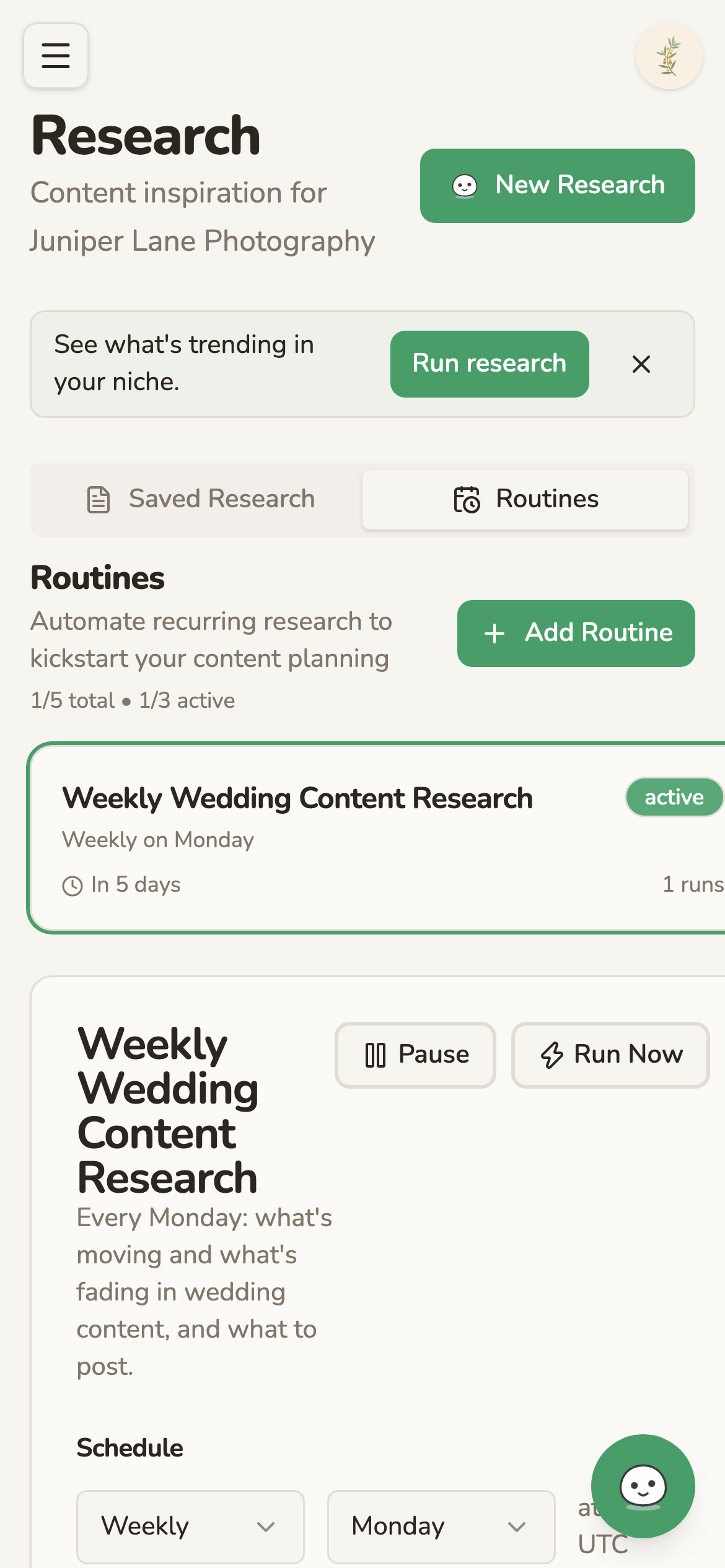
A research routine runs weekly on its own schedule and shows when it's running next.
Whatever you use to hold the plan, the plan has to survive a bad week, because every cafe has them.
A cafe's Instagram and TikTok don't need to be a second job. They need a feed that actually looks like your room, captions that sound like the person behind the counter, and a handful of unscripted TikTok clips that feel like something real happening at 7 a.m. Get those three things right and the posting schedule mostly takes care of itself. What's one thing about your cafe, right now today, that's never once made it into a post?
More for Cafes
The deeper guides for cafes are on their way.
What changed this week for cafes: this week in your niche.
Part of a series
The Creator's Playbook
Evergreen craft for working creators: brand, content planning, and publishing, written by the team that builds Mochi.