 Mochi Labs
Instagram Hashtags: A Practical Guide for Working Creators
Instagram hashtags still matter, just not the way most advice says. Here's how to build a set that actually fits your work, step by step.
A hashtag used to feel like a lottery ticket. Tag a post #photography, #music, #smallbusiness, and hope the algorithm pulls a stranger into your feed.
That's not really how it works anymore, and treating hashtags like a numbers game is how a lot of good posts end up buried under tags that do nothing for them. Hashtags on Instagram today work more like a filing system than a megaphone: they tell the app, and a tiny number of people actively browsing those tags, what category your post belongs to.
If you're still deciding what to post before you worry about tagging it, our guide to Instagram post ideas is the place to start. This piece picks up after that: which hashtags earn their spot in a caption, how to build a set that holds up across weeks instead of one lucky post, and where the old "throw on thirty tags and see what sticks" advice stopped being true.
What hashtags actually do on Instagram right now
Instagram's own help pages are blunt about the mechanics: a hashtag turns your post into something that can show up on that tag's dedicated page, and people who follow a hashtag can see it in their feed the way they'd see a followed account. That's the whole trick. It's not a reach multiplier, it's a sorting label, and it only works if someone is actually looking at that label.
Which means the question isn't "how many hashtags should I use." It's "who is actually browsing this tag, and would they want what I just posted." Instagram's help center walks through the mechanics of adding and using tags, and the page on hashtag pages explains when a post becomes eligible to show up there at all. Worth reading once, because most hashtag advice skips straight past this and goes to tactics.
The research backs up the skepticism. A study out of Sungkyunkwan University looked directly at whether using more hashtags, or more specific ones, actually tracks with a higher reach rate, rather than just assuming it does. Separate work from the University of Surrey examined how hashtag use affected the reach of sustainability-focused content specifically, which is a useful reminder that what works for one niche's tags won't automatically transfer to yours. Neither paper hands you a magic count. Both are good evidence that the volume-first approach to hashtags was always a guess dressed up as a strategy.
Step 1: Build your set around what you make, not where you post it
Most creators build a hashtag list once, save it as a note on their phone, and paste the same twenty tags under every post for a year. That's the habit worth breaking first.
A set that actually works has layers, and each layer does a different job:
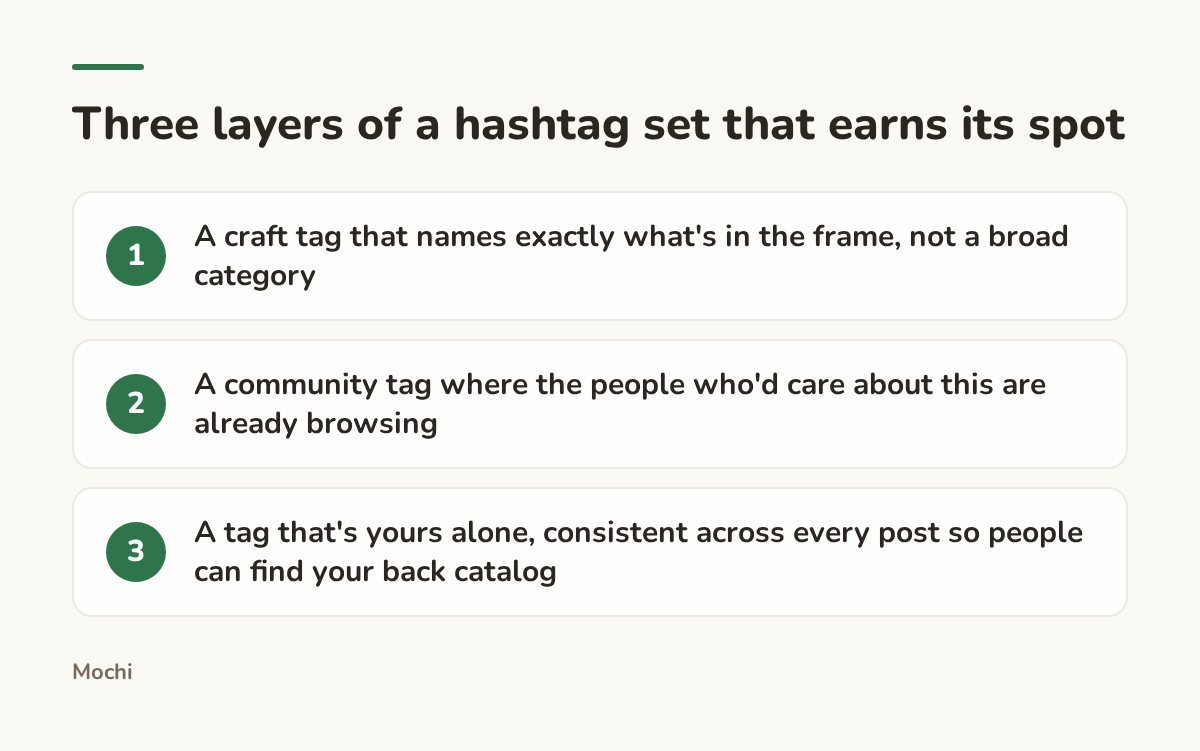
Each layer brings a different kind of viewer.
Take a wedding photographer shooting a first look. A broad tag like #wedding is competing with content from every country and budget on earth, so it's close to decoration. A craft tag like #firstlookphotos names the actual moment in the frame. A community tag like #engagedcouples puts the post in front of people in the exact planning window who'd want it. A branded tag, something like #[studioname]weddings, costs nothing and makes every past post searchable in one place.
Or picture a DJ posting a clip from a wedding reception. #dj is noise. #weddingreceptiondj names the actual gig. #weddingvendors puts it in front of other vendors who refer work. A tag with the DJ's own name turns every post into a searchable portfolio entry.
The pattern holds for a bakery, a boutique, a videographer, anyone whose audience is a specific group of people rather than the entire internet. Name the craft precisely, find where that specific audience already hangs out, and keep one tag that's unmistakably yours.
Four before-and-after hashtag sets
Reading the logic is one thing. Having an actual set to copy and adjust is another, so here are four, built the same way the examples above were.
A cafe Before: #coffee #cafe #foodie #breakfast #brunch After: #specialtycoffeeshop #thirdwavecoffee #cafehopping #latteart Why it works: the before set competes with every coffee photo on the internet. The after set reaches people actually hunting for a new cafe to try, not just scrolling food pics.
A fitness coach Before: #fitness #gym #fitfam #workout #health After: #beginnerstrengthtraining #postpartumfitness #homegymworkout #strengthcoaching Why it works: the generic set gets buried under supplement ads and gym selfies. The after set names the exact training style and client, so the people who'd actually book a session can find it.
A musician Before: #music #singer #newmusic #musician #song After: #indiefolkmusic #bedroompop #singersongwriter #livemusician Why it works: the before tags are shared with every genre and every artist on the platform. The after tags name the actual sound, so people already browsing that sound land on the post.
A boutique Before: #fashion #boutique #shopsmall #style #ootd After: #sustainablewomensclothing #capsulewardrobe #slowfashionbrand #boutiqueshopping Why it works: the before set is decoration next to every fast-fashion account using the same tags. The after set names the actual style and values, putting the post in front of shoppers looking for exactly that.
Step 2: Match the hashtags to the post, not a template you reuse everywhere
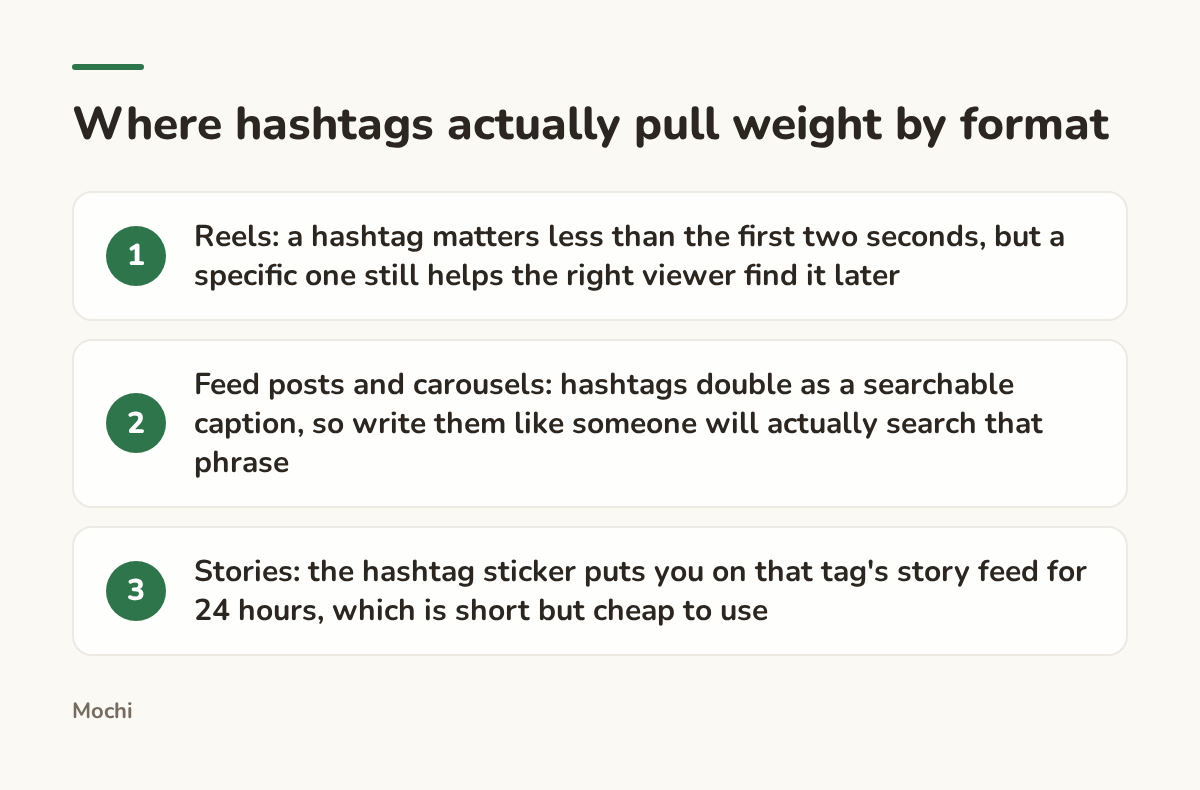
The same hashtag set pasted under a Reel, a carousel, and a Story is doing three different jobs badly instead of one job well. Each format surfaces hashtags differently, so the tags earn their keep differently too.
Reels
A Reel lives or dies on its hook and its watch time first. Hashtags are a distant second lever here, so don't spend five minutes agonizing over them. Pick the two or three that actually describe the clip and move on.
Feed posts and carousels
This is where a precise tag earns the most. Someone who follows #weddinghairideas or #homebaristasetup is actively looking for exactly that, and a carousel that matches the search intent has a real shot at showing up for them. Write the tag like a phrase a person would type, not a hashtag-ified slogan.
Stories
The hashtag sticker on a Story is a cheap, low-effort way to appear on a tag's story feed for the day. It won't move the needle the way a well-placed feed tag can, but it costs ten seconds and the downside is nothing.
Step 3: Check the hashtag page before you trust a tag
A tag can look perfect on paper and still be wrong in practice, and the only way to know is to look at what's actually posted there.
Imagine a videographer about to tag a corporate highlight reel #eventvideo. A quick look at that hashtag's page shows it's dominated by drone wedding footage from a completely different price point and audience. Wrong room. Swapping to #corporateeventvideography puts the post next to the clients actually looking for that kind of work. The lesson travels: open the tag before you commit to it, the same way you'd scope out a room before walking in and starting to talk.
Following a hashtag you're considering for a week before you use it is a cheap way to do this scouting in advance, rather than guessing in the moment you're writing a caption.
Hashtag habits worth dropping
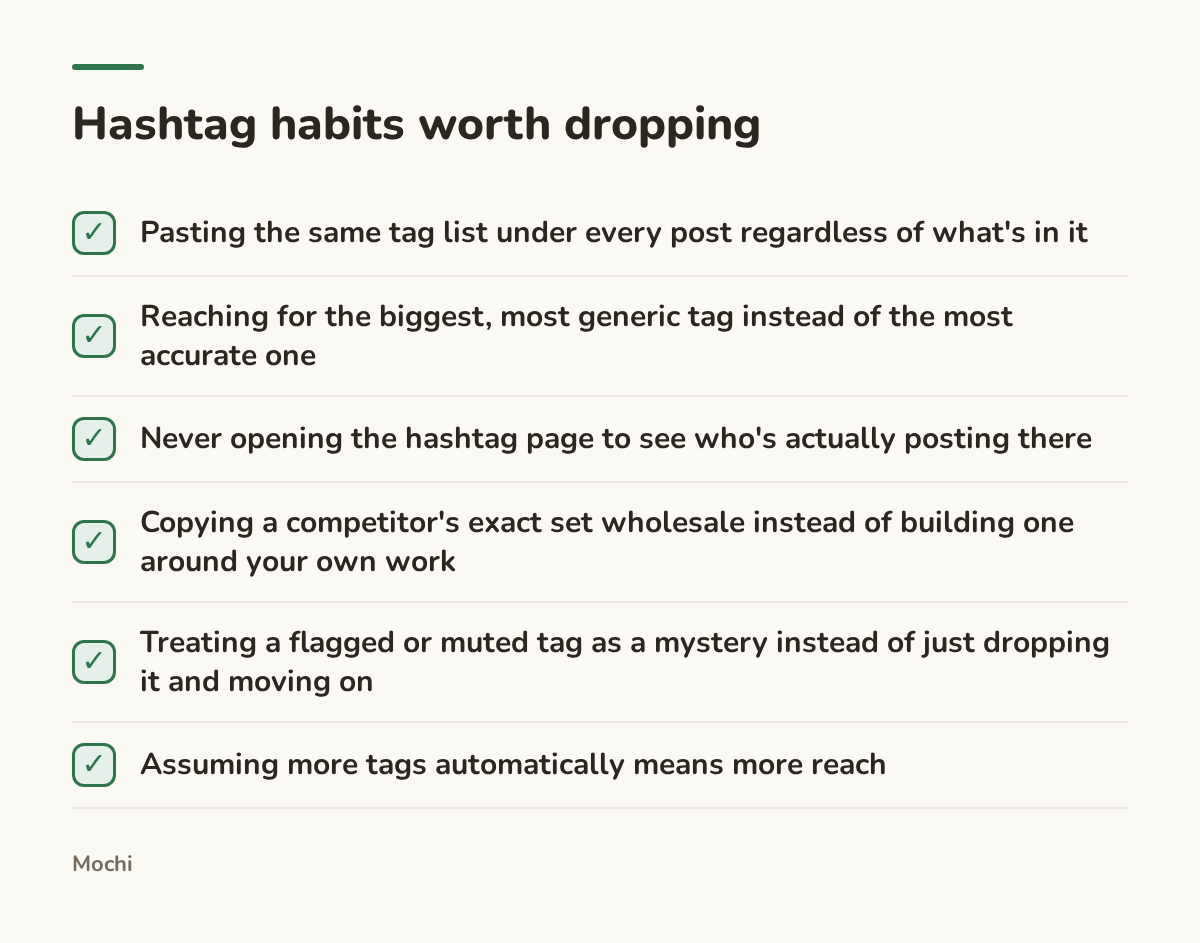
None of these habits are dramatic mistakes. They're just small bets that stopped paying off a while ago and never got reconsidered.
Step 4: Retire tags the way you'd retire a tired hook
A hashtag that worked a year ago can quietly stop pulling anyone in, the same way an opening line that used to land goes flat once everyone's heard a version of it. Treat your hashtag set like it needs occasional maintenance, not a fixed list you set once and never touch.
Picture a hair salon that's been using #balayage under every color post for two years. It's still accurate, but it's also one of the most saturated beauty tags on the platform, buried the moment it's posted. Swapping in a more specific tag tied to the actual technique or local area, alongside the broad one rather than instead of it, gives a new post somewhere to be found instead of just somewhere to disappear.
The habit worth building: every so often, open the hashtag page for your most-used tags and look at what's currently ranking there. If it's nothing like your work anymore, that tag has drifted away from you, not the other way around.
How we track hashtag and topic trends in Mochi
This kind of scouting, checking what's actually ranking on a tag, what's heating up in a niche, what's gone stale, is exactly the kind of noise we built Mochi's research routines to sort through. A scheduled research run produces a document that calls out which trends in a niche are accelerating and which are cooling, with the sources attached and suggested posts to go with it, so you're working from a current read instead of a hashtag list you wrote six months ago and never revisited.
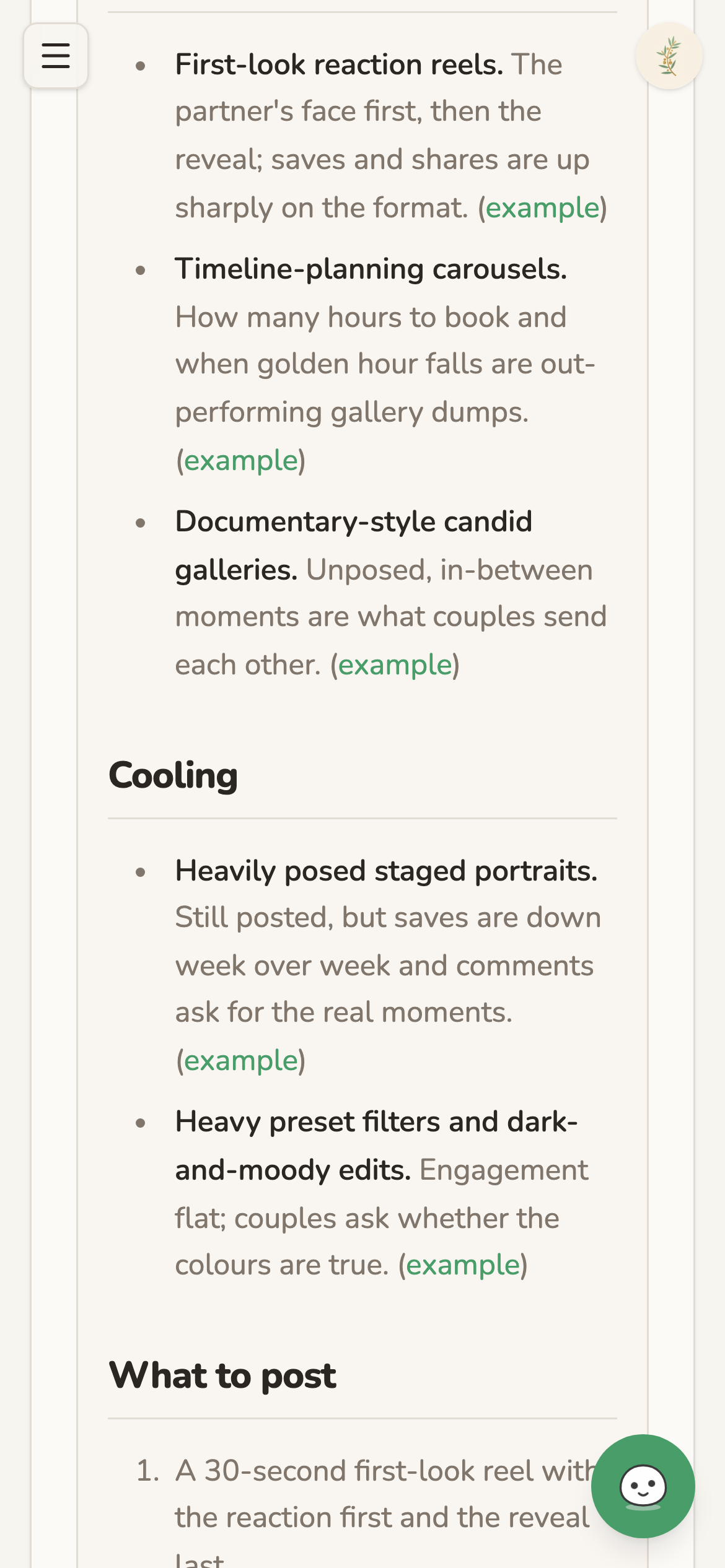
A finished research run sorting what's accelerating from what's cooling, with sources attached.
A working hashtag set isn't a longer list, it's a more honest one: a couple of tags that actually name your craft, one that puts you in front of the specific people who'd want it, and one that's unmistakably yours. Build that, check it against reality every so often, and the tags stop being decoration and start doing the one job they were ever good for. What does your current hashtag set actually say about who you think is looking for you?
Part of a series
The Creator's Playbook
Evergreen craft for working creators: brand, content planning, and publishing, written by the team that builds Mochi.