 Mochi Labs
Predis.ai Review: Generated Creative, and When It's the Wrong Call
A plain Predis.ai review: what it generates, what it costs, and when Mochi's brand-voice approach serves a creator better than AI-made creative does.
You take the photo. You light the set, you catch the moment, you edit it until it looks like you. So what happens when the caption underneath it, or worse, the image itself, was written by a prompt instead of by you?
That's the real question behind any Predis.ai review for a creator, not just whether the tool works. Predis.ai is built to generate the creative itself: videos, carousels, memes, ad creatives, straight from a text prompt. Mochi is built the other way around: it learns the brand first, then drafts posts in the creator's own voice, around the creator's own work. Both are real approaches. They are just not aiming at the same problem, and which one is right depends entirely on what "the content" actually is for you.
What Predis.ai Actually Does
Predis.ai is an AI creative generator for social media. Tell it what you sell or what you want to promote, and it produces the asset: a short video, a carousel, a meme, an ad creative, plus captions and hashtags to go with it. It also runs an "Idea Labs" feature and basic competitor analysis, so part of its pitch is deciding what to make, not just making it.
It posts to Facebook, Instagram, TikTok, Google Business Profile, LinkedIn, YouTube Shorts and X, and it plugs into Shopify, WooCommerce, Wix and Squarespace, which tells you who it's really built for: stores with a catalog to move, not individual creators with a body of personal work.
What it costs
As of 2026-10-11, Predis.ai's pricing runs in three tiers. Every plan starts with a 3-day trial, and your card is taken upfront.
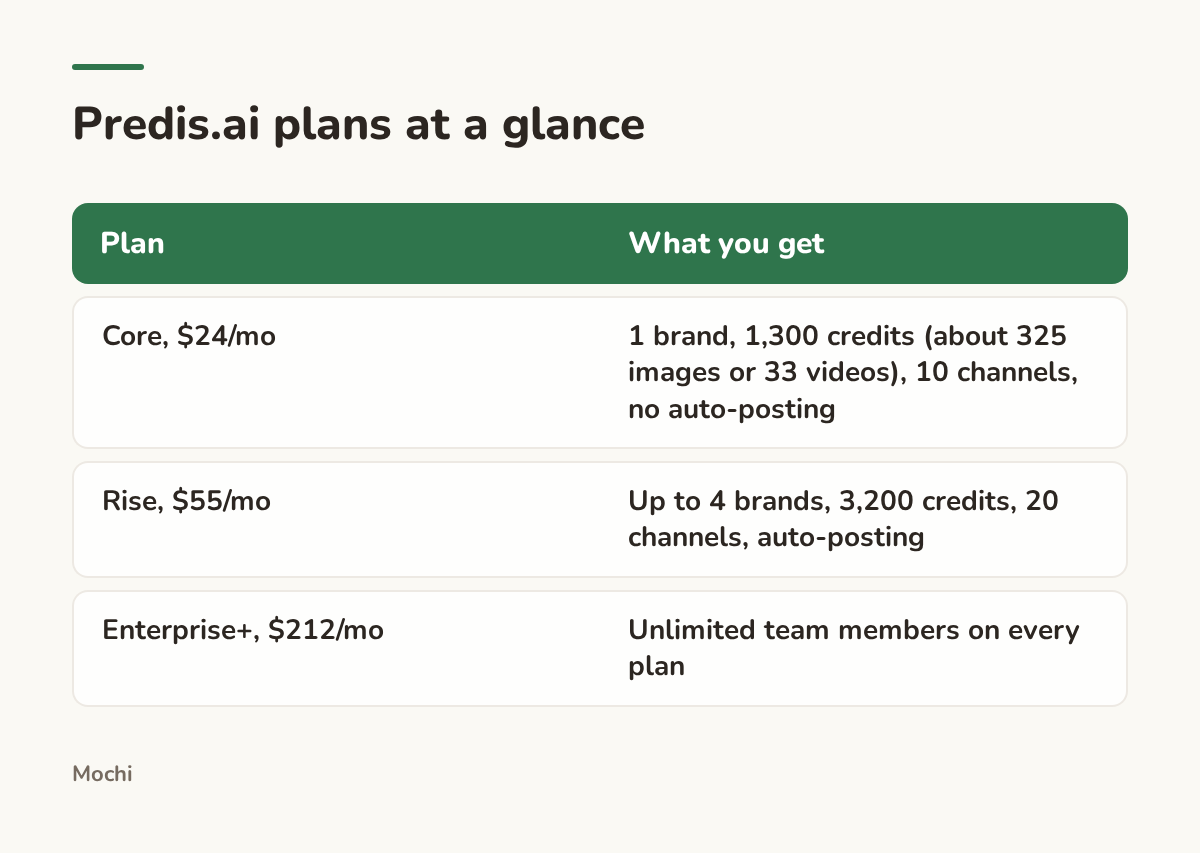
Figures as published on Predis.ai's pricing page, verified 2026-10-11.
Notice what's missing from the cheapest tier: auto-posting. On Core, Predis.ai will generate the creative, but you're still the one publishing it. That's worth knowing before you compare it to any tool that schedules for you by default.
What Mochi Does Instead
Mochi doesn't generate your photos, your footage or your voice. It starts by reading what you've already made: your site, your socials, your store if you have one, plus a short interview, and turns that into a Brand Playbook, a written record of how you actually sound and what you actually make.
From there it runs research routines on a schedule, the kind of trend-watching most creators mean to do and never find time for, and turns what it finds into scored ideas with a brief attached. You approve or edit, and the calendar fills itself and posts on schedule across Instagram, Facebook, Threads, TikTok, YouTube Shorts and LinkedIn. On Pro, it also answers the easy DMs and comments in your voice, and trigger words you set can hand a commenter a guide, a code or a catalog item automatically.
What it costs
Mochi's trial is $1 for seven days with 150 credits, and it rolls onto whichever plan you pick unless you cancel it first.
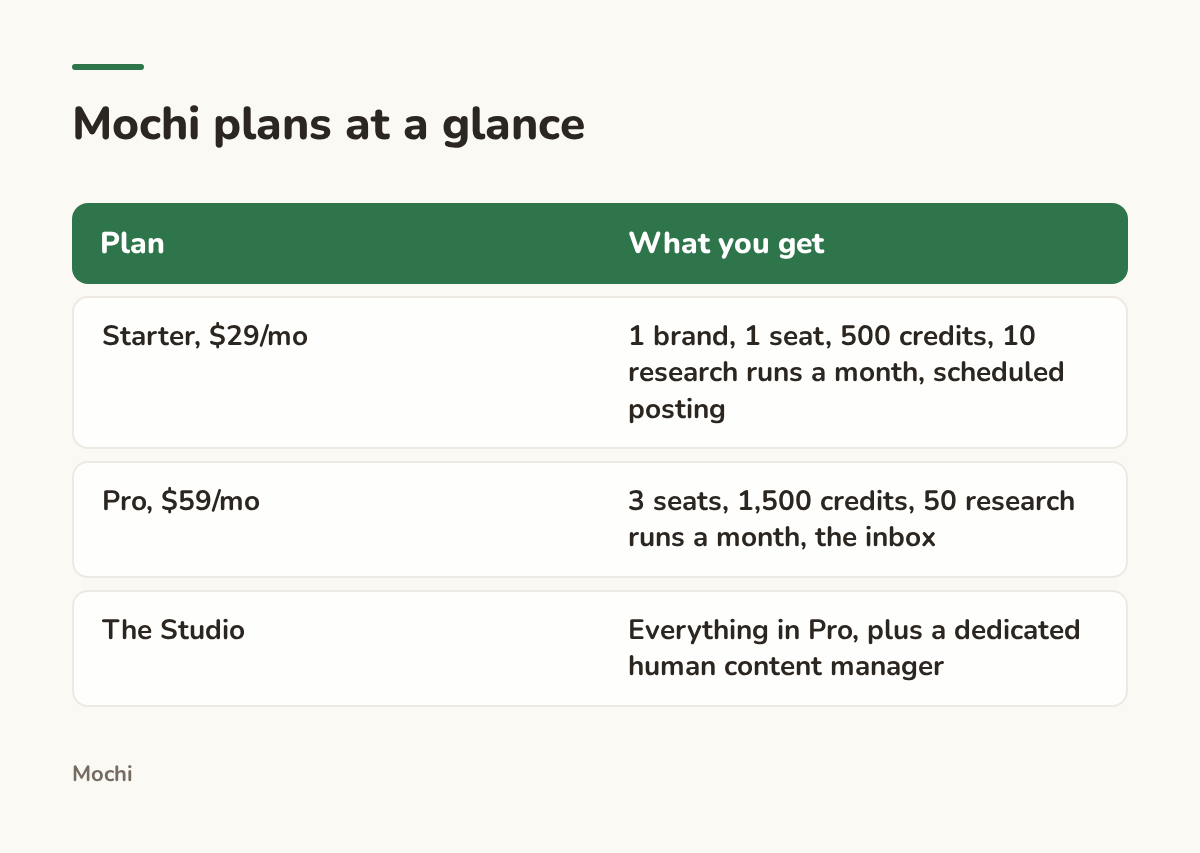
Mochi's published pricing, verified 2026-10-11.
Billing is monthly only, there's no annual discount, and credits don't roll over. It's also worth saying plainly where Mochi doesn't go: no free plan, no posting to X, Pinterest or Bluesky, and no ads management.
The Real Difference: Who Makes the Creative
This is the part a plan comparison can't show you. Predis.ai's job is to produce the asset from a prompt: the video, the carousel, the image. Mochi's job is to produce the words around an asset you already made, in a voice it learned from watching you work.
For a brand where the product is a product, a t-shirt, a skincare set, a subscription box, that difference barely registers. A prompt that says "carousel for our new drop" does the job a product shot would have done anyway, and nobody in the audience is looking for the brand's "voice" in the image itself. Harvard Business Review's framework for where generative AI belongs in a marketing workflow makes roughly this point: the right question isn't whether to use generative tools, it's which part of the workflow they actually belong in.
For a creator, the calculation flips. If you're a photographer, a musician or a videographer, your work isn't illustrating the brand. It is the brand. Hand that part to a prompt and you haven't saved time, you've replaced the one thing your audience actually followed you for.
When Predis.ai Is the Right Call
Picture an online skincare shop with forty SKUs and a launch every month. Nobody is scrolling past their feed hoping to recognize a signature style in the product photography. What they need is volume: a carousel for every launch, an ad creative for every promotion, captions and hashtags attached, produced faster than a design team could turn them around. That's a volume problem, and Predis.ai is built to solve exactly that one, with the Shopify and WooCommerce integrations to match.
When Generated Visuals Are the Wrong Call
Now picture a wedding photographer whose entire feed is her own frames: a hand catching light through a veil, a candid laugh at the reception, the kind of image a couple hires her specifically to make. If the carousel under her name was generated from a prompt instead of pulled from her own shoot, the first comment would be from someone who's noticed. That's not a hypothetical; it's the whole reason a photographer has a style in the first place.
This isn't just a hunch. Independent reporting on the current glut of AI-generated content has tracked audiences actively rewarding the rougher, more obviously human post over the polished generated one, precisely because it's easy to tell the difference now. Academic comparisons of AI-made versus human-made social creative land on a similar split: generated assets can match human output on some tasks, but a personal, recognizable style is exactly the part they struggle to reproduce. For a creator whose style is the product, that gap is the whole business.
How this works in Mochi
This is the problem the Brand Playbook exists to solve. It writes down how you actually sound, with real examples of what reads as you and what doesn't, so every draft starts from your voice instead of a generic one.
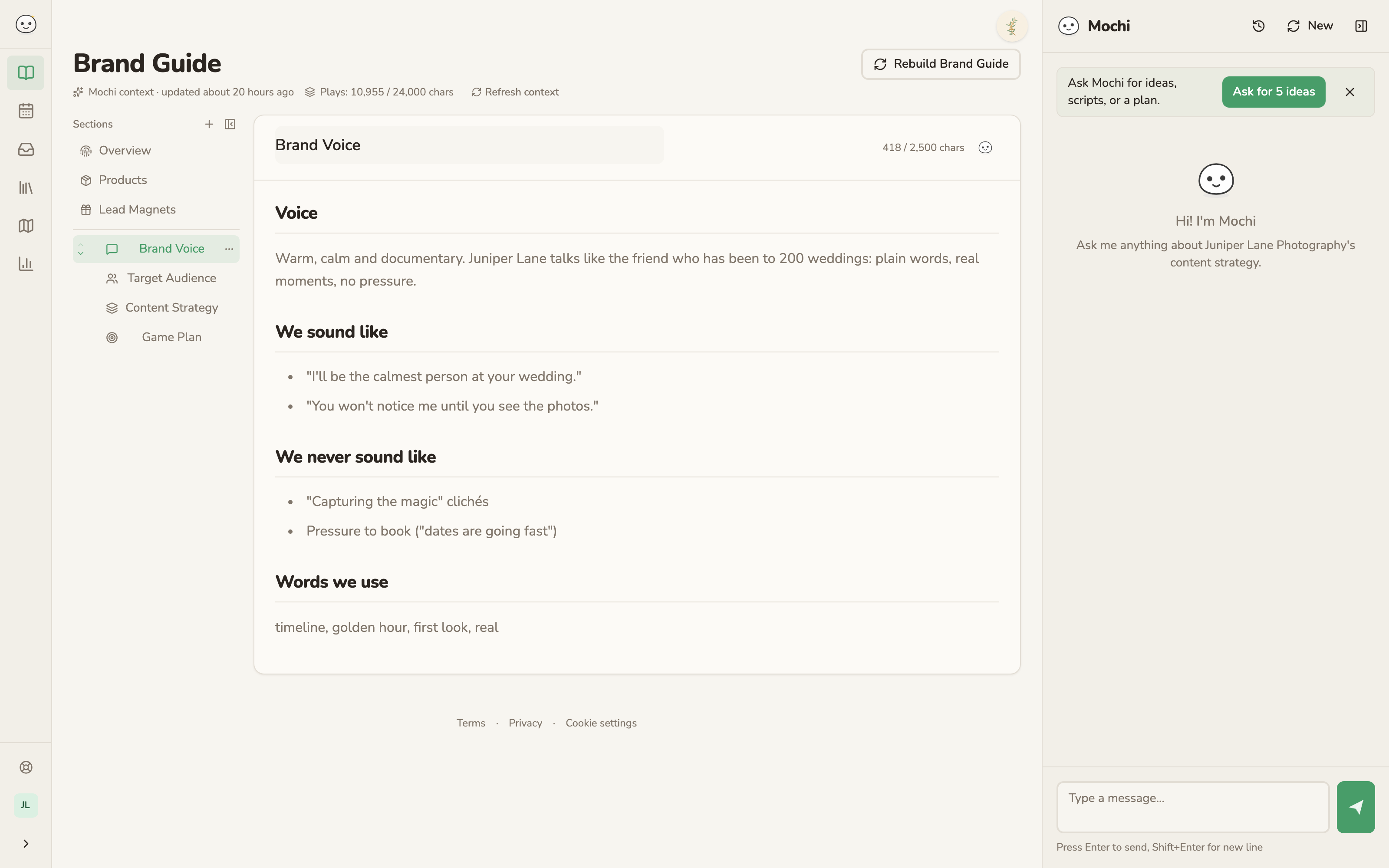
The brand's voice is written down in the playbook, with examples of how it does and does not sound.
We built the Brand Playbook this way on purpose: a tool that drafts in your voice only works if it actually learned your voice first, not a category average of what brands in your niche tend to sound like.
Who Each Tool Actually Fits
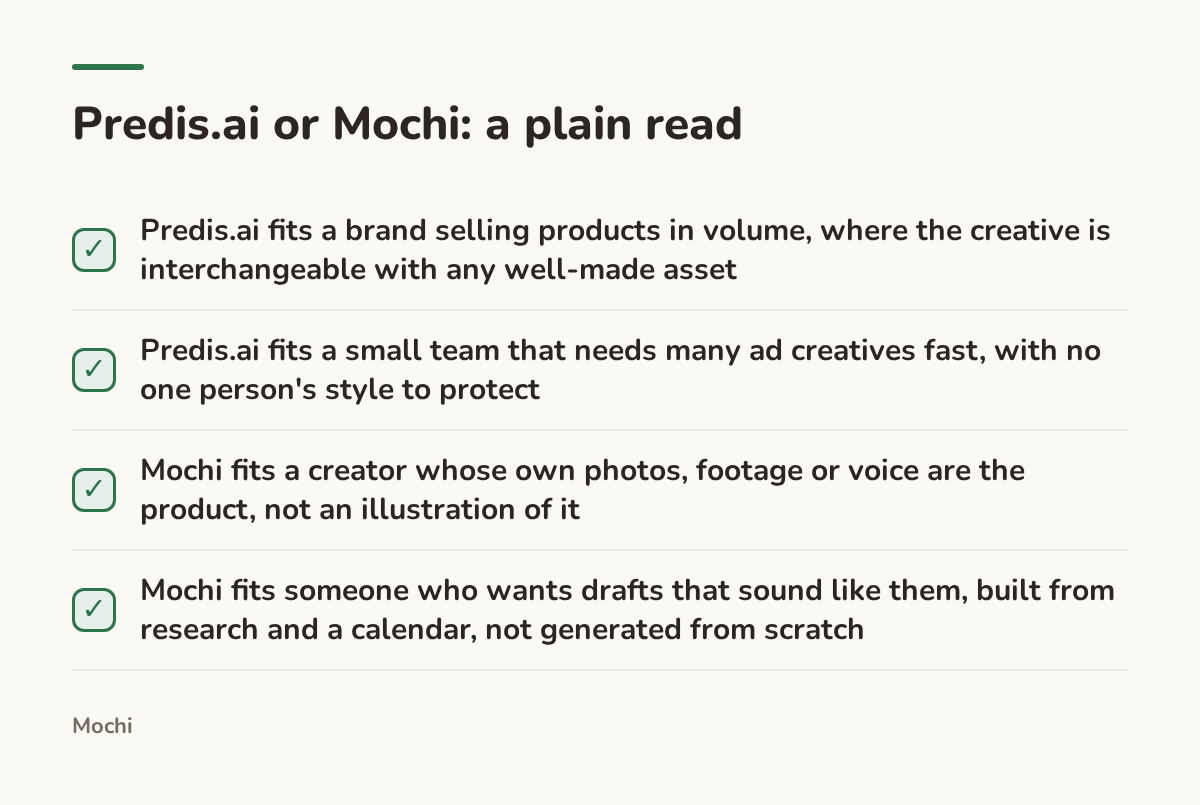
Berkeley's research on authenticity in the age of AI makes the same split from the brand side: audiences aren't rejecting AI assistance outright, they're rejecting the version of it that replaces a recognizable human hand with a generic one. The tool isn't the problem. Using it on the wrong part of the work is.
Neither tool is the wrong product. Predis.ai is honest about what it's for: creative, generated, at volume, for brands where the asset is the job. Mochi is honest about what it's for too: your work, drafted into posts, scheduled and replied to, without anyone mistaking the writing for the photograph.
So before you start either trial, ask yourself the one question that actually decides it: when someone looks at your feed, are they looking for your work, or just for a brand's?
Part of a series
Mochi vs. the Field
Honest comparisons of Mochi with the social media tools creators already use, and what is different about an agent that learns your brand.