 Mochi Labs
How to Research Other Creators for Inspiration Without Copying Their Voice
A practical guide to researching other creators for inspiration: how to study what works for peers in your niche without quietly starting to sound like them.
You scroll a dozen reels from photographers in your market before breakfast.
A week later you post something, and a comment reads: "this feels like [someone else's] reel."
You didn't copy a single frame. You just studied too close for too long.
That's the part of researching other creators nobody warns you about. The failure mode isn't laziness, and it isn't theft either, not usually. It's that studying someone's work closely enough to learn from it and absorbing their exact cadence are the same motion from the inside. You can't always feel the line between them while you're doing it. So the real skill isn't "research your competitors," which every platform's help center will tell you to do anyway. It's learning to take the structure of what's working and leave the voice behind.
Why Studying Other Creators Can Quietly Turn Into Copying
There's a term for this in memory research: cryptomnesia, when something you absorbed resurfaces later feeling like your own original idea. You read it, forgot you read it, and your brain filed the shape of it under "things I think." Psychologists who study cryptomnesia point out it's not a character flaw. It's just how memory for phrasing actually works: we're far better at remembering the gist of something than the exact words, so weeks later the gist comes back dressed as inspiration.
For a creator, the practical version looks like this: you watch a photographer's reel three times to catch how she paces her cuts, and by the fourth watch you've also picked up her exact opening line. You meant to study her editing. You walked away with her words.
What You're Actually Allowed to Steal
The useful reframe here isn't "don't look at other creators." It's "look harder, at a different layer." Austin Kleon's Steal Like an Artist draws a line that holds up well for this exact problem: there's creative theft, which studies and transforms, and straight imitation, which just repeats. The line sits at the level of abstraction you're copying from. A sentence is imitation. A structural move, the order a story unfolds in, the beat where a hook turns, the place a call to action lands, is raw material. Nobody owns a shape.
So before you open a single competitor's profile, decide which layer you're there for.

Study the wall. Fill the notebook in your own hand.
Step 1: Build a Watch List Before You Build Opinions
Most creators research the wrong way around: they open a handful of big accounts in their niche, form a vague impression, and start reaching for that impression every time they sit down to post. By the third week they can't tell which ideas were theirs.
A watch list fixes the order of operations. Pick six to ten accounts, not just the biggest names in your niche but a spread: a couple who are ahead of you, a couple at your size, and a couple adjacent to your craft entirely. A wedding photographer gets more out of watching a florist's behind-the-scenes content than a tenth wedding photographer, because the adjacent account hands over structure without any risk of the two of you sounding alike by accident.
Write the list down somewhere you'll actually revisit, not a mental note that evaporates by Thursday.
This is the part that's easy to let slide: the research has to run on a schedule, not just whenever you remember to open a profile before bed. We built Mochi's research routines so a watch list keeps moving on its own, on a fixed day each week, and shows you when it last ran and when it's due again.
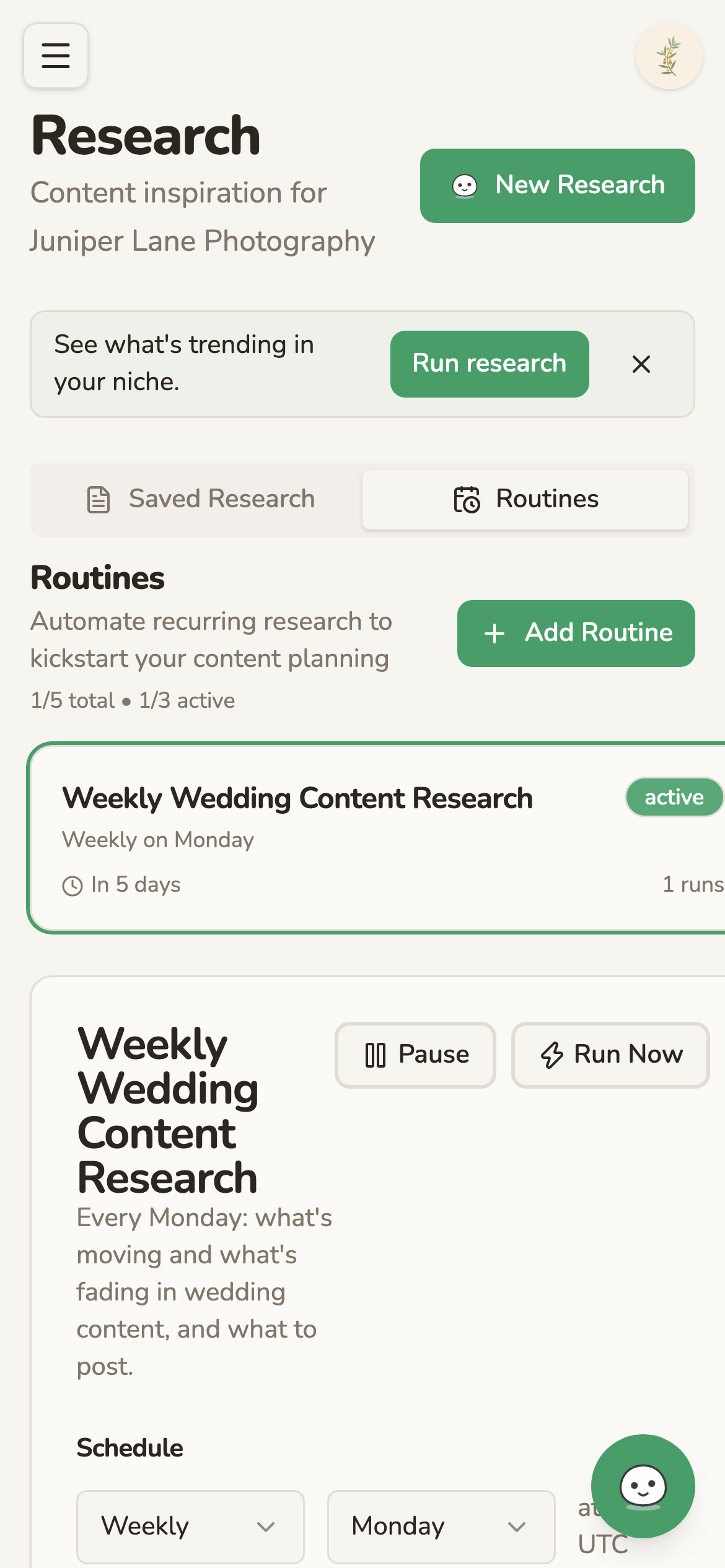
A weekly research routine runs on its own schedule and shows you when it's due next.
Step 2: Read for Structure, Not for Lines
Once the watch list is running, the question is what you're actually looking for when you open each post. "Inspiration" is too vague to act on. Usability researchers who run competitive audits for a living treat this as a method, not a vibe: competitive usability evaluations work because they ask narrow, specific questions about how something is built, not broad ones about whether it's "good."
Borrow that discipline. For every post you study, log the shape, not the sentence.
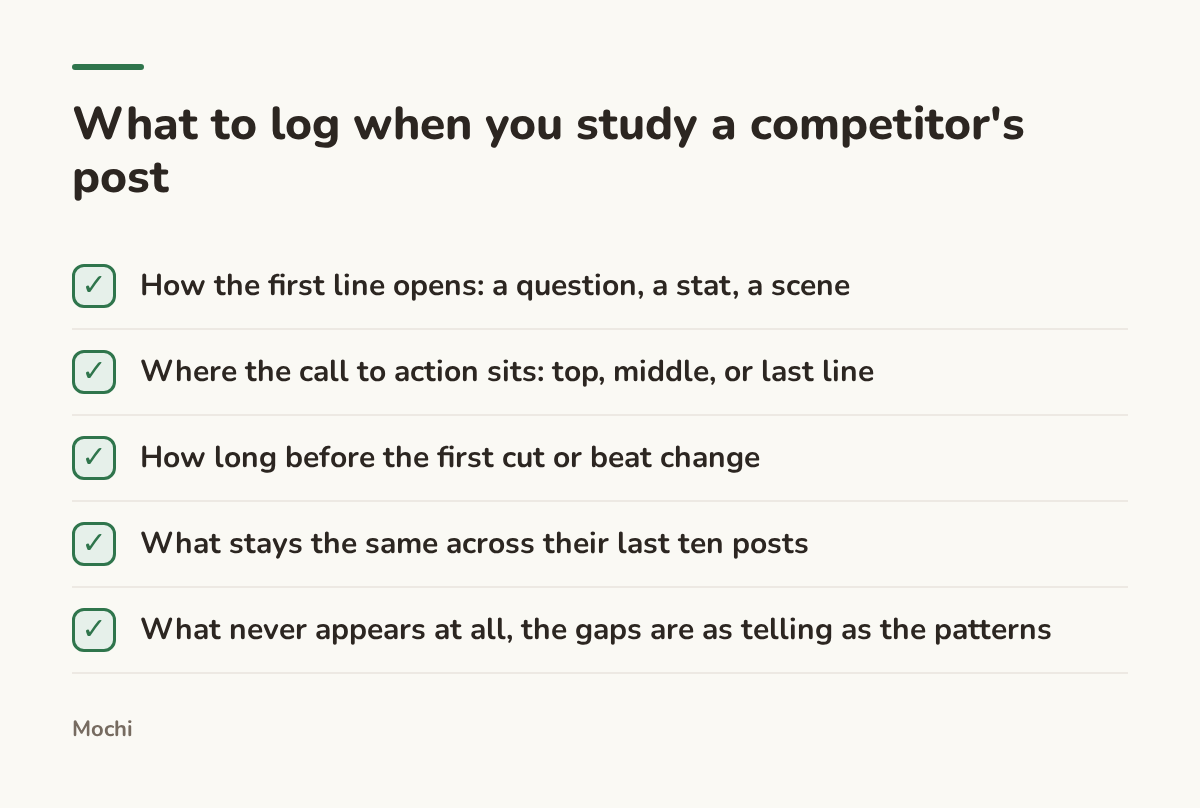
Log the shape. Leave the sentence where you found it.
Do this for a few weeks and patterns surface that a single viral post never shows you: maybe every reel that performs for the photographer you're watching opens with a problem before it shows a single frame of the actual work. That's the move. The specific words she used to state the problem are hers. The decision to lead with stakes instead of scenery is the part worth taking.
The rewrite below keeps the one decision that made the original hook stop a scroll, leading with a stake instead of a topic, while swapping in a detail that only one photographer actually lived through.
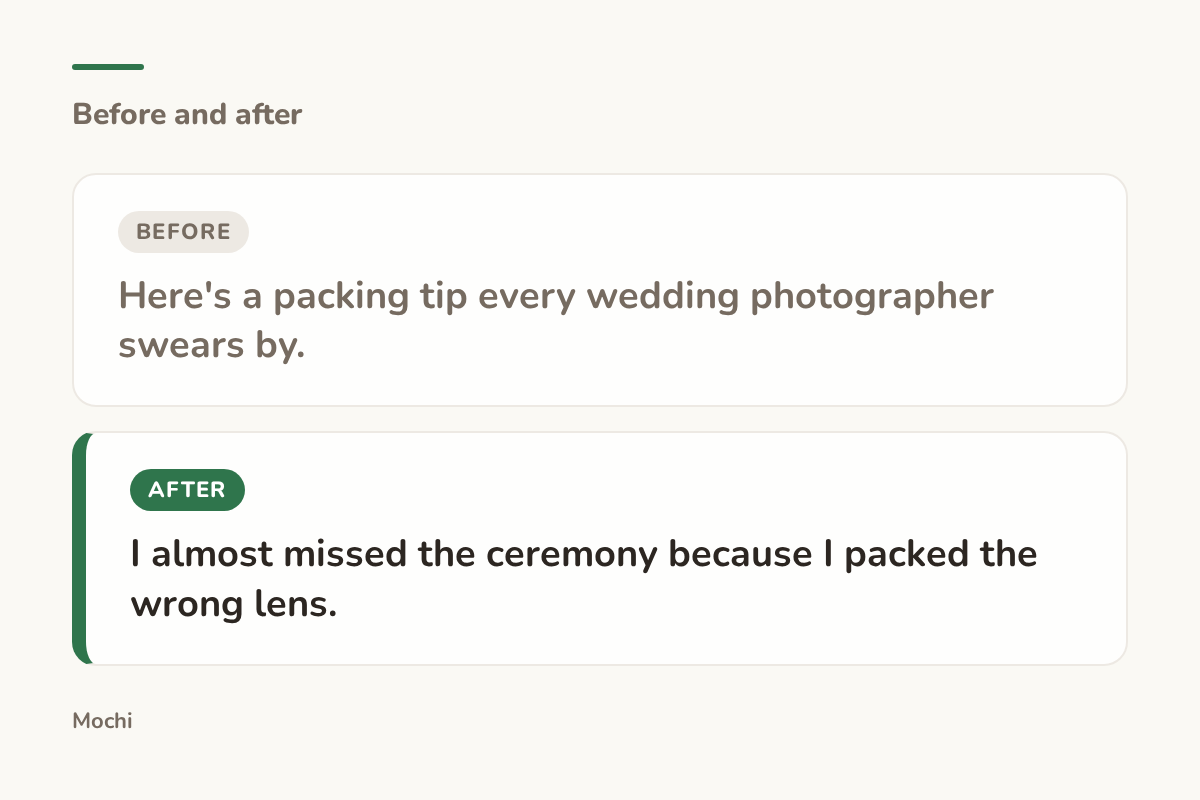
Before: Here's a packing tip every wedding photographer swears by. After: I almost missed the ceremony because I packed the wrong lens.
Same stakes-first structure, a completely different story.
Step 3: Name the Move, Not the Creator
Here's a habit that quietly prevents voice-copying before it starts: when you log a technique, name the move itself instead of the person you saw do it. Not "do the thing [creator] does." Write "stakes-first hook" or "problem-before-product" or "question-close." A technique with a name travels. A technique tied to a name invites you to reach for that specific person's cadence the next time you sit down to write, because that's what your memory actually indexed.
Take a musician who studies how a peer announces merch drops. The peer's caption works because it pairs an announcement with urgency and a direct ask, all inside two lines. Naming it "announce, raise the stakes, ask" lets her reuse the beat. Naming it "do what she does" would have her reaching for the peer's actual sentence six months later without remembering why.
The version below still does the job the structure is built for, pulling attention toward something new and giving a reason to care right now, but nobody reading it would mistake it for the account she studied.
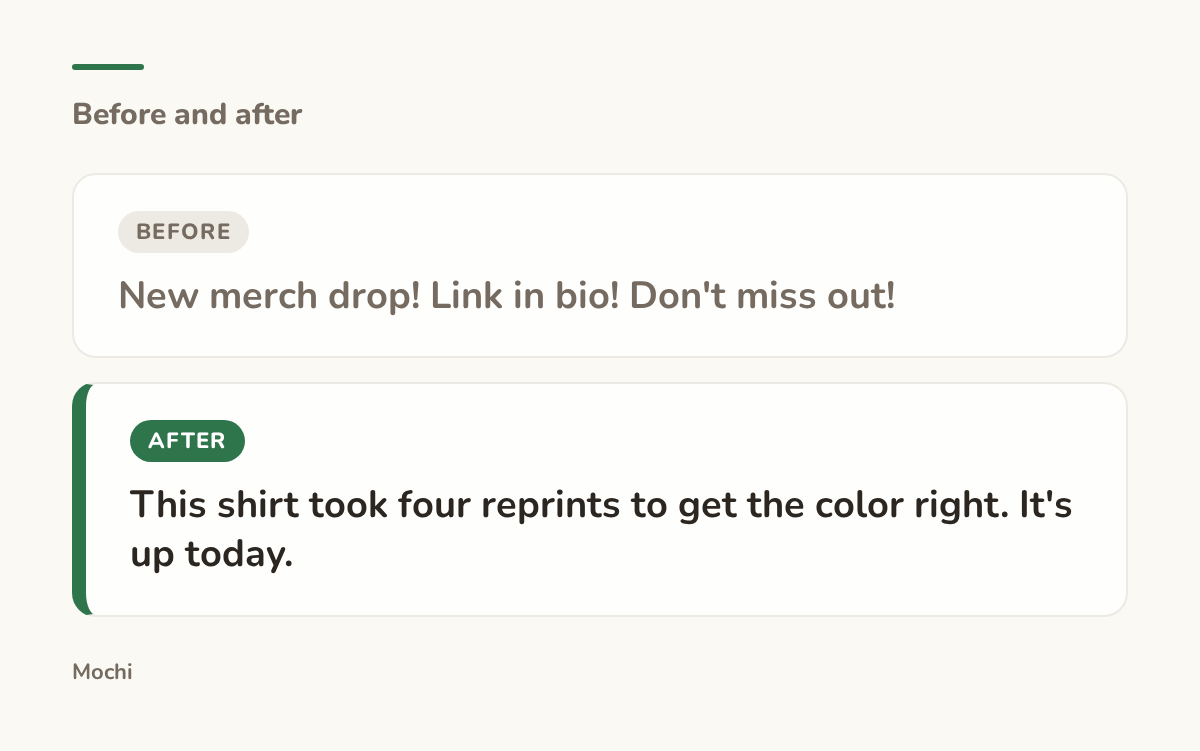
Before: New merch drop! Link in bio! Don't miss out! After: This shirt took four reprints to get the color right. It's up today.
Same announce-and-raise-the-stakes beat, her own story behind it.
Step 4: Run It Through Your Own Brand Filter
A technique that works for another creator still has to pass through what makes your own work recognizable before it's worth posting. If you haven't written your brand voice down somewhere, this is the step where that gap shows up, because without a reference point it's genuinely hard to tell "this fits me" from "this is just what I watched most recently." A process for defining brand voice ahead of time, rather than deciding case by case, turns competitor research into something that informs your strategy instead of quietly setting it.
A videographer who's funny and self-deprecating on camera and a videographer who's calm and instructional will take the exact same structural move to a different place. The same "POV" framing that worked for a trending creator becomes a different joke, a different pace, a different payoff depending on whose brand it runs through.
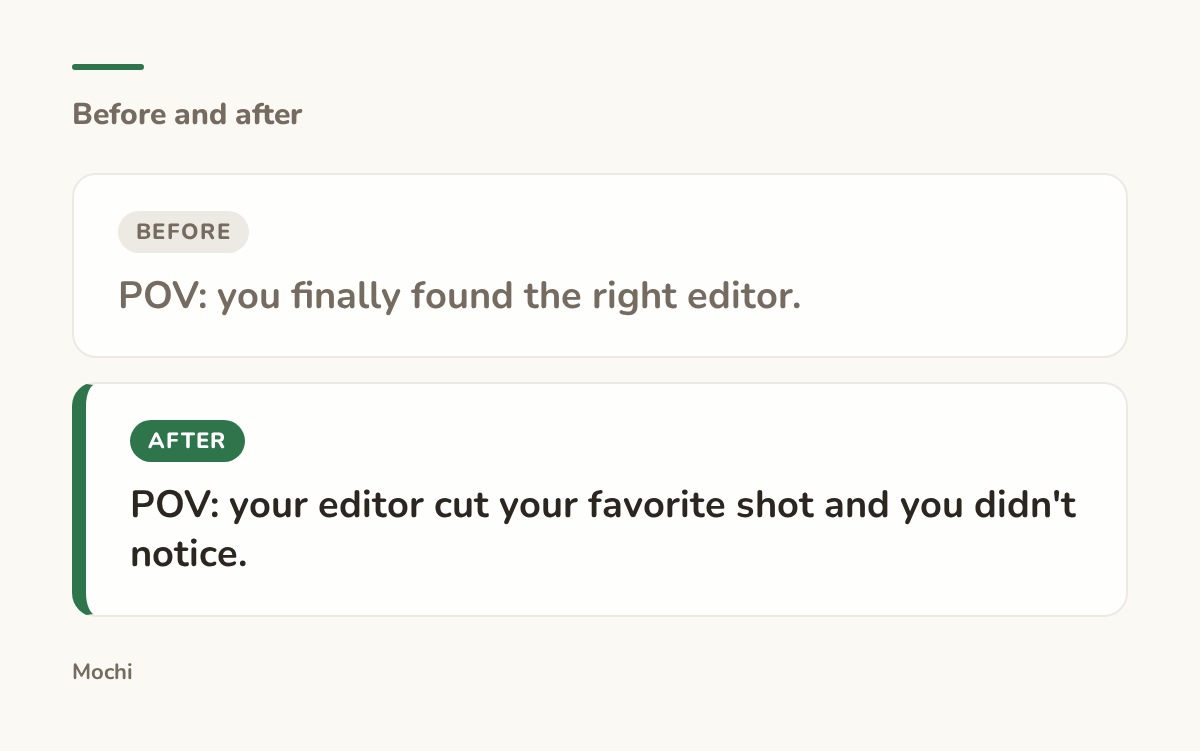
Before: POV: you finally found the right editor. After: POV: your editor cut your favorite shot and you didn't notice.
Same POV frame, a joke that only makes sense coming from her.
If you can't picture the account behind a post from the caption alone, the filter didn't do its job yet.
Step 5: Ship It, Then Check If It Still Sounds Like You
The last step happens after you post, not before. Pull up the piece next to three or four things you made in the last couple of months. Does it read like it belongs in the same body of work, or does it read like it was borrowed for an afternoon and handed back? If a follower who knows your usual tone would do a double take, that's worth catching before it becomes a pattern rather than a one-off.
This is also the moment to ask whether you can name, out loud, which structural move you borrowed and why it fit. If the honest answer is "I'm not sure, I just liked how it felt," that's the sign cryptomnesia did more of the work than your own judgment did. Go back to Step 3 and name the move properly before you reach for it again.
The Difference Between a Reference and a Habit
Researching other creators isn't the part to feel guilty about. Every craft gets built by people looking sideways at each other's work; that's just how a field moves forward. What separates a reference from a habit you didn't choose is whether you can point to the specific structural decision you took and say why it belonged in your own work, not just that it was lying around when you needed a post.
Keep the watch list running, log shapes instead of sentences, name the move instead of the creator, and run everything through what actually makes your work yours. Do that consistently and the accounts you study stop being a risk to your voice and start being one of the better tools you have for sharpening it.
What's the last post you made that you could trace back to a specific thing you studied, and still call entirely your own?
Part of a series
The Creator's Playbook
Evergreen craft for working creators: brand, content planning, and publishing, written by the team that builds Mochi.