 Mochi Labs
Short-Form vs Long-Form Video Strategy: Build the Long Cut First
Short-form vs long-form video strategy for 2026: build the long-form video first, then cut your shorts from inside it, instead of making both separately.
Thirty seconds. That's how long a lot of creators now think an entire video strategy needs to be.
Scroll any feed and short clips dominate: reels, TikToks, Shorts stacked end to end, each one chasing a few seconds of someone's thumb before the next clip arrives. It's tempting to read that and conclude long-form is dead weight, something to produce less of, not more.
Here's the catch. Treat short and long form as rivals and you end up optimizing for whatever an algorithm rewards this month, and starving the format that actually builds a channel. Picture two creators shooting the same number of days a month. One treats every video, long and short alike, as its own project, planned and edited from scratch. The other shoots once for a long core and lets every short fall out of it. A year in, the second creator usually has more finished work to show for the same number of shoot days.
The real question for video strategy in 2026 isn't short versus long. It's which one you build first.
The Short-Form vs Long-Form Debate Is Asking the Wrong Question
Most arguments pitting short-form against long-form share a hidden assumption: that a creator has to pick a side. That made more sense a few years ago, when a short clip and a long video felt like two separate jobs fighting for the same hours.
What's changed is less about which format wins and more about what each one is actually for. Short clips are built for discovery: cheap to make, cheap to watch, the kind of thing an algorithm can test on a stranger who's never heard of you. Long-form is built for depth, the place where a stranger becomes a subscriber and a few minutes of watch time tells a platform you're worth recommending again. An EEG study on short-video use and attention found measurable effects on how attention holds up afterward, which helps explain why a clip can travel far and still rarely do more than get noticed.
Neither job is more important. But one depends on the other existing first.
A short with nowhere to send its new viewer is a dead end dressed up as a win.
Step 1: Build the Long-Form Core Before You Touch a Single Cut
Start with the piece that can stand alone
The long-form video is the one that has to work without any help: a wedding recap, a process walkthrough, a sit-down interview, a full studio session. It should answer a real question completely, not tease an answer a short will deliver later. If the long cut depends on a short to make sense, the order is backwards.
This is close to what the production industry calls content atomization: one deliberate pillar piece, then smaller atoms pulled from inside it. The pillar carries the depth. The atoms carry the reach. Skip the pillar and the atoms have nothing to come from.
A long cut, then the pieces that come from it
Take a wedding videographer planning a Saturday shoot. The long-form core is a twelve-minute ceremony-to-reception recap, built to post on the couple's channel and the videographer's own. Only after that cut is locked does the cutting start: a twenty-second clip of the first look, a fifteen-second shot of the ring exchange, a thirty-second dance-floor moment. Each short borrows its best seconds from a video that already exists and already works.
Plan it the other way, cutting the short clips first and treating the long recap as an afterthought, and the shorts end up polished while the long cut ends up thin: assembled from leftovers instead of built with intention.
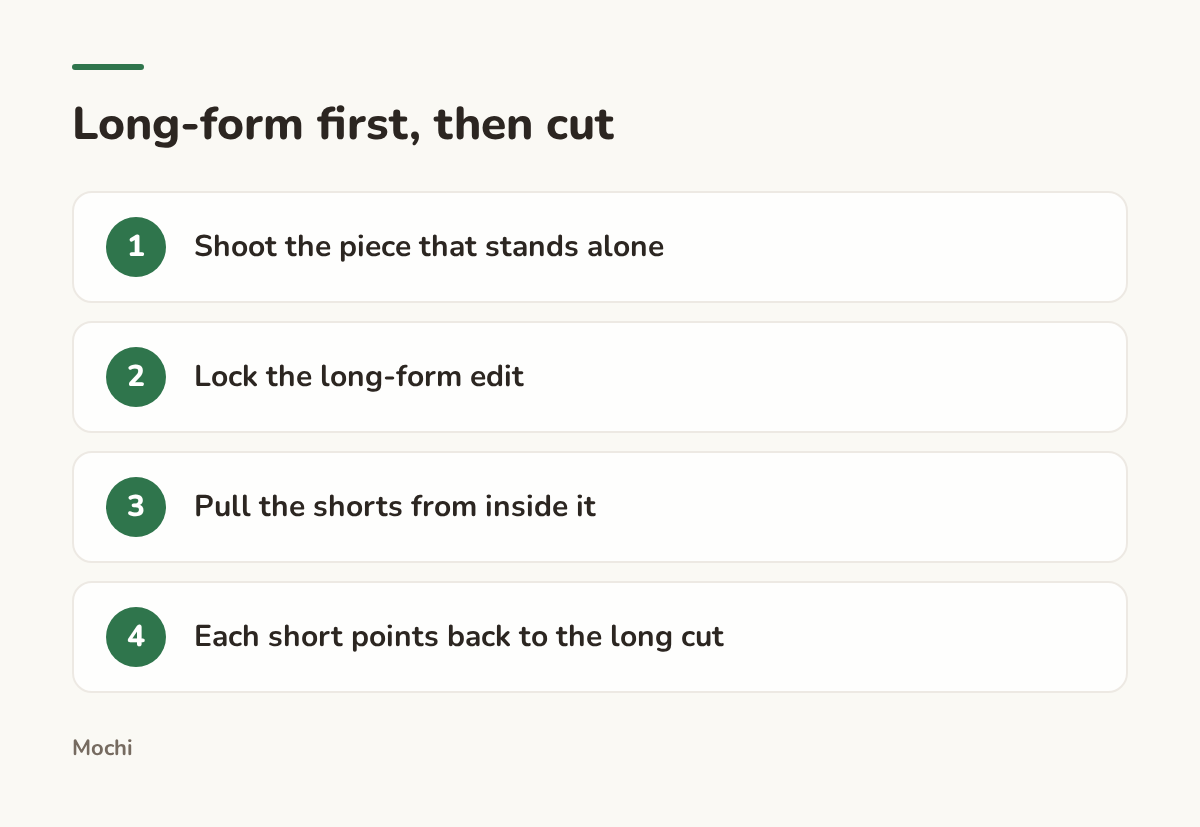
The long cut comes first so the shorts have something to come from.
Step 2: Treat Every Short as a Trailer, Not a Sibling
A trailer's only job is to make you want the feature. Nobody complains that a movie trailer doesn't resolve the plot, because that was never the point. Shorts deserve the same low bar and the same high standard: they don't need to stand alone, but they do need to make the long cut feel necessary.
Cut for the open question, not the full answer
That changes how you cut. Instead of asking whether a clip works by itself, ask whether it leaves something unresolved that only the long cut answers. A short that fully satisfies a viewer in fifteen seconds has done its job too well. There's no reason left to click through.
Picture a DJ who played a two-hour set at a small venue. The long-form upload is the full set, posted in one piece. The short is thirty seconds of the crowd reacting to one transition, cut off right before the drop actually lands. The caption says where to find the rest. Viewers who only wanted thirty seconds got them. Viewers who wanted the drop have exactly one place to go.
Why the platform is already built for this order
This is also where the platform does real work for you. YouTube has written about how it routes Shorts viewers toward a creator's long-form catalog through Related Videos, which is a big part of why a short's description and end card matter as much as the clip itself. A caption that just names the moment wastes that routing. A caption that promises what the long cut resolves uses it.
A short that fully satisfies the viewer in fifteen seconds has done its job too well.
Step 3: Write the Cutting List Before You Shoot, Not After
A lot of editing time lost to shorts happens because nobody decided what the shorts were going to be before the camera rolled. Scrubbing back through two hours of raw footage looking for something short-able is slow, and it shows: the clips that get pulled are whatever's easiest to find, not whatever's actually good.
A cutting list fixes this before a single frame exists. Before the shoot, write down three or four moments you expect to be in the footage and what each one is for: a reaction shot for a short, a quote for a caption, a wide shot for a thumbnail. During the shoot, flag those moments as they happen instead of hunting for them later. The list won't be perfect, footage never behaves exactly as planned, but it turns editing from a search into a selection.
How this works in Mochi
We built Mochi's ideas to carry this list with them instead of leaving it to memory. Each idea keeps its own brief: the angle, the hooks, the key points and a call to action, sitting right next to the idea so the cutting list exists before the shoot does.
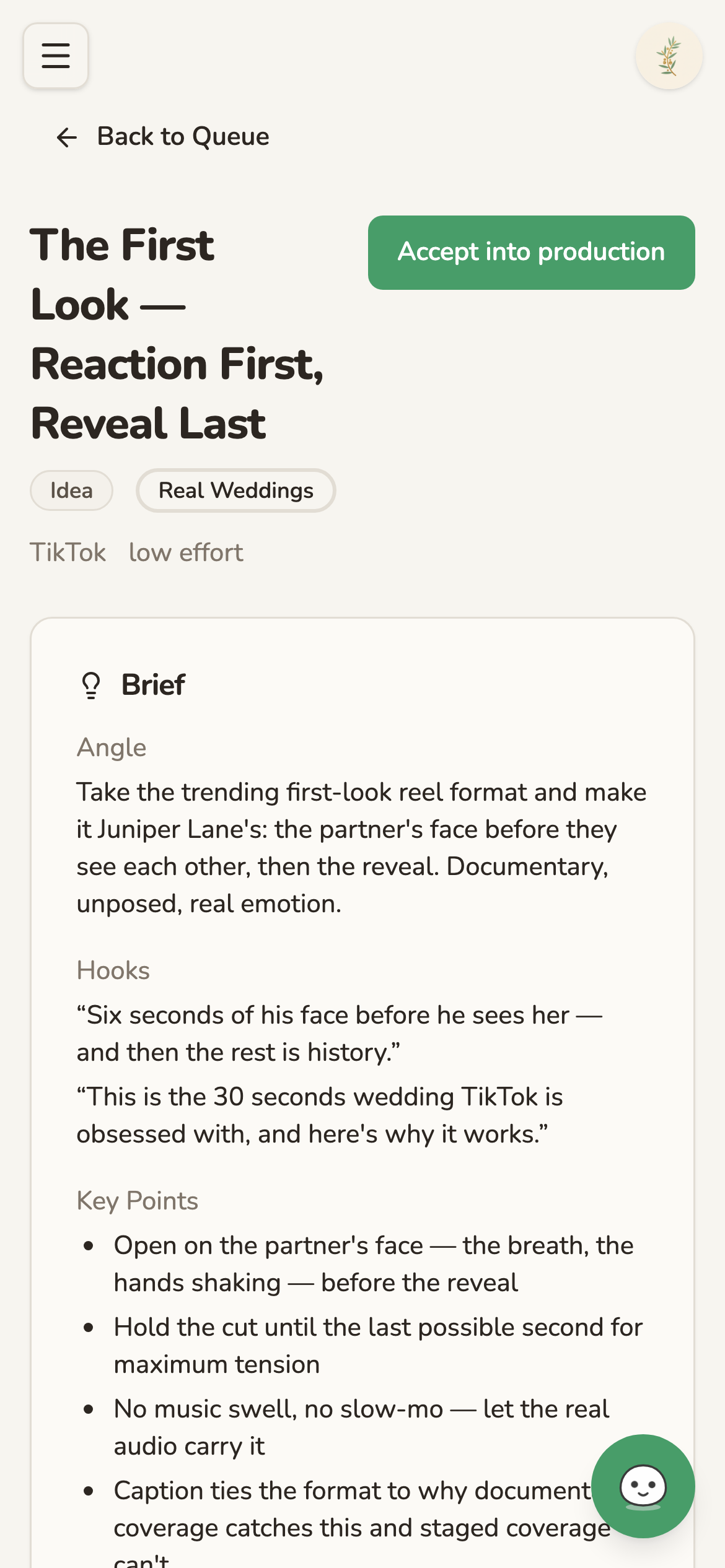
An idea's brief holds the hooks and key points before the camera ever rolls.
Step 4: Measure the Short by What It Sends, Not What It Gets
A short that racks up views and sends nobody to the long cut is a fun number on a dashboard and not much else. The view count on the short was never the point. What matters is whether the people who watched it went looking for more.
Watch different numbers than the short's own panel shows you
That means tracking signals a short's own analytics don't foreground: clicks to the channel, watch time on the long-form video in the days after a short goes out, comments asking where the rest of it is. A short with modest views but a visible bump in long-form watch time the same week is working exactly as designed, even if its own number looks unremarkable next to a viral clip that went nowhere.
A worked example: a quiet short doing its real job
Take a photographer who posts a tight fifteen-second shot of a couple's first dance as a short, with the full ceremony-to-reception film linked in the caption and pinned comment. The short's view count might sit well below her best-performing reels. But if the long film's watch time climbs the same week the short goes out, the short did exactly what it was built for.
The view count on the short was never the point.
What a Month of Two-Speed Video Looks Like
Spread across four weeks, the order looks less like two separate production lines and more like one process running at two speeds. Shoot one long-form piece a week, or every other week if that's the honest pace the work allows. Lock its edit before cutting a single short from it. Pull two to four shorts from inside that long cut, each one ending on an unresolved beat. Post the long-form piece, then stagger the shorts across the days after it, so each one has something fresh to point back to.
The caption on the short is where a lot of this falls apart, so it's worth getting right on its own.
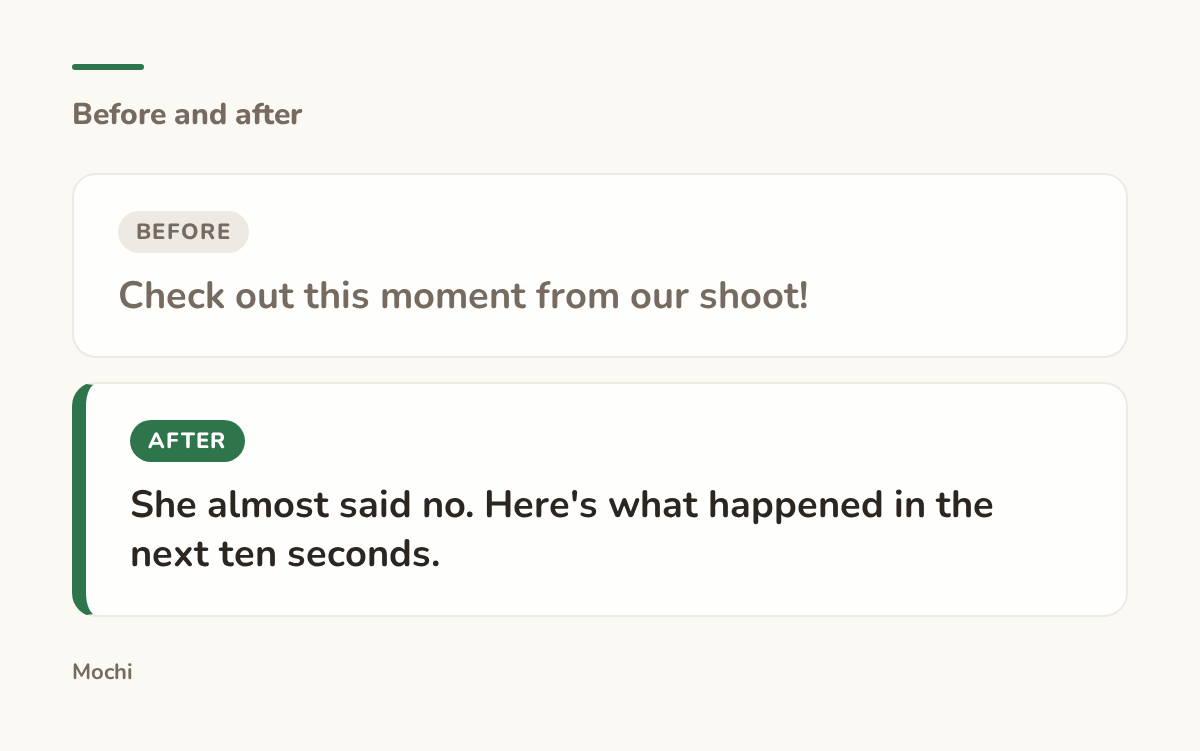
Before: Check out this moment from our shoot! After: She almost said no. Here's what happened in the next ten seconds.
The second line names a stake and leaves it open, which is the entire point of a trailer. The first line describes a moment that's already over.

The Order Is the Strategy
None of this is really about choosing a format. Both formats earn their place when the depth comes first and the reach comes after it, built from something that already works on its own. Skip that order and you end up with two unrelated content calendars fighting for the same hours instead of one video doing two jobs.
Next time you plan a shoot, decide which piece is the long-form core before you decide anything else. The shorts will tell you what they want to be once the core exists. What's the last long-form video you made that actually earned the shorts cut from it?
Part of a series
The Creator's Playbook
Evergreen craft for working creators: brand, content planning, and publishing, written by the team that builds Mochi.