 Mochi Labs
The Newsletter Is Your Only Owned Channel: A Creator's Case for Building One Anyway
Why creators need a newsletter: the case for owning one channel no algorithm controls, and the few things worth writing when you only get one email a week.
Your posts used to reach almost everyone who followed you. Then, on some ordinary day, they didn't.
Nothing about your work changed. The platform did.
In January 2018, Facebook announced it would show people more posts from friends and family and fewer from pages, a tweak to one algorithm that quietly cut reach for publishers and creators across the feed, overnight, with no warning and no appeal, as NPR reported at the time. It became the textbook case, the one people point to when they explain what "you don't own your audience" actually means in practice. It wasn't the last time something like it happened, and it won't be the last time either.
When the newsletter question comes up with creators, it's rarely about open rates or clever subject lines. It's about something plainer: which few things are worth writing when you only get one email a week, and why bother building a second channel at all when the one you already have is working, right up until the day it isn't.
Why Creators Need a Newsletter
A social account is a lease, not a deed. You post into a feed somebody else ranks, somebody else owns, and somebody else can redesign without consulting you. A newsletter is the opposite kind of thing: a list of people who asked, by name, to hear from you, delivered straight to an inbox with no algorithm standing between you and them.
That distinction used to sound abstract, until independent writers and creators spent a decade watching platforms change the rules mid-game and started rebuilding direct distribution around something they could actually keep. Media researchers have called this the long peak of the newsletter: not a new format, but one that became durable infrastructure for writers after years of platform instability taught a whole industry the same lesson creators are learning now. Here's a good account of why that happened. Inside newsrooms, the shift went further still: entire audience teams were rebuilt as creator teams, because reach borrowed from a platform stopped counting as a strategy and started counting as a risk worth hedging against. Nieman Lab traced that shift in detail.
None of that is unique to media companies. If you post your work for a living, you're running the same bet a newsroom runs, just with a much smaller team.
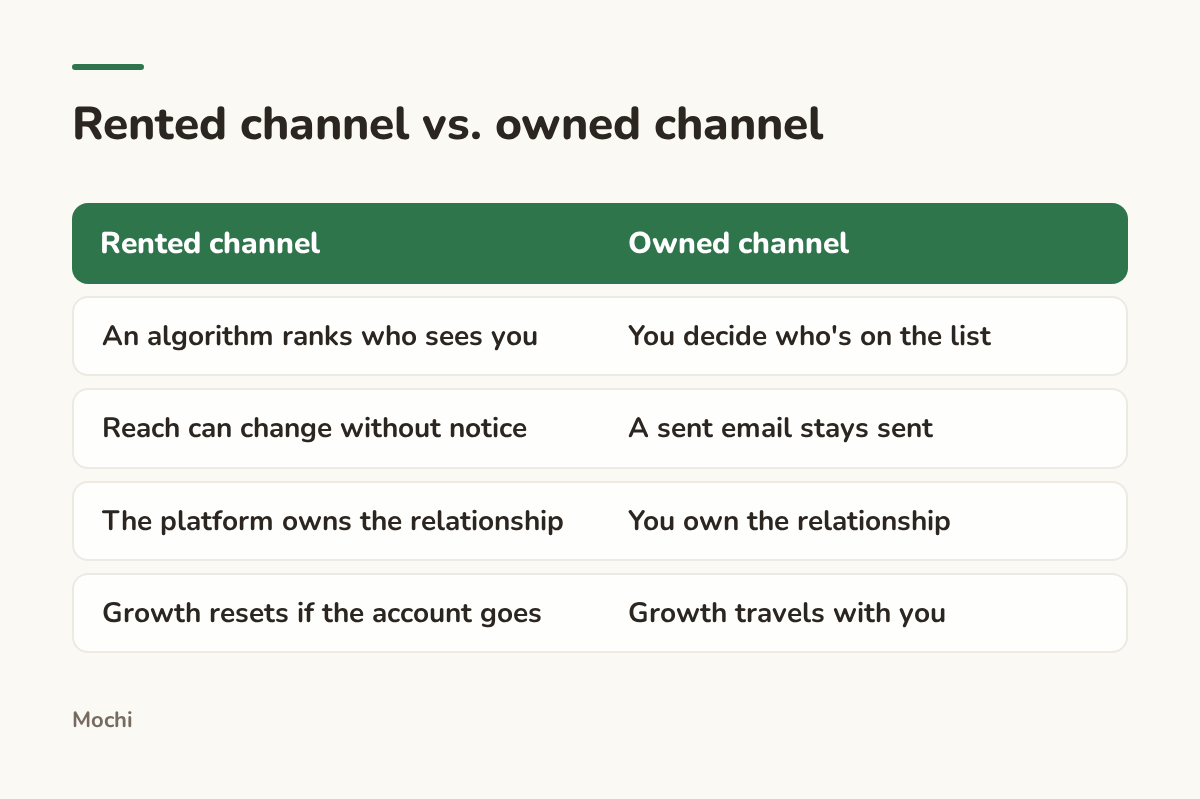
One of these you can lose by Tuesday. The other you can't.
What Owning a Channel Actually Buys You
Why would losing one platform matter if you've still got four others? Because the four others can all move the same way, on the same afternoon, for reasons that have nothing to do with you.
It isn't ranked
Nobody is deciding whether your email is "worth" showing to the people who asked for it. It either lands, or it doesn't, and almost always it lands.
It's portable
Research into platform-mediated audiences backs up a hunch most creators already have: a relationship that depends on an algorithm to keep delivering it is a weaker, less reliable relationship than a direct one. Pew's research on platform-mediated reach makes a version of this case about news specifically, but the underlying point travels: a relationship mediated by someone else's ranking system is never fully yours. A list, by contrast, moves with you. Change platforms, get banned by mistake, or just get tired of one app's whole personality, and the list is still there.
It compounds instead of resetting
Picture a documentary photographer who built four years of following on a platform that, overnight, rewrote its ranking to favor short video over photo carousels. The follower count didn't disappear, but the reach did, and work that used to land in front of forty thousand people started landing in front of four hundred. An email list wouldn't have made that less painful. It would have meant the people who'd already said yes once were still reachable the next morning, the next post, and the one after that.
That's the case for a newsletter. Not that it replaces social media. That it's the one thing that doesn't reset when social media does.
The Few Things Worth Writing When You Only Get One Email a Week
A newsletter that tries to cover everything ends up saying nothing in particular, and it shows in the first line, before anyone decides whether to keep reading. The fix isn't a content calendar. It's a short, honest list of the only things actually worth an email, written down somewhere you'll hold yourself to it.
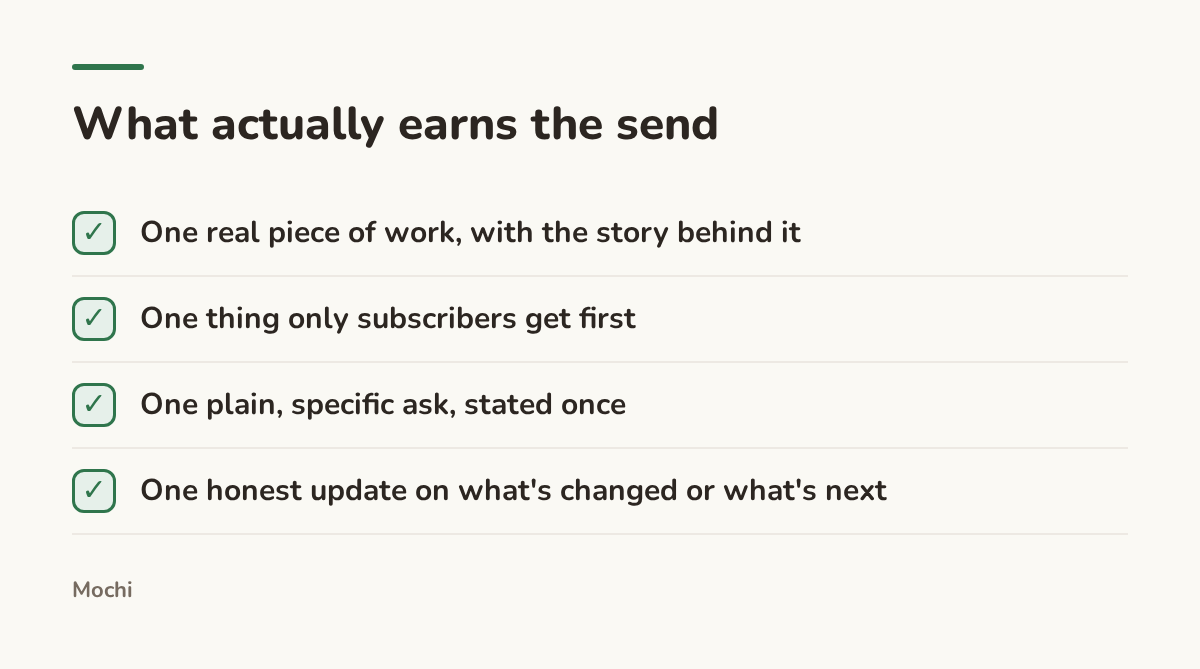
If an email isn't one of these four, it's probably filler.
Lead with one real piece of work
Take the first item on that list seriously, because it's the one creators skip most. A finished piece of work with the story behind it beats a roundup of five pieces every time, because a story is something a reader can actually picture. The subject line is where that story shows up, or doesn't.
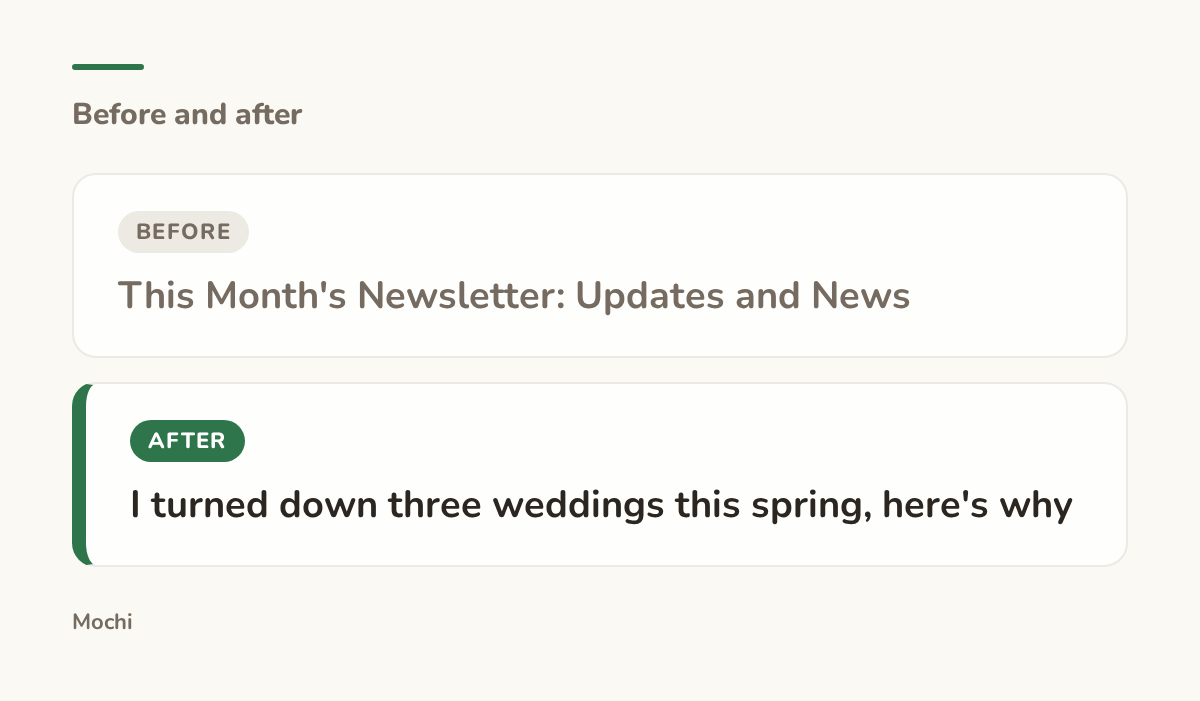
Before: This Month's Newsletter: Updates and News After: I turned down three weddings this spring, here's why
The first line describes the email. The second line describes a decision, and a decision is the kind of thing a person opens an email to find out about. The same logic holds for a working illustrator keeping subscribers close to process instead of just the finished piece.
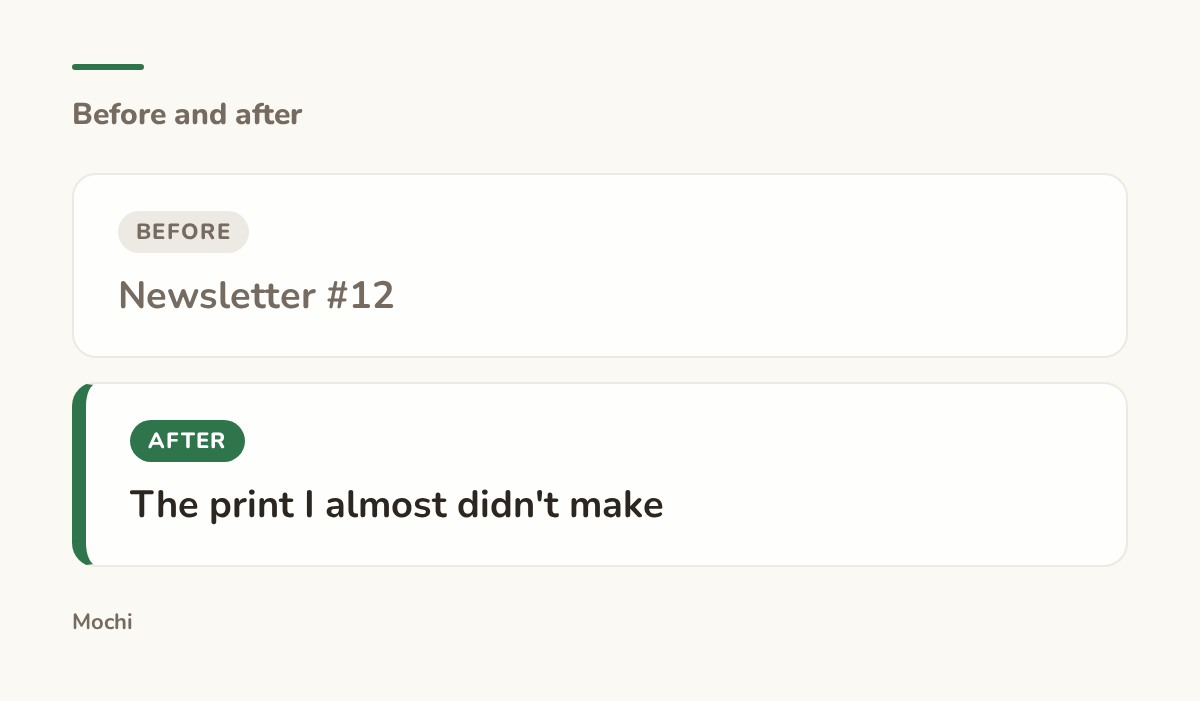
Before: Newsletter #12 After: The print I almost didn't make
Specific beats general every time, because a reader's eye catches on a concrete detail in a way it never catches on a label. A number in a subject line tells a reader nothing about whether this one is for them. A single, true sentence about one thing that happened does the work instead.
Give subscribers one thing first
This doesn't need to be exclusive content in the content-strategy sense. It can be as small as the gallery before it goes on the site, or the rough cut before the final edit. The point isn't scarcity for its own sake. It's giving the list a reason to exist that isn't just "the same things you'd see on Instagram, slightly later."
State the ask once, plainly
The plain ask is the one most creators are too polite to write. An ask buried in paragraph four of a long update gets skimmed past. An ask stated once, early, and in plain language, "the print shop closes Friday," "three slots left for spring sessions," gets acted on, because the reader never has to guess what you actually want.
Growing a Newsletter as an Artist, Without Turning Into a Marketer
Here's the part that puts most creators off before they start: growing a list sounds like a second job stacked on top of the one they already have. It doesn't have to be.
Start where the work already lives. A line at the end of a caption, a pinned comment, a single slide in a carousel that says what the list is for in one sentence, not five. The ask travels better when it's tied to something real: "get the full gallery before it goes on the site" does more work than "subscribe for updates," because it tells the reader exactly what they're trading an email address for.
Keep the email itself plain, too. Writers who moved away from heavily designed, frequent newsletters and toward simple, personal-feeling ones found the plainer format tended to survive longer, because it read like a person instead of a brochure. Nieman Lab tracked that shift toward plain-text email as it took hold across independent writers. A plain-text email also has a practical advantage: it's less likely to get filtered as promotional in the first place, since mail providers judge sender reputation partly on the kind of heavy formatting and link-stuffing a flashy template tends to encourage. Gmail's own sender guidelines spell out what keeps a message out of spam.
An Email List for Independent Creators Who Don't Want a Second Job
None of this requires new software, a rebrand, or a weekly deadline you'll resent by March.
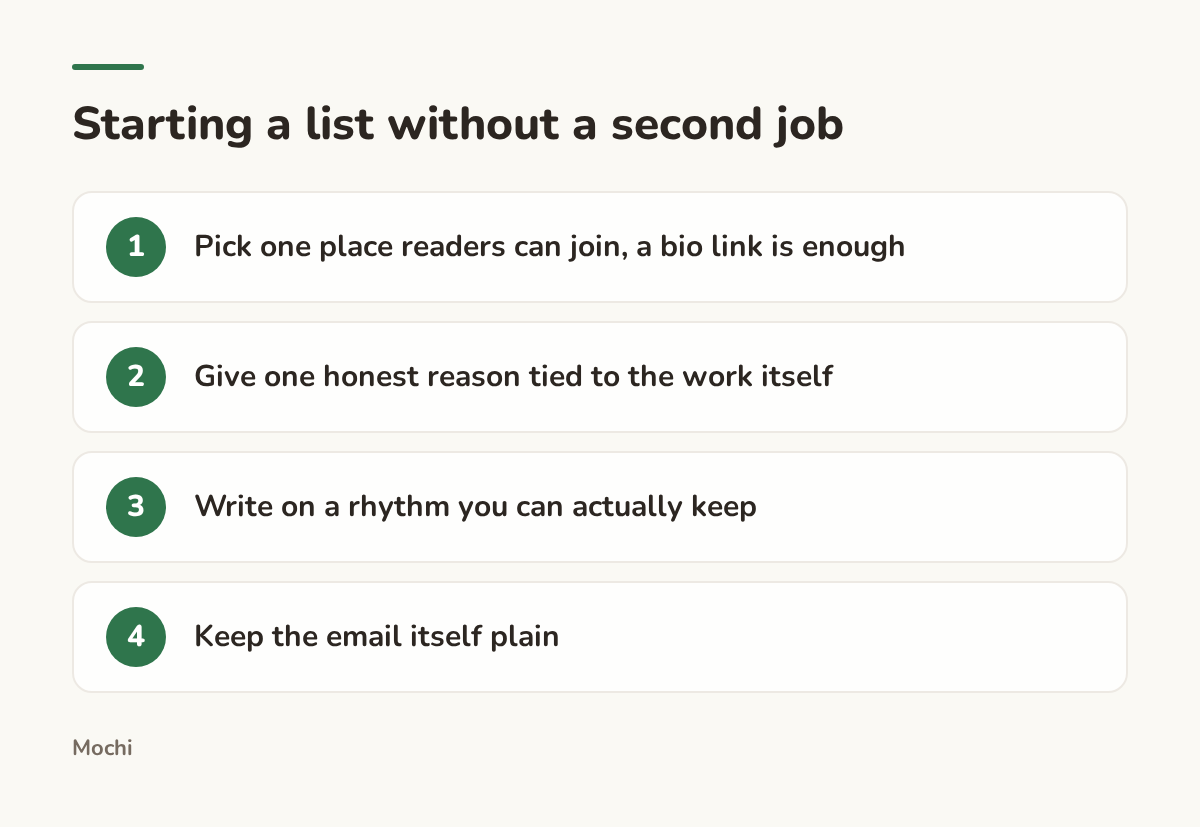
Monthly is a perfectly good rhythm if monthly is the one you'll keep.
The social side of the job is still real, and it's still the part that eats the most hours for the least guaranteed return, which is a big part of why we built Mochi: to take the planning, the research, and the posting off a creator's plate so the one channel that's actually theirs gets the attention it deserves. Mochi isn't a newsletter tool, and it won't write your email for you. But if the reason you haven't started a list yet is that you're already stretched thin keeping up with five feeds, that's a different problem, and it's the one we work on.
A newsletter won't replace your social channels, and it shouldn't try to. It's the one list a platform can't take back. Build it slowly, write to it honestly, and the day a feed resets under you, you'll still have somewhere to land.
What would you write in the one email you're actually proud of this month?
Part of a series
The Creator's Playbook
Evergreen craft for working creators: brand, content planning, and publishing, written by the team that builds Mochi.