 Mochi Labs
YouTube Is Testing New Creators More Aggressively in 2026: What Your First Five Videos Need to Prove
YouTube is testing new creators more aggressively in 2026, judging channels on their first few uploads. Here's what your first five videos need to prove.
How many uploads does YouTube actually watch before it decides whether to bother showing your channel to anyone new?
Fewer than it used to.
Outside reporting on creator tools has been saying the same thing from a few different angles this year. Channel-growth tool TubeBuddy, the agency AIR Media-Tech, and the creator-economy outlet Panstag have each published breakdowns describing YouTube testing new channels' opening uploads harder and faster than before: watching click-through rate and retention on literally the first few videos before deciding how far past a creator's own subscriber count to push a channel. The same coverage points to YouTube widening its Hype boost, a feature built to surface new creators to nearby viewers, to more channels under 500,000 subscribers.
That changes what your first five videos are actually for.
Why YouTube Is Testing New Creators More Aggressively in 2026
A channel used to get a slow runway. Post inconsistently for a few months, find your footing, and the algorithm would eventually catch up once you'd built a pattern worth reading.
2026 runs differently. Instead of waiting for a body of work, the system reads the pattern off the first handful of uploads and makes an early call about whether a channel is worth testing further. YouTube has always said its recommendation system optimizes for two things at once: whether a video is relevant to a given viewer, and whether watching it actually satisfied them, as laid out in YouTube's own explanation of how recommendations work. What's shifted is the speed at which a new channel gets judged against that bar.
Part of this is just scale. More people are trying to start channels than ever, and YouTube's own Partner Program eligibility rules keep nudging more of them to try. A faster read on which new channels are worth the shelf space is a reasonable answer to that pressure, even if it's a rough one for the creator on the other end of it.
You don't get a slow runway anymore. You get a pop quiz.
1. Win the Click With the Thumbnail and Title
Click-through rate is the first and crudest filter a new upload has to pass. YouTube can't know whether a video is good before someone watches it, so it leans hard on whether the thumbnail and title make a stranger stop scrolling. YouTube's own impressions and CTR guide is worth reading before you publish anything, because it's the clearest official picture of what the system is actually measuring here.
A wide, polite preview of the whole video tends to lose to a narrow, specific promise. Take a wedding videographer putting up a first upload.
Before: Title: "My First Wedding Film." Thumbnail: a wide shot of the ceremony aisle. After: Title: "I Filmed a Wedding in the Rain With No Backup Plan." Thumbnail: a tight shot of a shaking hand gripping a camera, rain beading on the lens.
The second title names a specific, risky situation instead of a category. The thumbnail shows a hand and a problem instead of a venue. A stranger scrolling past can guess exactly what's at stake in four words, and that guess is what earns the click the test is measuring.
2. Hold the First 30 Seconds
Winning the click only sets up the next test. Average view duration and the retention graph are what YouTube reads to decide whether a video actually satisfied the person who clicked, not just whether the thumbnail kept its promise. A slow, polite opening bleeds viewers before the video has said anything worth staying for.
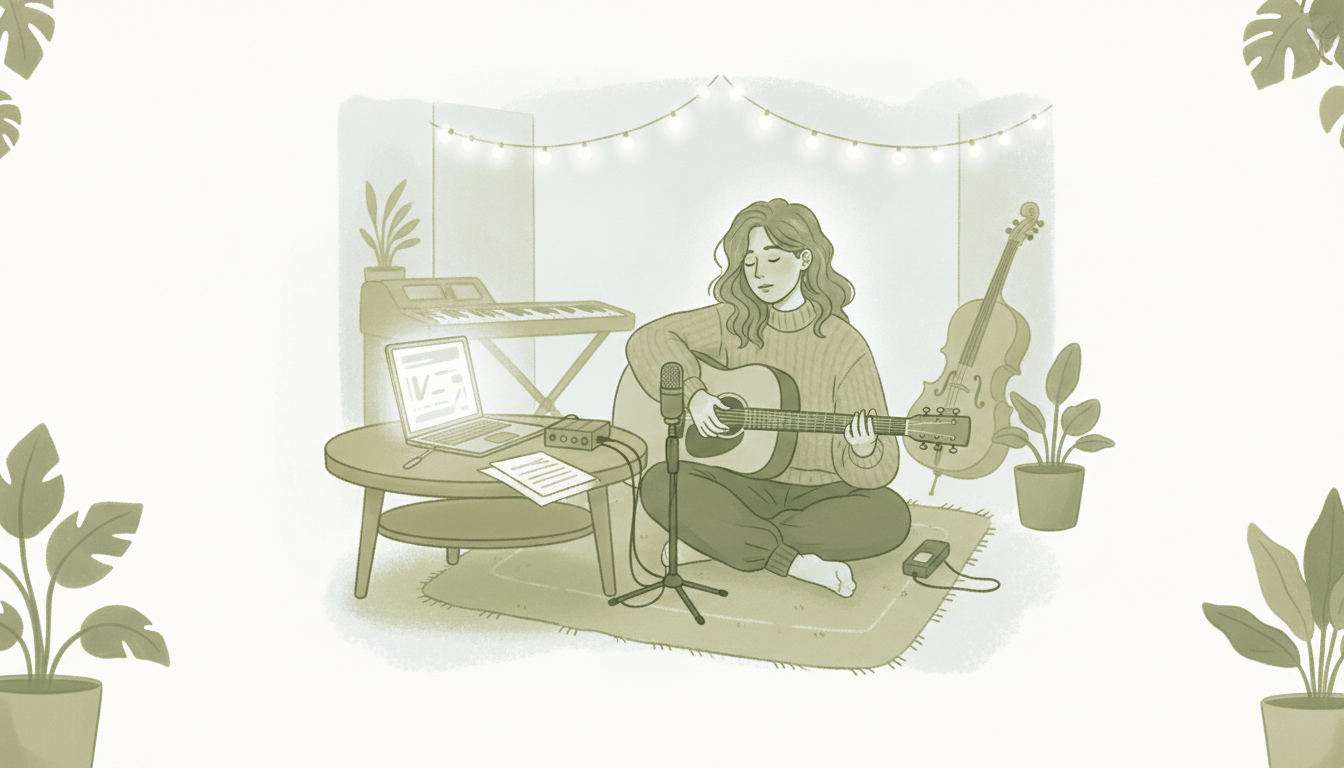
Picture a musician opening her first upload the usual way, and then the same upload rebuilt around the thing the title already promised.
Before: "Hey everyone, welcome back to my channel, today I wanted to share a song I've been working on." After: She opens cold, already mid-chorus on an unfinished take, then cuts straight to camera: "That's the song I almost didn't release."
The second version spends its first five seconds on the thing the title promised instead of on a greeting. Viewers who were on the fence about clicking get an immediate reason not to leave, and that's the number the retention test is actually watching.
3. Keep the Topic Narrow
A channel that jumps between a gear review, a travel vlog, and a cooking video in its first five uploads gives YouTube nothing consistent to match against viewer interest. Relevance is a pattern-matching problem, and five unrelated videos are five different patterns, none of them strong enough to act on yet.
Picture a photographer whose first five uploads stay inside one tight lane: "Shooting a Wedding in Direct Noon Sun," "Why I Carry Two Flashes, Not One," "The One Lens I'd Keep If I Lost Everything Else." That run hands the system a single, clear bucket to test her against: tricky-light wedding photography. A photographer who scatters a cooking video and a travel vlog into that same run makes every one of those tests noisier, because the system can't tell which audience it's even evaluating her against.
Pick the narrow lane for the first five, even if it's not the whole range of what you eventually want to post. Widen later, once the channel has an audience worth widening for.
4. Make the Batch Look Like a Pattern, Not a Fluke
One strong video sitting in a batch of four flat ones reads to YouTube as a fluke, not a channel worth testing further. The Hype expansion that outside reporting has pointed to this year rewards early, sustained performance, not a single spike, because a channel that performs consistently is a safer bet for the system to keep promoting than one lucky upload is.
That means the fifth video matters as much as the first. If your strongest idea is sitting at the back of the queue because it still needs prep, move it up.
The test doesn't wait for your best work to be ready. It's already running on whatever you post first.
Research the Niche Before You Press Upload
None of the four checks above are things you can fix after the fact. A test that runs on your first few uploads punishes learning in public, so the research has to happen before you hit publish, not after the retention graph tells you what went wrong.
That means spending real time before the first video goes up: watching what titles and thumbnails are already working inside the exact lane you've picked, not the platform in general, and noting which ones are climbing versus which ones are fading. A wedding videographer picking "rain day" as an opening topic should know, before filming, whether that angle is still fresh in wedding content or already worn out.
Look at recent uploads from channels a size or two above yours in the same lane, not just their best-performing videos ever. A video that did well eight months ago tells you less than one that's doing well this week, because the second one is closer to what's actually working under the current version of the system you're about to be tested against.
This is one place a standing routine earns its keep instead of a one-time scramble. We built Mochi's research routines to run on their own schedule, so the read on a niche is already sitting there the morning you're ready to plan a launch batch instead of something you have to remember to go do.
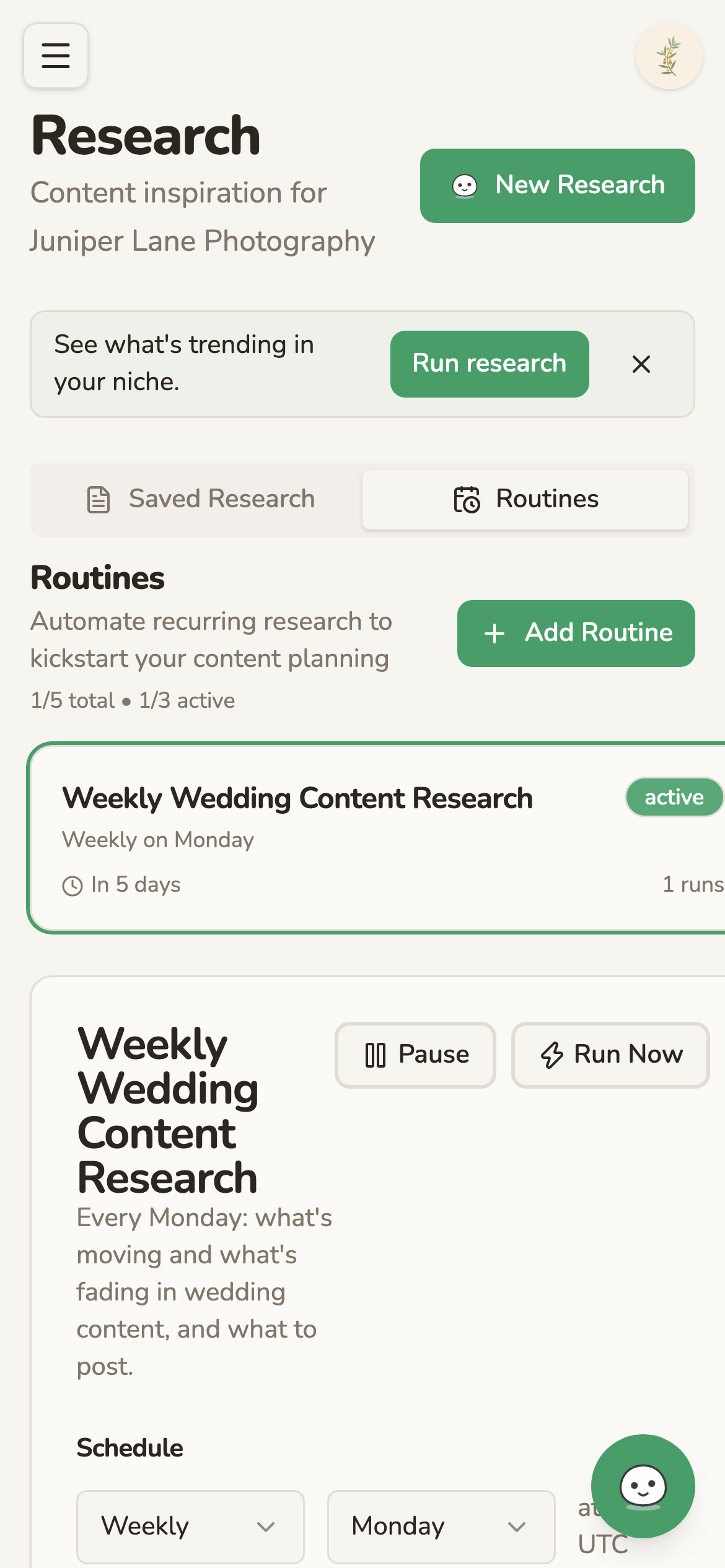
A research routine checks the niche on its own schedule, no one has to start it.
What to Check in Studio After Each Upload
Treat each of the first five uploads as data, not a finished bet you walk away from. YouTube's own guide to reading your content performance in Studio is the clearest map of what to look at, and it's worth having open the day each video goes live, not a week later.
Five numbers matter most in this window: impressions, click-through rate, average view duration, the shape of the audience retention curve, and the split between traffic from Browse, Suggested, and Search. A video that's getting impressions but a weak click-through rate has a thumbnail and title problem. A video that's getting clicks but a steep early drop in the retention curve has an opening problem. Reading the right number tells you which of the four checks to fix before the next upload in the batch goes out, instead of guessing.
Traffic source is the one new creators skip past fastest, and it's worth a second look. A video sitting almost entirely on Search traffic with nothing coming from Browse or Suggested hasn't failed. It just hasn't been offered to anyone outside the people already looking for it, which is a different problem than a weak thumbnail, and one the next video can't fix on its own.
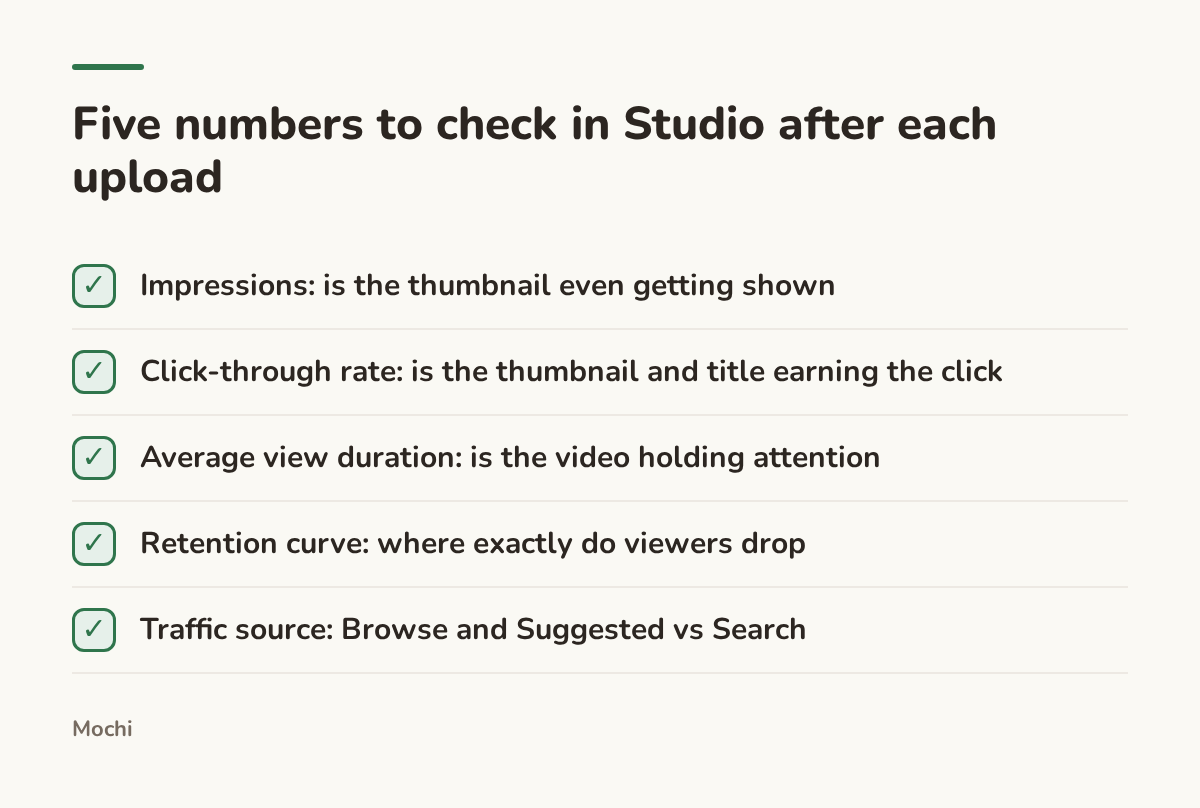
Read the right number before posting the next video in the batch.
None of this guarantees a channel takes off in five videos. Nothing does. But it changes what the first five are for: not a soft introduction, but a fast, honest test of whether the click, the hold, the topic, and the pattern are all pulling in the same direction. Tighten those four, do the research before you film instead of after, and read the numbers between uploads instead of waiting for all five to land. That's the version of "early days" that actually gives YouTube's faster read something worth paying attention to.
What would your first five videos say about your channel if YouTube were grading them this week?
Part of a series
The Creator's Playbook
Evergreen craft for working creators: brand, content planning, and publishing, written by the team that builds Mochi.