 Mochi Labs
Social Media Marketing for Salons: The Complete Playbook
A practical guide to social media marketing for salons: Instagram and TikTok setup, content pillars, hashtags, and a rhythm that survives a full book.
· We keep this page up to date, so bookmark it and come back.
A client walks out with a color she'll post about before she even gets to her car. A bride cries looking at her trial makeup two weeks before the wedding and tags the artist within the hour. That's the raw material every salon already has: real moments, happening constantly, in a room most other businesses don't get access to. The problem isn't material. It's that between appointments, color processing, and the next client already in the chair, nobody has time to turn it into a plan.
This is the complete rundown on social media marketing for salons: what to actually do on Instagram, what's different on TikTok, how hashtags work for a local business, and how to build a rhythm that survives a fully booked week. Here's the shape of it:
Getting the accounts set up right, before a single post goes out
Instagram for salons: content pillars, Reels, and a realistic posting rhythm
TikTok for salons: what performs differently and why
Hashtags for salons: the mix that actually helps people find you
Paid promotion: when it's worth boosting a post
Keeping the queue full without losing a Tuesday
Social media marketing for salons starts with setup, not content
Before a single caption gets written, the accounts themselves need to be doing their job. A personal Instagram with a cute bio doesn't give a stylist or a salon owner any of the tools a business actually needs: a booking link that clicks through, a services breakdown, or reply automation down the line.
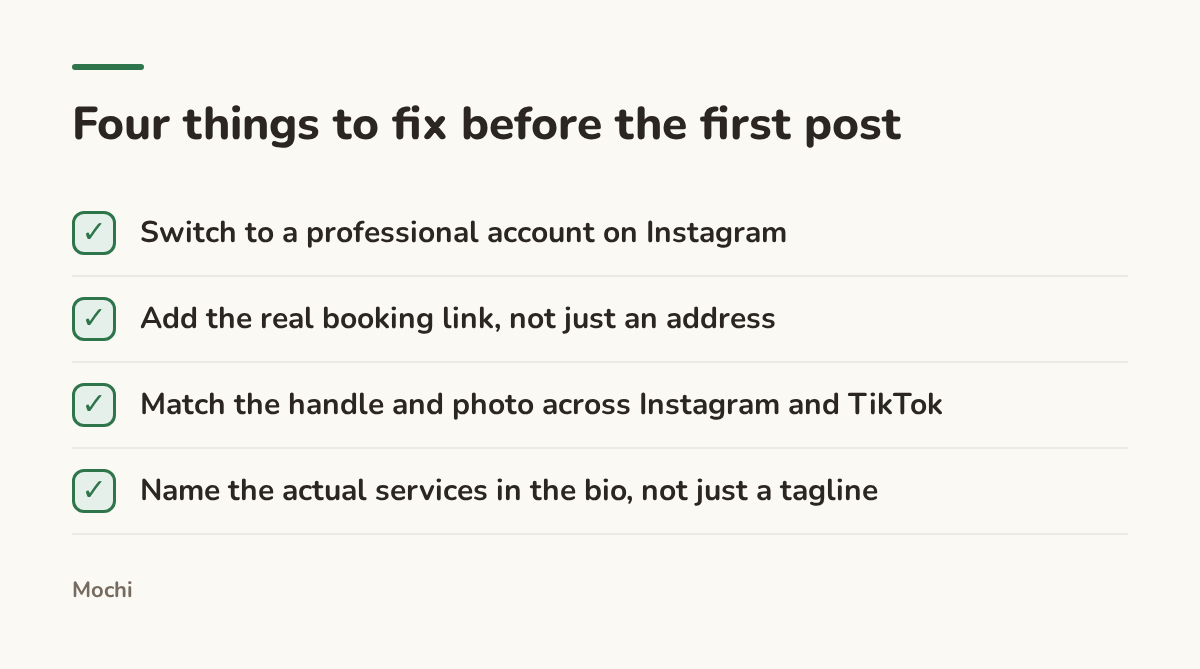
Switch to a professional account on Instagram first. It's free, it takes a few minutes, and it unlocks the insights and contact buttons that a personal profile doesn't have. Do the same on TikTok: a business account there isn't optional if the salon wants to run any paid promotion later.
Then get the basics right everywhere the salon shows up:
The handle matches across Instagram and TikTok, so a client searching for the salon finds the same name twice, not a guessing game.
The bio names what the salon actually does (balayage, lash extensions, barbering) instead of a vague tagline. A stranger scrolling past should know what they'd be booking.
The link in bio goes straight to booking, not to a homepage the client has to dig through.
Setup is boring. Skipping it costs bookings later.
Platform choice isn't guesswork either. Independent research on global platform use keeps confirming what most salon owners already sense from their own clients: the audience splits across more than one app, by age and by region, which is exactly why this guide covers Instagram and TikTok rather than picking a favorite.
Instagram for salons
Instagram is where most salons already have an audience, even an accidental one, built from years of clients tagging the account after a cut or a set. The job now is to stop treating it as a tag wall and start treating it as a content plan.
Instagram for hair stylists: the pillars that fill a book
A stylist's feed works best around two or three repeatable pillars, not a grab bag of whatever got shot that day. Take a colorist who posts the mixing and the foil process on slower days, then saves the reveal for right after a big appointment: the process content builds trust in the craft, and the reveal does the conversion work. Someone watching the process is pre-sold by the time the after-shot lands in their feed.
A third pillar worth adding is the client's own reaction, caught on camera at the moment the chair spins around. That's not vanity content. It's social proof a testimonial page can't match, because nobody fakes that particular gasp.
Instagram for makeup artists: showing the work, not just the result
A finished face photographs beautifully and tells a viewer almost nothing about the skill behind it. Picture a makeup artist who posts the brush-by-brush build of a bridal look next to the final photo, with a few seconds on the part that's hardest to get right, like color-matching foundation under mixed lighting. The transformation is the hook. The technique is what turns a viewer into a booking, because it answers the question every bride is actually asking: can this person handle my skin, my event, my timeline.
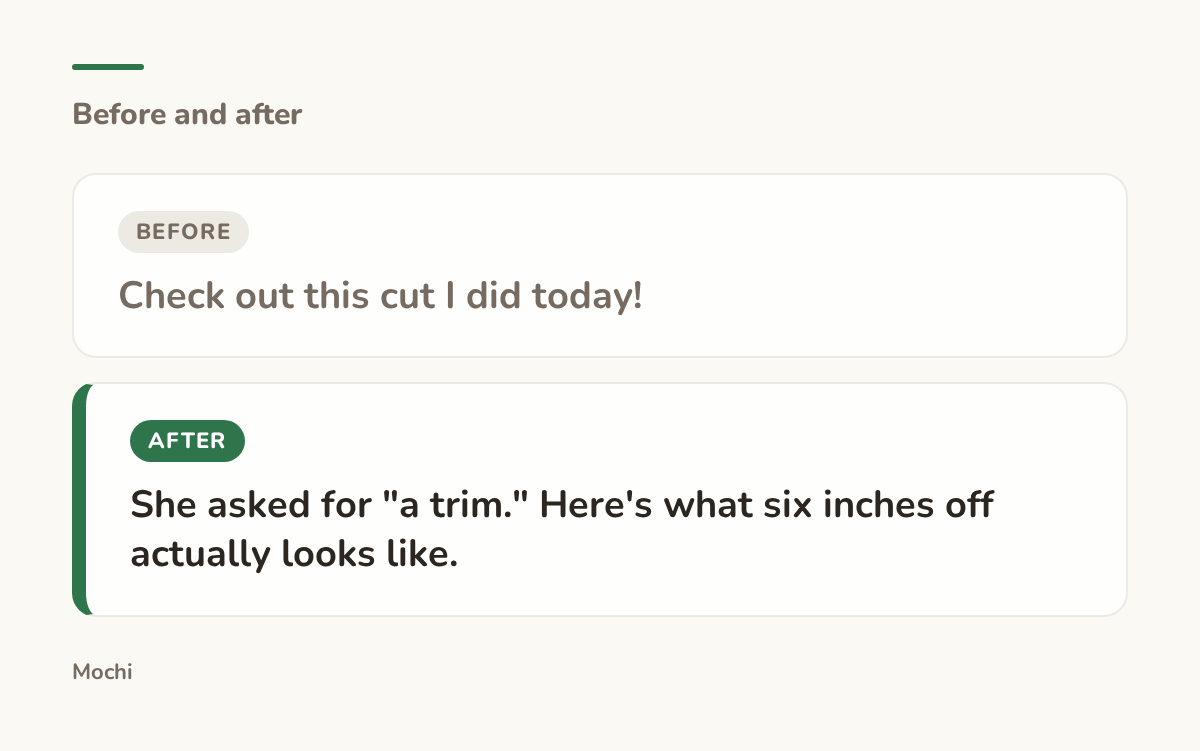
Before: Check out this cut I did today! After: She asked for "a trim." Here's what six inches off actually looks like.
The second version gives a stranger a reason to stop scrolling.
The specificity is what does the work here. "A trim" versus six inches is a concrete detail a viewer can picture, and a vague caption like the first one asks nothing of the reader's imagination at all.
Reels, Stories, and a rhythm you can keep
Reels are where new clients find a salon they've never heard of; Stories are where existing clients get reminded the salon exists between appointments. Both matter, but they're not interchangeable. A transformation Reel earns reach. A Story showing today's chair, today's playlist, or a flash sale on open slots earns a DM.
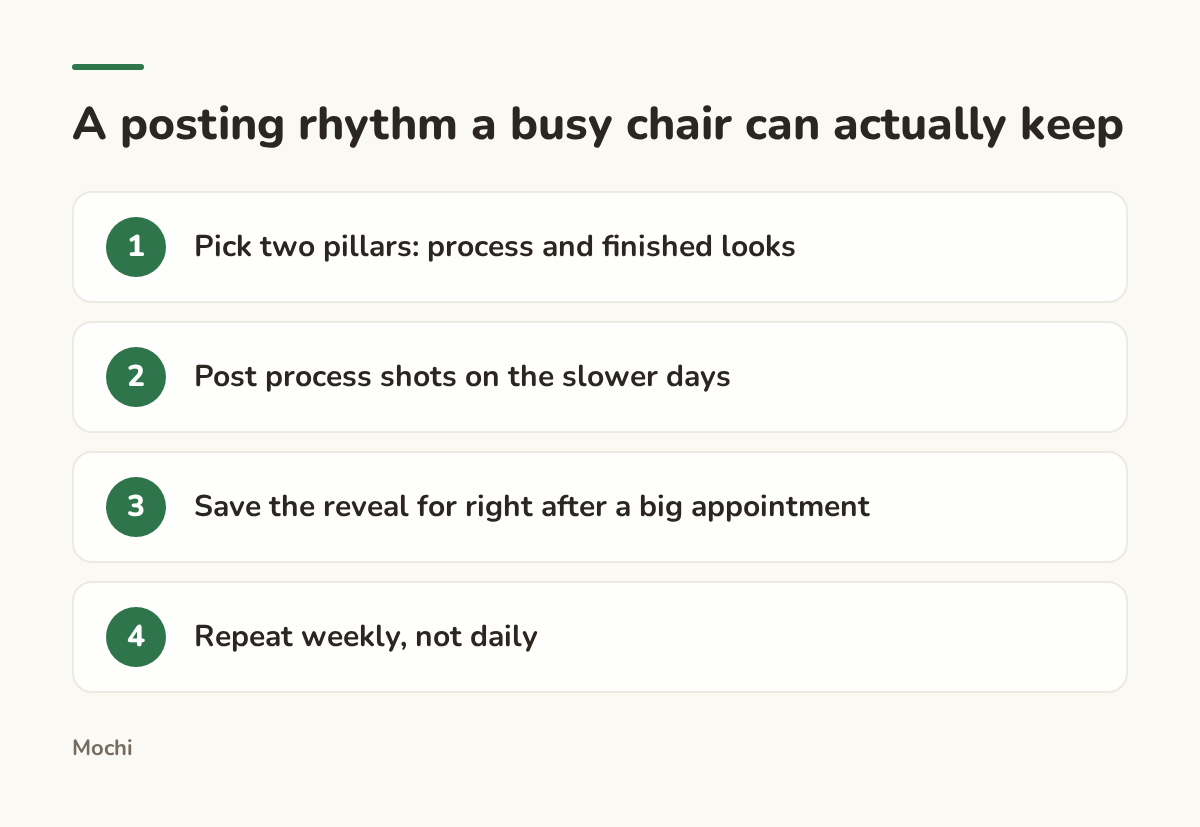
The rhythm follows the week's bookings, not a content calendar imposed on top of them.
A second worked example makes the point clear. Consider a makeup artist who books out two weeks and posts three or four times a week, mostly from appointments she already had: no extra time spent, just better use of what the chair already produced.
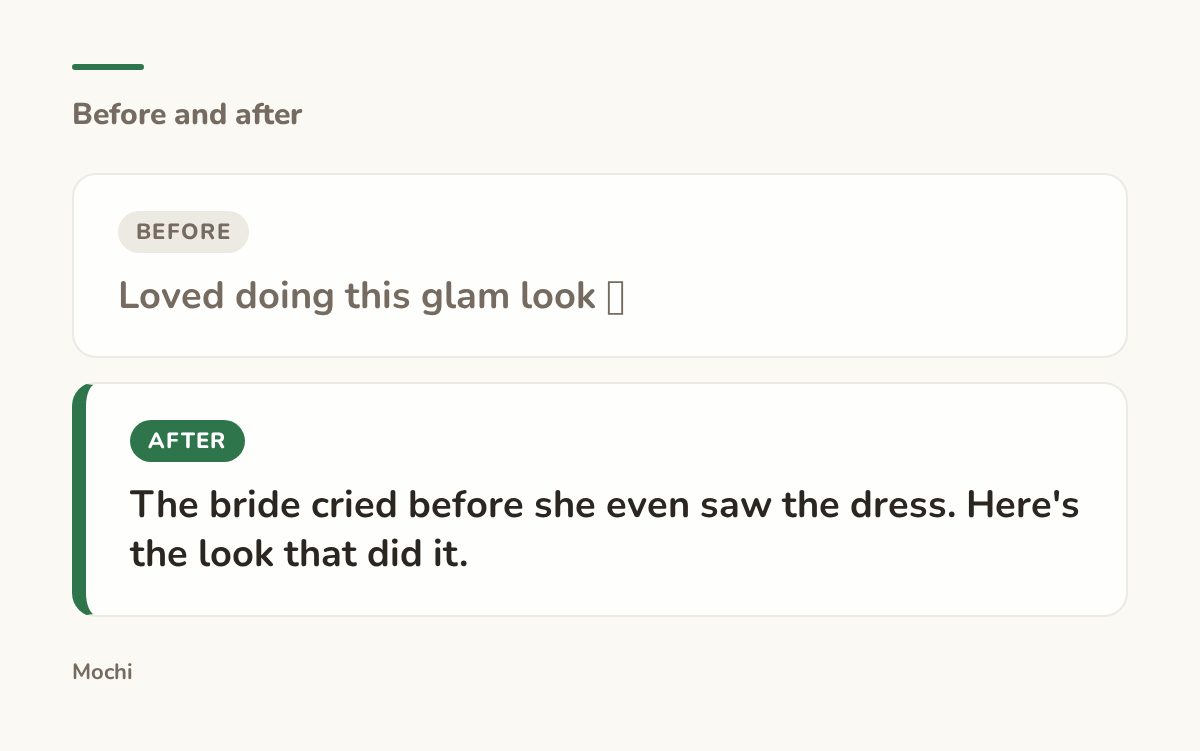
Before: Loved doing this glam look 💕 After: The bride cried before she even saw the dress. Here's the look that did it.
The before caption describes a feeling. The after caption gives a reason to watch.
TikTok for salons
TikTok rewards a different instinct than Instagram does. A polished reveal that performs well on Instagram can read as slow or over-produced on TikTok, where the native style is closer to a friend filming over your shoulder than a studio shoot.
What performs for a local, in-person business
The accounts that do well tend to lean into process, not polish: the sound of scissors, the moment a color corrects, a client's unfiltered first reaction. TikTok's own guide for small businesses is worth reading end to end, because it's written for exactly this kind of local, appointment-based business rather than for a national brand with a media budget.
Take a barber who posts the final two minutes of every cut, no voiceover, just the clippers and the reveal. It costs nothing to film, since the camera is already propped up for the client's benefit anyway, and it travels well because the format repeats cleanly from client to client.
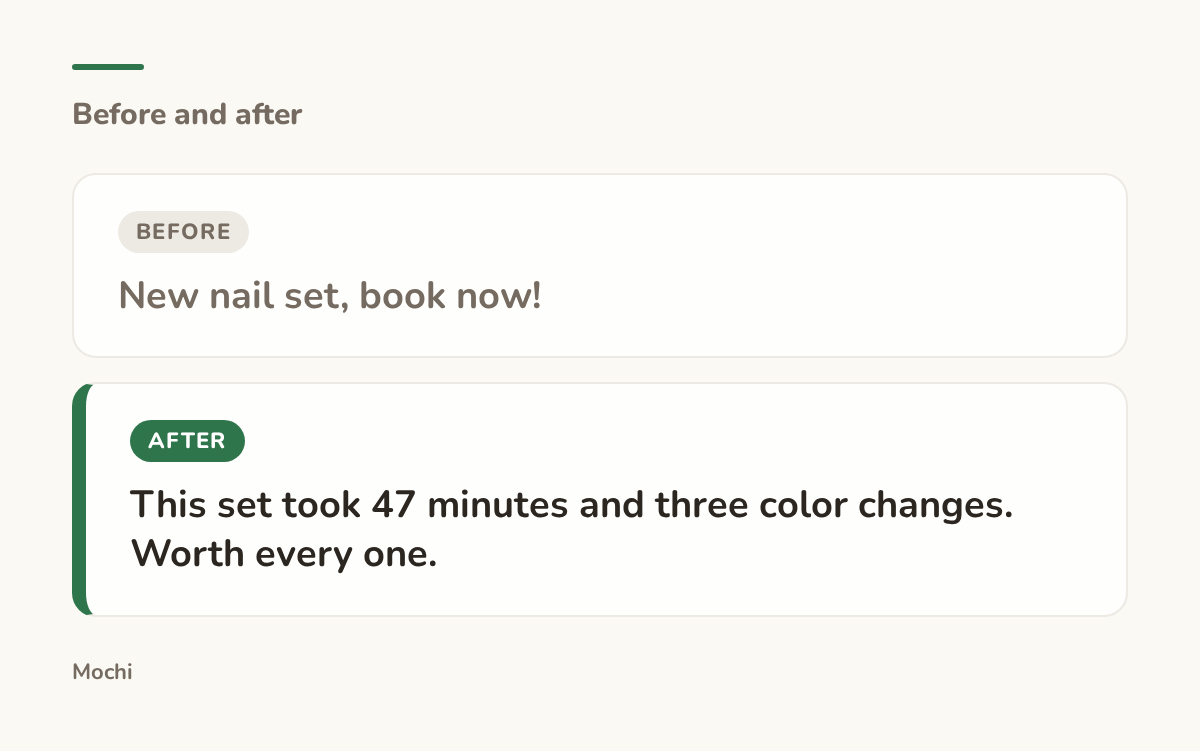
Before: New nail set, book now! After: This set took 47 minutes and three color changes. Worth every one.
The number gives the craft a scale the viewer can respect.
Trends without losing the salon's voice
A trending sound or format can bring a salon in front of people who've never seen the account before, but it only works layered onto what the salon already does well, not swapped in for it. If a trend doesn't have an obvious place for the actual craft, a cut, a color, a brush stroke, it's probably not worth the hour it takes to film.
TikTok's guide to promoting a small business covers profile setup and creator partnerships in more depth, which matters if the salon ever wants to work with a local creator rather than only posting from its own account.
Hashtags for salons
Hashtags for salons do less heavy lifting than they used to, but they're not dead weight either. They still help connect a photo to the right search, both inside the app and in Google, as long as the tags actually describe what's in the shot.
The three tiers worth using
A workable mix is one broad tag, one craft-specific tag, and one local tag, on every post that can carry them.
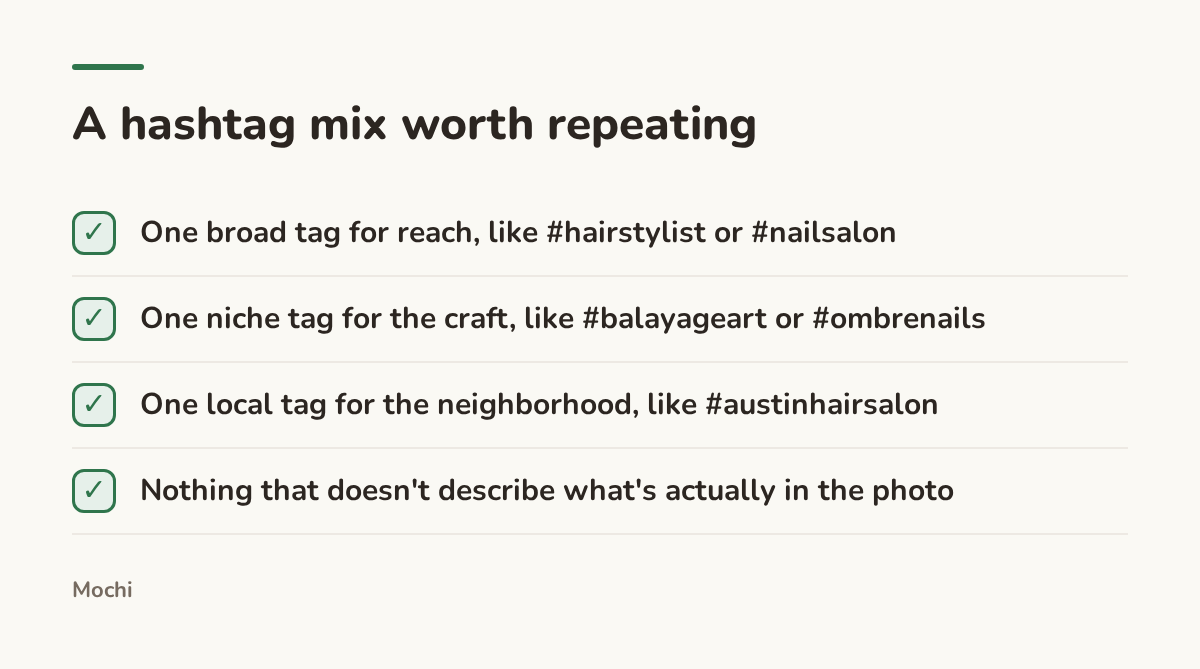
Three tags that earn their place beat ten that don't.
How many is actually enough
More isn't better once the tags stop describing the photo. A reveal video tagged with every beauty hashtag that exists reads as noise to both the algorithm and the client scrolling past it. Three to five specific tags, picked because they genuinely match the shot, outperform a wall of generic ones.
Paid promotion: when it earns its money back
Organic posting should come first, because an ad behind weak content just buys more people a look at something that wasn't working anyway. Once a post is already getting saves, shares, or comments on its own, that's the signal it's worth boosting.
How advertising works on Instagram is worth understanding before spending anything, especially the targeting by location, since a salon's actual customer base is almost always a tight radius around the chair, not a national audience. A modest budget aimed at the neighborhood tends to outperform a bigger one aimed everywhere.
Keeping the queue full without losing a Tuesday
The honest obstacle for most salons isn't knowing what to post. It's that the day is full of clients, and the plan that only lives in someone's head quietly falls apart the first busy week. Writing the rhythm down somewhere that doesn't depend on memory is what actually makes it survive.
This is the part of the job we built Mochi to carry. A week's worth of posts, split across whatever pillars the salon is actually working, process shots, finished looks, client reactions, can sit on a calendar ahead of time instead of getting decided after close on a Tuesday.
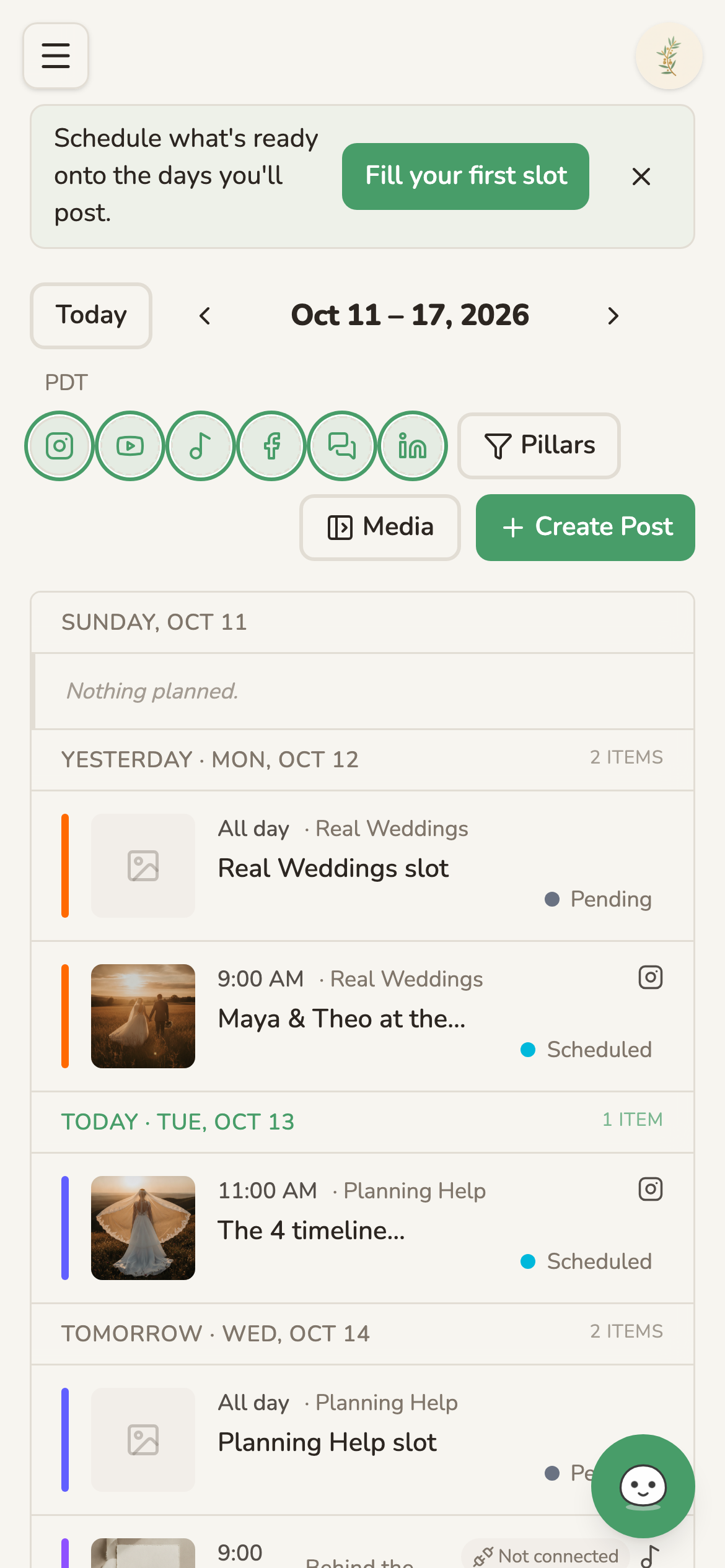
A week of posts, already split across pillars, sitting on the calendar before the week starts.
Whether that calendar gets filled by hand on a Sunday or by a tool like Mochi, the principle is the same: the plan that's written down is the plan that survives a fully booked Thursday.
None of this works without the material a salon already makes every single day in the chair. The job is just catching it on camera, picking the two or three pillars worth repeating, and giving the queue somewhere to live besides someone's memory. What's the last thing a client did in your chair that you forgot to film?
More for Salons
The deeper guides for salons are on their way.
What changed this week for salons: this week in your niche.
Part of a series
The Creator's Playbook
Evergreen craft for working creators: brand, content planning, and publishing, written by the team that builds Mochi.